
EP 266 - Cyrus Shepard: What Local Brand Actually Means to Google and AI
Cyrus Shepard, founder of Zyppy, joins Greg Sterling and Mike Blumenthal for Part 2 of the Near Memo brand-building series — this time on the technical side: how Google and AI systems actually model a brand, and what a local business can do about it.


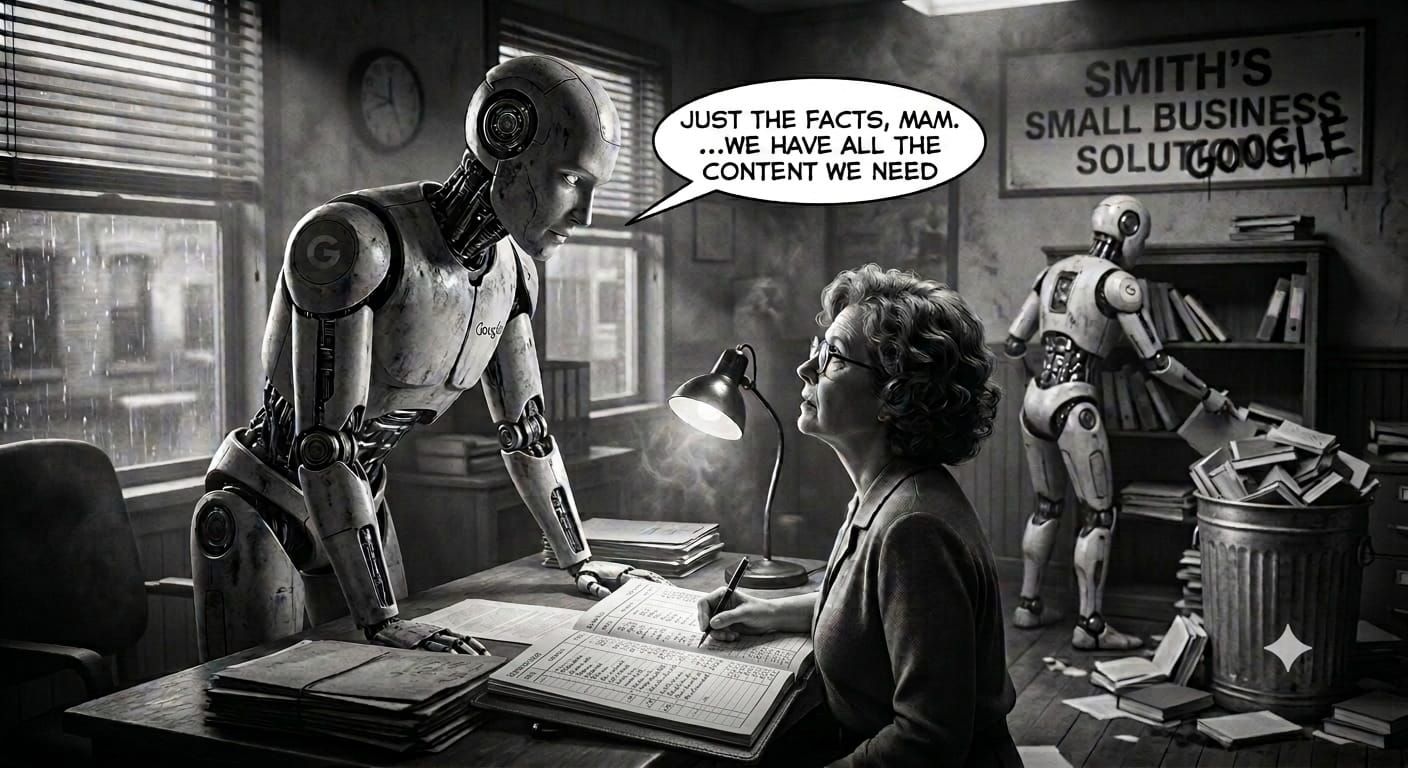
A local brand is an entity in a database — a cluster of relationships Google and AI systems can verify — so as answers get generated rather than ranked, the levers that matter shift away from anything you can do on your own site and toward demand you generate in the real world and corroboration you earn from third parties.
Cyrus's Four Pillars of Digital Brand
Shepard recaps his own framework near the close (45:49). Treated as the episode's spine:
| Pillar | What it answers | Primary lever |
|---|---|---|
| Distinctiveness | Can Google tell you apart from a generic query? | Naming, schema, consistent entity references |
| Relevance | What are you known for? | Web pages, business description, review language, photos all naming the same thing |
| Reputation | What do third parties say? | Reviews, cross-referral mentions, category-specific sources |
| Demand | How many people seek you specifically? | Branded search, clicks, calls, direction requests, offline-to-digital conversion |
Takeaways
-
Chrome, not search, is Google's actual moat. Shepard's argument is that Google's value doesn't rest on the search engine but on the browser telemetry underneath it — every action by every user, on Maps or any website, whether or not they're on Google. Courts have been asked roughly six times to force Google to share that Chrome data with competitors; none has agreed. (08:03–09:05)
-
Ranking first no longer means being recommended. The pre-AI game was position; today you can hold the number-one spot and still be omitted from an AI answer because nobody else is talking about you. "Ranking may not save you." The consequence is that third-party sites dismissed five years ago now carry more weight than your own optimization work. (14:36–15:05)
-
Google doesn't want content anymore — it wants evidence. Google built a machine that produces content on any topic on demand, so the differentiated assets are the ones the machine can't generate: original research, product pages, tools, calculators, in-depth testing, first-person perspective. Shepard describes the residue of the old model as "zombie sites" carrying hundreds of thousands of informational pages as dead weight. (21:58–23:00)
-
NAP consistency has had an unexpected second life. The decade-old local SEO fundamentals — consistent name, connected social profiles, schema, third-party references that resolve to one entity — matter again specifically because AI systems need the same entity-disambiguation signals traditional local search needed. Practitioners let these lapse on the assumption Google had gotten good enough to infer them. (09:37–10:31)
-
Email is a live brand channel for AI visibility. Shepard cites the iPullRank experiment led by Garrett Sussman: brand mentions embedded in customer emails measurably increased how often those brands surfaced in Gemini and AI Overviews, via personalization. Greg's caveat from Near Media's own two-part interview with Sussman — the lift required opting into Google's personalization. (17:03–18:00, 18:34)
-
Amazon's email design is a tell worth inverting. Amazon deliberately writes vague shipping notices — "your health and wellness product has shipped" — to keep Google from scraping purchase specifics out of Gmail. The tactical inversion for a local business: send the detail Amazon withholds, and let it be scraped. (18:00–18:27)
-
Click signals are real but nearly immovable. Google evaluates roughly thirteen months of click data across thousands of searches for a given business, which is why gimmicks like volunteer driving-direction campaigns produce a short-lived bump at best. Shepard rates them workable only for a business starting from zero visibility, and expects an established business to need continuous repetition for no durable gain. (34:34–35:36)
-
The review flywheel has an observable trigger point. A three-year-old coffee shop sitting at four or five reviews ran a counter QR code, hit roughly 20–25 reviews, and started ranking in Google Maps — after which foot traffic, branded search, and further reviews became self-reinforcing. The threshold is low enough to be reachable deliberately. (38:25–39:10)
-
Skip llms.txt and markdown; fix JavaScript instead. Against a large chunk of current industry advice, Shepard sees only marginal evidence that markdown improves AI readability and doesn't consider llms.txt worth resourcing for most businesses. The real technical failure is rendering: AI systems either can't render JavaScript or won't, and defer to Google to do it. Serve HTML. (32:40–33:30)
-
Photos are an entity-extraction channel, not an alt-text exercise. Google now pulls entities directly out of images, which makes a professional photographer one of Shepard's top recommendations for mid-sized clients — and makes photographing branded product in situ (the Lennox unit with the label visible, the Nike sneakers on the shelf) a way to assert both service and brand association. Photos with actual humans in them outperform generic product shots. (43:15–45:00)
-
Cross-business referral pages are the episode's most novel tactic. Genuine "we recommend these local businesses" pages exchanged among complementary non-competing businesses — the electrician, plumber, and roofer — produce exactly the local third-party mention AI systems reward. Shepard calls it "gold" and rates it well above a directory listing; Greg notes he has not heard anyone else propose it. (37:34–40:02)
-
Own your pricing or Reddit will own it. When a business publishes no pricing information, AI tools source it from third parties and frequently get it wrong. Where executives won't approve full transparency, Shepard's fallback is a published range — "we start at five thousand dollars" plus a call-for-quote — purely so the system has something authoritative to pull. (27:46–28:20)
Related Reading
- Cyrus Shepard — LinkedIn
- 17 Content Types to Survive Google's Zero-Click Future — Zyppy Signal
- How Google Click Signals Drive SEO Rankings and AI Answers — Zyppy Signal
- Ep 251: Google Lied About Click Data — with Cyrus Shepard — prior interview on the leaks and brand proxies
- EP 265 - Decoding Local Branding with John Jantsch - Brand as measure of satisfying client needs
- Ep 256: The Death of Keywords — Google's Personal Intelligence — the Sussman email research
- Google and the Visual Future of Local Search, Part 1 — photo impact on GBP rank
- Bing as a source in ChatGPT — Lily Ray
Practitioner Notes
-
Near Media's PI research is direct corroboration of Shepard's demand argument. Greg's finding that prior brand awareness — usually built by offline advertising — dominates click behavior among personal injury searchers is the same claim Shepard makes from the Google side. Two independent vantage points converging on offline demand as the upstream variable is a stronger publishable position than either alone. Worth foregrounding rather than leaving as an aside at 16:31.
-
The photo discussion has an existing Near Media data set behind it. Shepard's entity-extraction argument at 43:15 maps onto the visual-future-of-local-search work already published. Linking them turns his qualitative recommendation into something with measured GBP rank impact attached.
-
TrueSignal fills the gap Shepard names but doesn't solve. He argues repeatedly that businesses fail to supply an evidence layer; TrueSignal productizes exactly that by publishing verified operational history as citable third-party data. The connection wasn't made on-air because the name escaped Mike mid-episode — worth making explicit in the post.
-
The cross-referral tactic is a testable follow-up, not just a segment. Greg states on-record he hasn't heard it proposed elsewhere. A small pilot — three complementary local businesses, reciprocal recommendation pages, tracked AI citation before and after — would be original research of the exact type Shepard says now earns visibility.
Concepts
- Brand-as-entity — a brand is a database entry; your site, your profile, and you personally are separate entities whose relationships you strengthen
- The demand side of brand — branded search volume as a ratio of site visits; Shepard's "golden egg"
- Good / bad / satisfied clicks — bad click bounces instantly; good click browses; satisfied click ends the search journey entirely
- Synthetic modeling — Google using ML to estimate user behavior where real traffic data has disappeared to zero-click ("a synthetic circle jerk," per Mike)
- The map portal view — local ranking as a deliberately bounded problem; AI appears to be widening those bounds
- Zombie sites — large informational content libraries that now function as dead weight
- The evidence layer — what AI systems reward at grounding and citation time, distinct from what's in training data
- Levels of AI visibility — training data (would it recommend you offline?) vs. grounded retrieval via Google or Bing
- The snowball / flywheel effect — reviews → Maps ranking → foot traffic → branded search → more reviews
- Leaving breadcrumbs — varied directory descriptions that still resolve to one consistent entity
- The offline-to-digital bridge — billboards, events, and QR codes only convert to brand signal if you deliberately build the handoff
Watch just a snippet
00:00 Intro
01:46 What "brand" means to Google
03:20 A brand is an entity in a database
05:11 Behavioral signals and the CRAPS tables
08:03 Chrome is Google's real moat
09:37 Why NAP consistency came back
11:32 Local's map view vs. AI's boundaries
14:36 Ranking #1 no longer means recommended
17:03 Email as a brand signal
21:26 Google wants evidence, not content
27:10 Pricing: own it or Reddit owns it
32:05 llms.txt, Markdown, and JavaScript
36:05 Converting offline demand
38:25 The coffee shop flywheel
43:15 Photos and entity extraction
45:49 The four pillars, recapped
Full Transcript -->
What Local Brand Means to Google & AI — with Cyrus Shepard
Brand Building, Part 2 of 2 · Guest: Cyrus Shepard, Founder, Zyppy · Runtime ~49:48
Editor's note: This is a cleaned reading transcript. Stutters, false starts, and repeated words have been removed for readability, backchannel interjections have been folded into the surrounding turn, and clear transcription errors have been corrected. Wording is otherwise faithful to what was said. Timestamps mark the start of each speaker turn.
Greg (00:10) Welcome back, loyal listeners, devoted fans, and casual observers, to the Near Memo — episode 266, today with Cyrus Shepard. I was going to inject something pithy and clever before your name, which is why I hesitated. Cyrus is the founder of Zyppy and a long, long-time SEO — now a search and AI consultant, and a very visible figure in the SEO community, talking a lot about AI ranking and visibility these days.
This is the second installment of our series on brand building and brand development. Last week we had John Jantsch on and talked about the essence of building a small business brand. Today, we want to talk about some of the more technical aspects of brand building — how Google and AI understand brand, and how you can improve your visibility there. And be sure to stick around till the end, where we're going to go through a list of very practical, tactical recommendations for improving your visibility. So, welcome, Cyrus, after that very long and rambling introduction.
Cyrus Shepard (01:12) Thanks, Greg. Mike, good to see you. Glad to be back. Always happy to talk to you guys.
Mike B (01:17) Well, we're super happy to have you. We know you've been sort of practicing silent meditation outside of the blogosphere of SEO, and we appreciate your reentry on our show. So, thank you.
Cyrus Shepard (01:29) Yes. Hello. I shaved for this, so let's do it.
Greg (01:33) And while we're at it — what other ascetic practices have you adopted?
Cyrus Shepard (01:37) Well, I do laundry once a week. I vacuumed this weekend, washed the sheets. You know — cleanliness and SEO go hand in hand.
Greg (01:40) Mm-hmm. All right — no, no, no. So let's jump into the deep end. What does brand mean to Google?
Mike B (01:46) With that, Greg is speechless — first time ever.
Cyrus Shepard (01:48) Ha. That is such a good question. Brand has been part of Google since the beginning. Think about it: they have billions of websites to sort through, all competing for attention, and most of those websites are spam. So Google has always leaned on brand — a little, or a lot — to sort the garbage from the good stuff.
Eric Schmidt, the old CEO of Google, back in 2008 — I printed this out so I could get the quote right — said, "Brands are the solution, not the problem. Brands are how you sort the cesspool." And that's probably even more true today, in 2026, than it was in 2008, as more and more businesses compete for attention and SEO tactics become commoditized. Google is looking for things that people are actually looking for in the real world. Google wants to be a reflection of the real world, and brand is how they do it, to a certain extent.
To get to the other part of your question — what is a brand to Google? A brand is an entity. It's an entry in a database. And your website can have many such entities: your website could be an entity, your local business profile could be an entity, you could be an entity. When we think about branding, we think about how those things connect together in Google's databases, and how we can strengthen those relationships to become more prominent. So that, in a nutshell, is how Google thinks about it.
Greg (03:20) So it's purely a function of all these elements — consistency, complete data, and so on? There's not another aspect to Google's brand understanding?
Cyrus Shepard (03:31) Well, I think it's multidimensional. You named a couple of them — consistency, distinctiveness. Like, if my business is named "Thai food near me," do I mean the restaurant Thai Food Near Me, or do I actually mean Thai food in general? These are things that have been working in local SEO for a long time. There's reputation that can go into a brand. And there's the idea we've learned a lot about in the last few years, which is the demand side of things: How many people are actually looking for you? How many people are spending time on your website or your Google Business Profile? How many people are getting driving directions to your business? We've got a lot more evidence on the demand side of brand over the last few years than on the other side.
Greg (04:12) So — brand queries, and also clicks and dwell time.
Cyrus Shepard (04:17) Yes, exactly.
Mike B (04:18) And driving directions, as Cyrus pointed out — that's a really clear brand signal. If somebody lives fifty miles away from a business, there's a patent from 2013 where this is detailed extensively.
Cyrus Shepard (04:29) Yeah. We've known this for a long time. We've done correlation studies for years and years in traditional SEO, with regular websites: the more people search for a website, the better it does in Google rankings. We see this pattern over and over. Google has a few patents — quality scores — where they actually look at how many people are searching for you as a ratio of how many people are visiting your website. If you can get more people searching for you specifically, that's one of the best SEO levers we know, whether you're doing local search or traditional SEO. That is the golden egg of brand signals: how many people are specifically looking for you.
Greg (05:11) Let's talk about behavioral signals a little bit. Brand queries are one, but the great revelation of the antitrust trial was that Google does in fact rely very heavily on behavioral signals — something they'd historically denied, vehemently and repeatedly. So talk a little about that. How does that show up?
Cyrus Shepard (05:32) Yeah. Google has these database tables. They're called CRAPS, for the technically inclined — they literally call their click data "craps." So when they say click data is a bunch of crap, that's probably what they mean. In these databases, they measure how many people are clicking on your website, how many impressions you're getting, good clicks versus bad clicks. I think we've discussed this on another episode.
A bad click is when someone clicks on your site and instantly moves away. A good click is when they stick around and look at a lot of pages, compared to your competitors. And a satisfied click is when they come to your website and don't go back to Google to look for something else. Think about the average search journey: you look at a website, go back to Google, pick another website, or ask another question because you didn't get it quite right the first time. But when they end their journey — when they find what they're looking for — Google is really good at determining that a user got what they wanted. If you can deliver that, it's a good ranking signal for you. We don't have evidence in the Google leak that they do this for Google Business Profiles, but I would highly assume they use some of those same click signals there as well.
Greg (06:43) Well, the interesting thing about Google Business Profile, versus more general web search and click-through behavior, is that very often in local — and this has been true even before the modern era of zero-click — people get their questions answered simply through the business profile, and they don't need to go to the website. People still do visit websites, but you can make certain determinations by looking at pictures, reading reviews, getting the information on the profile — the hours, directions, and so on. So how does that differ, or factor into, this consideration of user behavior in a brand context?
Mike B (07:26) And particularly in the context of a declining web presence — with AI Overviews — that Google has relied on so strongly. How are they going to replace that with equivalent signals?
Cyrus Shepard (07:36) That's an excellent question. I think we have some indication that Google is using AI and machine learning to guesstimate and model what actual users would do when they don't have the real website-traffic data.
Mike B (07:52) So — a synthetic circle jerk, huh?
Cyrus Shepard (08:03) Yeah, a synthetic circle. But it's important to remember Google still has quite a bit of data. What people need to realize is that on our phones, most of us use Chrome — even on an Apple phone or an Android. Chrome is the predominant web browser in the world. Billions of people use it; billions of searches, maybe trillions, per day. That's how they gather all this data. They don't have to be on Google Search, because they have all that Chrome data, and they can measure every single thing every user is doing — whether they're on Google Maps or searching a website. As long as they're using Chrome, Google has all of that data, and it's an incredible amount.
Mike B (08:36) You mean that's why they nag me every time I use Safari that I should be using the Google app?
Cyrus Shepard (08:40) Yeah. Yeah. So, you know, Google has been declared a monopoly something like six times now. The judges and the plaintiffs — the US antitrust division — have called for Google to lose access to that Chrome data, or to share it with competitors. And no court has agreed to that. That is Google's moat. That's why they're a successful business — not because of search, but because they have all that Chrome data. That's what makes them valuable.
Greg (09:09) Right. So let me ask you this. We've established there are many signals that, from Google's point of view, establish brand trust and brand authority. What happens if you're a newer business, or a smaller player, that doesn't have the same visibility, the same click history? What do you do? How do you elevate yourself in that context?
Cyrus Shepard (09:37) So, we were talking beforehand about some of the traditional SEO things people were doing ten years ago — NAP consistency, things like that. Weirdly, that has had a resurgence in the age of AI, because AI systems are looking for the same sort of consistency and relationships between entities that traditional SEO was.
I think you have to start with the fundamentals — and a lot of people have kind of forgotten them, because Google got so good. So: Is your name consistent across multiple platforms? Do you have connected social media profiles across multiple platforms? Do they all connect to your website? Are you using schema to properly identify and distinguish yourself? Is your NAP consistent? Is your business referenced by third-party websites in a way that lets people distinguish exactly who you are?
This works one way with Google and a different way with these new AI systems, but they're looking for the same consistency signals. And what you say about yourself is so important. Do you have a page on your website that says who you are? I was discussing this with my wife, who's a graphic designer, and we realized she didn't have a page on her website that actually laid out exactly what her services were, what they cost, what she can deliver. A lot of businesses don't do a very good job of explaining what they do. You can use AI now to answer these questions — ask your AI, "Can you tell from my website exactly what I do, who I am, and what my services are? And if not, recommend suggestions." I'm getting off track going down this rabbit hole of consistency, but I think it's a fundamental thing we have to revisit. We've taken it for granted that Google just knows what we do and can figure it out on its own.
Mike B (11:32) I have a question for you. In local, Google has always defined the problem of identifying brand within a map-portal view. They create a world limited by the query and the implied geo-spatiality of the query — okay, we only care about brands within this three-, five-, or ten-mile radius. In that context, it's a problem written small; you're up against other people within that frame.
Does AI change that? And if so, how? I've noticed AI is much more flexible. I don't remember exactly — I think it was Pigeon, around 2013 — when they reduced the radius pretty dramatically. So if there were twenty lawyers on a street corner, you'd only go a quarter mile out on the map. But with AI, it seems to be expanding those boundaries. Again, we're trying to scale this down from Google's point of view. How do they see the world you're searching in?
Cyrus Shepard (12:32) Yeah. Going back to the entity within that local area — Google is probably looking at all those local signals much more. If you're a bakery known for your cinnamon rolls, are people mentioning cinnamon rolls in their reviews much more within your area than outside it? One example of local relevance: Google can look at a review a business gets and determine the location of the user who left it. If you're reviewing a bakery in Oregon, does the reviewer live in India, or New York? They may count that review a lot less.
But when I think of local and ChatGPT and all these others, I think they're not very good at local themselves. They're leaning on Google's local ecosystem — or Bing's, depending on the engine — to pull a lot of this information.
Greg (13:37) I mean, AI uses Yelp and, strangely, MapQuest and all these third-party directories nobody ever visits. And that goes back to your basics of SEO — NAP consistency and all of that. AI also seems to lean very heavily on reviews. That's become a focal point for AI visibility.
Mike B (14:00) Which accentuates this NAP consistency to the point where you should be getting reviews on Yelp and/or TripAdvisor, if they're relevant. And you should try to be on the top-ten list for your categories in your markets on those two sites — both do these top-ten algorithmic calculations based on how many reviews you have, acceleration of reviews, total quantity of reviews, and rating. If you can get that designation, I've seen it's golden — both across the Google local ecosystem, Google AI Overviews, Google AI Mode, ChatGPT, and Claude.
Cyrus Shepard (14:36) Yeah. It's obvious to a lot of people, but I think we have to recognize this fundamental shift: before AI, it was just about ranking. You wanted to rank your website at the top. Today, that may not matter — you may rank number one, but AI doesn't recommend you, because no one else is talking about you. So we have this shift where it's way more important now what other people are saying about you. These third-party sites we may have dismissed five years ago are increasingly relevant today — because ranking may not save you.
Greg (15:09) And what we've learned from our own research and from others is that the customer journey is fragmenting and getting more complicated. That's true — it's sort of always been true, but often hidden from marketers because they've fixated on Google. They don't necessarily see what comes before Google. The same is true now with AI, especially in local — and it's not uniform; it depends on the category.
People will include AI in the mix very often. Sometimes they start with it, sometimes they use it to compare something. And then, at the end of the journey, you typically get a Google search — a brand search, or a search to validate with reviews, or to find hours and directions, things that ChatGPT and Claude don't do as good a job with (although Claude's got the Google Maps API — that's what they're using for local). So we now have this multi-touch journey, which may include social search, AI, and back-and-forth.
Mike B (16:19) The other thing we see in our research, Cyrus, a lot — offline brand awareness totally kills it once they get someplace. Once they get to Google, or ChatGPT, or wherever.
Greg (16:31) I was going to bring that up. What we see in our research on personal injury lawyers in particular — though it can be generalized — is that when there's prior awareness of a brand, and we watch people search and interact with ads and organic content, that prior awareness has a very powerful influence on their clicks, whether it's an ad or an organic listing. And very often, at least in the PI context, prior awareness comes from offline ads. So what would you say about the role of offline marketing and advertising in this whole process?
Cyrus Shepard (17:03) That's an excellent question, because I think we have to think outside traditional search channels. I don't know if you saw the research from iPullRank, from Garrett Sussman. They did some interesting things with email — they emailed their customers with positive brand mentions embedded in the email, and then tracked how often those brands appeared in Gemini and AI Overviews. Simply emailing information about yourself increases the likelihood that you'll be recommended by AI, because of personalization. Which is fascinating.
Mike B (17:48) Google's control of mail seems to align with your thesis. Are they going to have to give up data they've scraped from Gmail, as well as data they've scraped from Chrome?
Cyrus Shepard (18:00) Great question. Probably not. I don't know if a lot of people know this, but anyone who shops on Amazon — Amazon typically doesn't put your purchase details in the email. They'll say something like "your health and wellness product has shipped," because Amazon doesn't want Google to scrape the data and know exactly what you bought. But we can leverage this: we can email our customers with our own brand information and allow Google to scrape it, to try to get more AI recommendations that way. But yeah — prior brand...
Mike B (18:27) Don't give Amazon any ideas — they'll charge the business to put the brand mention in the email. It'll be an ad format.
Cyrus Shepard (18:33) Yeah. Yeah, there we go.
Greg (18:34) Because it becomes a new advertising thing. Well — we did interview Garrett; we had a two-part interview, and that was a fascinating discussion about personalization. For the phenomenon you described to have an impact, you had to opt into Google's personalization. That was the precondition for the email-specific lift you're describing.
But as you say, Google has so much data that they're drawing on all kinds of things. Is there a distinction in your mind between AI and search? Those categories are breaking down because of what Google is doing with AI Overviews and, increasingly, AI Mode. Is there a distinction, in your mind, between the world of ChatGPT, Claude, et cetera, and Google — now with all the AI pieces they're bringing together? Or is Google just now part of this whole AI phenomenon? Are there concrete things about Google that are distinct?
Cyrus Shepard (19:38) Yeah, I think there are. Within any AI system, there are levels of information. One: are you in the core training data? If AI weren't connected to the internet, would it recommend your brand? That's level one. But increasingly, the AI systems are relying on Google Search — and increasingly on Bing Search. There's a lot of evidence that's come out in the last few weeks that OpenAI is transitioning more and more to Bing and their own internal search results.
Greg (20:06) There is a distinction, apparently — at least for now — between ChatGPT and Claude in terms of how quickly they go to web search. ChatGPT apparently goes to web search much more quickly than Claude does; Claude answers many more questions with its own training data. That's just a little footnote, but keep going.
Cyrus Shepard (20:22) No, that's an excellent point. More and more — the early AI systems just answered, and we got all sorts of hallucination. Everybody hated that, so now they're grounding everything in real-world search results, which makes traditional SEO so much more important: trying to get yourself mentioned in those top-twenty ranking results, and in all the fan-out queries. Then we have the real-world signals in Google's vast databases.
I was just thinking about QR codes on restaurant menus. If you can get your customer to scan a QR code, Google saw that you visited that website, and you're going to show up more in personalization. This entire ecosystem just grows and grows — real-world data, training data, everything. But ultimately, we need to remember that Google and all these AI systems are trying to mimic or reflect the real world through some sort of editorial process. That's what we need to be doing more of: getting ourselves out there in the real world.
Mike B (21:26) You wrote a great article on content that reinforces Google's desire to see users coming to your site. Could you tie that in here?
Cyrus Shepard (21:40) Yeah — are we talking about the click signals a bit?
Mike B (21:43) Well, I think you wrote several on this topic, but was it —
Greg (21:45) I think it was the one about content that breaks through — where people get more visibility from the content, as opposed to being filtered out because it's too generic.
Cyrus Shepard (21:58) Yeah, exactly. The old SEO model — which worked until very recently, the last couple of years — was that you could write content on any topic, get it to rank, and get traffic. There's this idea of topical authority and so on. But Google built a machine that can magically produce content on any topic it wants — Gemini, and AI generally. So Google doesn't want content anymore.
Google wants things that add distinct value. They want perspectives — human perspectives. That's why we see user-generated content exploding: Rick Steves' travel forum is a great example, Reddit, things like that. They're not looking for information anymore; they're looking for distinct information and distinct content types — original research, product pages, things AI isn't very good at: tools, calculators, in-depth reviews and testing. So it's shifted from content to what makes you distinct, that nobody else on the internet can offer. And we see a lot of zombie sites now littering the internet with hundreds of thousands of pages of informational content that they're just dragging around like dead weight.
Mike B (23:10) So let's say you're a Lennox air conditioner expert in a given market. Obviously there are hundreds or even thousands of Lennox experts, but in your market you're one of maybe two or three. How would you leverage that specific situation for this context?
Cyrus Shepard (23:28) Yeah. In the old days, we'd see a lot of people producing generic content around Lennox furnaces — "what to look for when buying a Lennox furnace." Thousands of websites can provide that information. What Google would rather have now is to know the people behind the business. So: owner interviews, with video, discussing exactly how they approach problems, their opinions, their certifications — things that make that individual distinct.
Mike B (23:55) Their certifications, perhaps. And you mentioned video specifically — could you elaborate on that?
Cyrus Shepard (24:06) Yeah, exactly. Talk about YouTube — YouTube channels, bringing video in, connecting people. If I were doing SEO for a Lennox business like this, I'd record myself and start producing short-form video with transcripts. One of the biggest sources of AI training data for Google is YouTube transcripts. They went through this entire process of transcribing all their videos a few years ago, simply for that AI training data. Just bringing the human perspective in, as opposed to producing generic content.
Greg (24:42) Let me push back a little and challenge that. In a situation like this Lennox example — let's say I don't have central air and I've decided to get it. I really don't know the considerations: cost, the machines I need, who the competitors are, pricing. I want to learn all of it. What I'm going to do is go to ChatGPT, or Claude, or my favorite AI tool — which is not AI Mode, in my case — and ask a bunch of questions to educate myself before I talk to any particular business. How much? How big? What do I need to be aware of? What are the pitfalls? What questions should I ask? What about my duct sizes? I'm going to learn through an iterative process, refining and refining. That content is coming from somewhere. There are SEOs who say abandon the top of the funnel, for exactly the reason you described — but, to play devil's advocate, don't I want to be answering some of those customer questions?
Cyrus Shepard (25:46) Yeah, absolutely. I think there's room in this world for both our perspectives. You can still produce that content — but the difference is, today I'd advocate making it personal. Instead of the generic "these are the top things to consider," I'd produce an article like "these are the top ten things I look for, based on my twenty-eight years of experience — and these are the good furnaces, these are the bad furnaces, I think this one is crap."
Mike B (26:13) And how it relates to your specific climate, for example.
Cyrus Shepard (26:16) Yeah, exactly. And here's the data to back it up, that nobody else has. So I think there's room for both.
Greg (26:23) So what you're saying is: top-of-funnel content still has value as a discovery mechanism, but make it very specific — as Mike is saying, to the geography, or to personal experience — grounded in concrete information, much more than platitudes and generic listicle stuff.
Cyrus Shepard (26:43) Yeah. The shift is that what AI systems are looking for today is evidence. They have everything in their corpus, their training data — but when they're grounding, citing, and ranking things, they're looking for people who can bring evidence, something beyond general knowledge. Or perspective — the personal perspective, which Google mentions all the time now. What does this person think about things? What does their expertise say?
Greg (27:10) Let me ask you specifically about pricing. You mentioned this with your wife and her website. One of the things Kevin Indig has talked about is that if you don't have pricing information, the AI tool is going to go to some third party and try to find it — and it may be inaccurate. A lot of businesses don't want to expose pricing, either because it's very specific to the job, or because they're fearful of competitive considerations. How do you handle that? What's your recommendation about pricing on your website?
Cyrus Shepard (27:46) I think you want to own your own pricing information, because — as you said — if you don't own it, someone else will. They'll go to Reddit or some other third-party site. So own as much as you can. I understand it's a business model for a lot of places — they want the leads, they want the call, "call for specific pricing." You might try a range, if you can't win that argument with your executives: "We start at five thousand dollars, up to so-and-so — call for a specific quote." But at least have a pricing page, so you show up and rank for it, and give the system something to pull from. Then you're not completely giving over to third-party sites where you have no control.
Mike B (28:29) Just a quick question, Greg — what was the name of the company that produces the internal data, that we talked to a couple of weeks ago? TrueSignal. They have a product that goes into your internal system and extracts all the data — the types of jobs you did, the categories, the pricing, customer loyalty, how many return customers, average price, all of it — and then makes it available both as an independent third-party assessment and on your own site. He went back through the customer management system.
Greg (29:02) We'll put it in the show notes. It was fascinating on two levels. One, the level Mike is describing: an additional source of data you might not otherwise have access to, that helps discoverability in an AI context. And the other, in my mind, was as an alternative to reviews — there are other signals that indicate quality or credibility.
Mike B (29:24) Time to response — that's right.
Greg (29:26) Right. Customer retention, customer loyalty, that kind of thing. It was very interesting. He's got a two-sided marketplace problem, or something like it — not exactly.
Cyrus Shepard (30:03) I think a lot of people are missing out on this evidence layer. If a local business just fires up ChatGPT and asks basic questions about their business — pricing, reputation — and sees, do you own the answer, or does somebody else? Where is it getting its information? A lot of times you'll find you're not providing anything for these AI systems to latch onto. Going back to the basics and building these pages out, so you are the authoritative source — they want to trust you; you have to give them the information.
Greg (30:10) So distinguish what you just described from third-party mentions, and talk about how important third-party mentions are in this AI visibility world — because a lot of companies are doing these self-referential listicles: "here are the ten best," but of course we're the best. That worked for a while, and now there's evidence it's not working anymore. What's your approach to disseminating your information across third-party sites, beyond directories — or soliciting third-party mentions? What's your general advice?
Cyrus Shepard (30:44) They're hugely important. The self-serving listicles don't work like they did a year ago, which is great. But all these systems are still relying on links and mentions from across the web. And the better visibility you have in those third parties — what you'll find when you search for something in AI is that they often go to very specific sources. If you're researching software, they'll go to G2, so you want good representation on G2. If you're looking for a consumer product, they might go to Reddit, so make sure you're referenced on Reddit really well. It's hugely important. Google is trying to figure out the spam problem they have with listicles and self-serving things, and to go to authoritative sources instead. I don't think that's changed very much — but it's become oddly way more important than it used to be.
I'm going to go back to what I said earlier, though: oftentimes no one's mentioning you at all. So what you say about yourself fills that hole. Going back to the pricing example — these AI systems, and Google, are going to trust what you say about yourself more than the third parties. And oftentimes we're just not providing it. So make sure you're filling those holes — do that analysis, that content gap. Worry about what you're saying about yourself first, before you worry about what third parties are saying.
Greg (32:05) We've been talking about tactical things throughout, but let's move into some practical advice you haven't given yet — about Google's understanding of brand, AI's understanding of brand, and what you as a business need to do to make those things clear to Google. One area we haven't talked about is your website. Do you need to do something different technically now — llms.txt, Markdown, something technical — to make yourself more visible or accessible to Google and AI?
Cyrus Shepard (32:40) There is a little bit of evidence that websites in Markdown are a little easier for AI systems to read, but I think the difference is pretty minor, and I don't think it's worth it for most businesses to invest a lot of resources into things like llms.txt files and Markdown.
Mike B (32:58) So you're saying: make it readable to the human. If it's readable to the human, it's good enough.
Cyrus Shepard (33:02) Yeah. Exactly.
Greg (33:03) What about JavaScript, though? Because apparently Google's the only one that reads JavaScript.
Cyrus Shepard (33:08) Yeah — AI systems are really bad at rendering JavaScript, or they just don't do it, or they rely on Google to do it. So, going back to basics: don't build websites that rely on client-side rendering. (Server-side, client-side — sorry, I switched the two.) Make sure you're delivering HTML to folks, because JavaScript has been problematic for twenty years, and it's still a little problematic even today. We have the solutions — you don't need to serve JavaScript websites.
Greg (33:37) Well, I threw you off a little there. We're marching down a list of tactical things you need to do to show up — not just as visibility, but as a brand to be understood as a brand by Google, Google AI, and ChatGPT.
Mike B (33:57) I have an idea I want to run by you, Cyrus. I want you to vote it up or down — I haven't had the wherewithal to test it. Everybody asks for reviews, but most people use Google's review link, which Google gives them, so it takes the customer right to the review box — more convenient. My proposal: instead of that, give people a brand search to Google, and let them click on the review link from there. Given that Google can track the link they gave you, and given that they don't otherwise know where a brand query comes from — if you supply it, do you think that would work at building Google's sense of brand in the local market?
Cyrus Shepard (34:34) Yeah, I think it would have a marginal effect. I don't think I'd rely on it as a core foundational strategy — Google is looking at a lot of information.
Mike B (34:41) But again, we're looking in a very narrow window — the map portal. It's much smaller, so the impact is probably more or less the same.
Cyrus Shepard (34:46) Yeah, exactly. It's probably a little more. It's important to remember that these traffic signals, these click signals — they're pretty hard to move, because Google is looking at all the data. They're looking at thirteen months' worth of clicks. So you're looking at thousands of searches, usually, for any given business. Go ahead, Greg.
Greg (35:04) I just wanted to interject. You get these occasional experiments where employees select driving directions to their company, drive there, and show up — people have done these kinds of things, or gotten a bunch of volunteers to — and that has had a positive impact on visibility. It's a gimmicky kind of thing, but what's your view?
Cyrus Shepard (35:36) No — it can be a snowball effect. For a business that has no visibility, it can work. For an established business, it's probably short-lived, and you'd have to do it over and over again.
Mike B (35:45) But if you're a truly service-area business — you have an address, but nobody really drives to it in real life — what do you think of it then?
Cyrus Shepard (35:54) I don't think it would —
Mike B (36:00) Well, it's a service-area business with an address, so there is an address, but most people aren't selecting it, because people are —
Cyrus Shepard (36:05) Yeah — in that situation, you want to do anything you can to get your brand visibility out there. We talked about offline demand: billboards. People see your billboard, they Google you — and you can tell people on the billboard, "Google-search us," and then they're clicking on your website. That's a classic example of how offline visibility can drive SEO demand. And QR codes, again — you have flyers up all over town: "Scan this QR code for our event."
Mike B (36:33) "Scan this QR code for a plumber that'll show up on time."
Cyrus Shepard (36:36) Yeah, exactly. Commercials — anything you can do to drive that offline visibility onto the website, and have Google start to associate those things and strengthen those brand connections.
Greg (36:45) That can show up in two ways. As a direct brand search — or as a click, a latent kind of click without the brand search. Like, I'm searching for a plumber. I saw the plumber's truck with the logo and the smiling plumbers on the side. When I see the organic link or an ad, I remember it — "yes, I know those guys" — and I click on it, but I didn't do a brand search. So that's another way it can show up.
Cyrus Shepard (37:12) Yeah. We haven't talked about phone calls at this point. I'd have to imagine Google probably doesn't know exactly who you're calling all the time — but if they're clicking that call button on their phone within your Google Business Profile, that's a positive signal. So anything you can do to generate demand that way — getting more people to simply call your business — because Google can track that.
Mike B (37:34) Just a quick interjection. Last week, John Jantsch recommended an idea I thought was interesting, about word-of-mouth referrals — where an electrician, a plumber, and a roofer all work together. They do a job, and then they hand out a card for a ten percent discount at the other businesses. So the plumber says, "If you don't have a good house cleaner, maybe call this guy." One: that would work well for word of mouth — but is there a way to bring it back into the digital world, that would generate enough volume that you'd see an impact? And part two: the snowball effect. You said maybe, if you're a new business, you might do these driving directions yourself. But does the snowball effect lead to higher visibility — and does higher visibility then lead to greater brand interactions?
Cyrus Shepard (38:25) Yeah, absolutely. I'm going to answer the second part first. I have a local coffee shop I go to. They've been around three years, and I absolutely love it. They had no Google reviews — maybe four or five. So we did the classic QR code, put it on their counter, and everybody was encouraged to leave a review. And they're awesome, so everybody was leaving five-star reviews. Once they hit twenty, twenty-five reviews, the snowball effect started — they started ranking better in Google Maps. We have a foot-traffic count, so people searching for coffee shops (because they're hard to find) start walking to this particular one — and then everything just started working, because people are Googling them, going to the shop, leaving reviews, and it grows and grows. So there's a flywheel effect that happens once you get the process going.
Greg (39:17) Okay — go ahead, I didn't mean to cut you off.
Mike B (39:19) Let him answer the first part of the question.
Cyrus Shepard (39:20) Yeah — the first part, the word-of-mouth recommendations. Putting that in a real-world context: I can imagine, if I had a page on my website that said "we recommend these local businesses," and I was one of the businesses being recommended, that would be gold for AI systems and Google search in general. And you could network it — you could recommend each other. That personal recommendation would be huge for the LLM.
Mike B (39:48) And the card you hand out could take people to that page, where they could redeem their coupon or whatever.
Cyrus Shepard (39:53) Yeah, exactly. Just a simple blurb on a third-party site in your local area — that's gold. That's so much more valuable than a directory listing.
Greg (40:02) So that's a local visibility tactic — a local SEO tactic — that I haven't heard anybody talk about: groups of businesses coming together. Other than John's recommendation last week, groups of businesses creating a kind of network and pointing to each other — not in a manipulative way, but in a sincere way: "here are some great local businesses." That's a very interesting strategy.
Mike B (40:29) I had an idea around that, where an engagement ring company, a wedding dress company, and a venue all work together — for a sort of, what do you call those, a scavenger hunt — where people would get driving directions to each location, prove they went to each one, and then be entered in a drawing to win an engagement ring, a dress, and a venue, or something. I never had a chance to implement it, but I just thought — there's a way of bringing that idea of outside-in, real-world-to-digital.
Cyrus Shepard (41:04) I love it. How about — here's a horrible idea: you just order a lot of pizzas, and the drivers enter directions to your business all the time.
Greg (41:14) Well, you could do once a week — a pizza for your employees, and all of that.
Cyrus Shepard (41:17) Yep. "Google Maps is showing we're really busy at five PM on Friday" — 'cause we ordered so many pizzas. Yep.
Mike B (41:25) And partner with a liquor store as well. So it's twice as much fun.
Greg (41:30) Right. Okay, so let's use your coffee shop as a model. Let's assume they're a new business — newer than three years. Not the particular shop you talked about, but an analogous cafe that's recently opened. What do they need to do to generate the digital signals to start ranking in AI and on Google — and distinguish those, if they're different things? What are the very specific tactical things to build and strengthen their brand? Let's frame it that way — not an SEO conversation, even though there's a lot of overlap.
Cyrus Shepard (42:06) Yeah. I'm worried this is going to sound too basic, but you always start off with a Google search: Is your business on the map? Those very foundational local SEO signals. Do you have a website? Is it connected? Are your social media profiles connected? Are you listed in the basic directories where AI is going to look for your business — and are you represented well there? All those traditional signals we've been ignoring for a little while, because we thought Google was really good at it — I think we need to revisit the basics and make sure everything is tightened up.
Mike B (42:38) And something in that vein that Darren suggested: in each of these third-party directories, have a different description that includes additional or varied information about your business.
Cyrus Shepard (42:50) Yeah — but you also want to leave the breadcrumbs, so you have consistency: they all point to the same website, and my business name is the same in all of them, so the AI systems understand we're talking about this one entity. That's important. The other thing is relevance. What are you known for? If you're a bakery known for cinnamon rolls, you want your web page to talk about cinnamon rolls. You want "cinnamon rolls" in your business description. You want your reviews to say it. And pictures — we didn't discuss images. The evolution of Google and image SEO: we used to rely on alt tags to tell Google what a photo was about. Google can get so much information from your photos now — it's ridiculous.
Greg (43:18) And pictures of cinnamon rolls.
Cyrus Shepard (43:40) Exactly. So I really encourage some of the mid-sized businesses I work with — one of my biggest recommendations is to hire a professional photographer, just to come around your business and take pictures of you, your products, everything you're doing, because Google can identify those things. They can extract entities from your photos. That can be harder if you don't have the resources, but owning those photos yourself and putting them on your website and Google Business Profile is valuable.
Mike B (44:02) Take that one step further. You should be taking pictures of every branded product you sell, and including that both in your Google profile and on your website.
Cyrus Shepard (44:14) Yeah — take pictures of the cinnamon rolls and put them on there.
Mike B (44:18) Or take pictures of the Nike sneakers and put them on there — or whatever brands you're selling. If you're an AC company, all of your AC brands should be shown, perhaps in situ, with the brand label showing, so Google can see you're installing a Lennox air conditioner on site. They see you're providing the service, and you're using the brand.
Cyrus Shepard (44:21) Yep. And a minor point: I encourage people to put themselves in the photos. If you're camera-shy, put your hands in, or put your employees in if you can — that can be a gray area, but put real human photos of you interacting with your product, or your customers interacting with the product, because AI systems and Google are looking for authenticity. They're looking for real human perspectives.
Greg (44:52) Just like this.
Mike B (45:06) A minor variation on that idea: you can't incentivize reviews, but you could incentivize clients to post pictures of themselves with your product. Totally legal, totally legit — and it would do equally well in terms of the user-generated content Google likes. On social and on Google.
Greg (45:22) On social media, or to send in to you.
Cyrus Shepard (45:29) I leave a lot of Google reviews for local businesses here. And sometimes, when I look at my photo stats, my sharing stats, I notice that the photos I'm personally in always do better than the generic photos of food and so on. So I think that's a great suggestion, Mike.
Mike B (45:45) Well, this could be unique to you, Cyrus — I mean, there's something like...
Cyrus Shepard (45:49) Yeah — but people enjoy authentic experiences of real humans. So: we talked about being distinctive, we talked about being relevant, and then we have the reputation angle, which we discussed a few ways — what are the third-party sites saying about you? You see this with hotels a lot: you check in, and they recommend local businesses — who are the restaurants in the area, who do we recommend? I really liked your idea, Mike, of the local review ecosystem — who are we recommending in our area that's doing well? Just building your reputation that way, through all the review tactics we talked about. Again, very classic stuff, but authenticity — more than anything that can be scaled — is so important.
And then the fourth part, I think, is demand: How many people are actually searching for you online? How many are clicking on your website? Are you satisfying their experience? Are you owning those? If you do all four of those things well, you can grow your brand in Google and AI.
Greg (46:47) And the offline stuff can generate a lot of searches. Through event marketing, or through advertising if you have the budget, or through these local cross-referrals, you can generate demand online that then feeds into this brand-signal phenomenon.
Cyrus Shepard (47:04) Yep. In fact, you could argue some of those are more important than the online things you do. If people are genuinely looking for you all the time, Google doesn't care if you have a website that's not optimized — they're going to deliver your website to those users. So, yeah — genuine demand.
Greg (47:21) I think offline event marketing is underrated as a digital visibility tactic, because it translates into online visibility.
Mike B (47:32) But you have to make a conscious decision that you want it to translate. A QR code is a good example — encouraging people to get a coupon by visiting your site or leaving a review. You have to tie the two together, so the event becomes digital.
Greg (47:45) Right. You could do a promotion where you say, "Search our website" — search for us with this specific keyword, or a subdomain you've set up — to get access to a coupon: a discount on admission to the event, or a free drink, whatever it is.
Mike B (48:07) So, "Search Near Media with the name Cyrus Shepard, and you too will win something."
Cyrus Shepard (48:13) Yeah. I'm thinking about our coffee shop again —
Greg (48:15) To be determined.
Cyrus Shepard (48:18) I'm thinking about our coffee shop again. We had great success with the review QR codes, but I'm wondering what else we could do within the shop — with QR codes or whatever — to get people to open the website: look at an art installation, get an instant coupon they can redeem at the counter, sign up for the newsletter. Anything to get them interacting with our website, maybe our email list — to bring them into our ecosystem and expand our brand footprint.
Mike B (48:49) So here's an idea for that. You take a QR code and stick it in a particularly aesthetic-looking spot of your shop. People go to the QR code, and you say, "Gee, we'd really like it if you took a picture of this and sent it along." So, somehow tie the two together.
Cyrus Shepard (49:03) Yeah — all these Instagram spots where people set up photo spots: just make sure you have your QR code embedded in the Instagram spot. Funny.
Mike B (49:08) Right. There you go.
Greg (49:13) All right, Mike — any other questions for Cyrus?
Mike B (49:15) No. I just want to thank you for coming out of hermitage to join us. It's always a pleasure to speak with you, and we'll speak again someday — hopefully sooner rather than later.
Cyrus Shepard (49:27) Thanks, guys. Always a pleasure talking to you. My mind's abuzz with my coffee shop now.
Mike B (49:33) All right — let us know. Keep us posted.
Greg (49:33) Well, I think there were a lot of great ideas in this session. Thank you very much, as Mike said, for joining us — and we'll have you on again at some point in the indefinite future.
Cyrus Shepard (49:46) All right, looking forward to it.
Greg (49:48) Okay.
Corrections applied in this version
- Zyppy (not "Zyppy Marketing") — 00:10
- ChatGPT (not "ChatGTP") — 12:32
- "cinnamon rolls" (not "roles") — 43:15, 44:14
- "breadcrumbs" (not "breadcombs") — 42:50
- "core foundational strategy" (not "search") — 34:34
- "hire a professional photographer" (stray backslash removed) — 43:40
- "leaving reviews" (not "leaving the room") — 38:51
- "My mind's abuzz" (not "a buzzing") — 49:27
- Oregon / India / New York review-provenance example restored at 12:32 (present in the original recording, dropped in v2).
- Stutters, false starts, and backchannel ("Yeah," "Mm-hmm," "Ha") folded into surrounding turns throughout.
What Local Brand Means to Google & AI — with Cyrus Shepard
Brand Building, Part 2 of 2 · Guest: Cyrus Shepard, Founder, Zyppy · Runtime ~49:48
Editor's note: This is a cleaned reading transcript. Stutters, false starts, and repeated words have been removed for readability, backchannel interjections have been folded into the surrounding turn, and clear transcription errors have been corrected. Wording is otherwise faithful to what was said. Timestamps mark the start of each speaker turn.
Greg (00:10) Welcome back, loyal listeners, devoted fans, and casual observers, to the Near Memo — episode 266, today with Cyrus Shepard. I was going to inject something pithy and clever before your name, which is why I hesitated. Cyrus is the founder of Zyppy and a long, long-time SEO — now a search and AI consultant, and a very visible figure in the SEO community, talking a lot about AI ranking and visibility these days.
This is the second installment of our series on brand building and brand development. Last week we had John Jantsch on and talked about the essence of building a small business brand. Today, we want to talk about some of the more technical aspects of brand building — how Google and AI understand brand, and how you can improve your visibility there. And be sure to stick around till the end, where we're going to go through a list of very practical, tactical recommendations for improving your visibility. So, welcome, Cyrus, after that very long and rambling introduction.
Cyrus Shepard (01:12) Thanks, Greg. Mike, good to see you. Glad to be back. Always happy to talk to you guys.
Mike B (01:17) Well, we're super happy to have you. We know you've been sort of practicing silent meditation outside of the blogosphere of SEO, and we appreciate your reentry on our show. So, thank you.
Cyrus Shepard (01:29) Yes. Hello. I shaved for this, so let's do it.
Greg (01:33) And while we're at it — what other ascetic practices have you adopted?
Cyrus Shepard (01:37) Well, I do laundry once a week. I vacuumed this weekend, washed the sheets. You know — cleanliness and SEO go hand in hand.
Greg (01:40) Mm-hmm. All right — no, no, no. So let's jump into the deep end. What does brand mean to Google?
Mike B (01:46) With that, Greg is speechless — first time ever.
Cyrus Shepard (01:48) Ha. That is such a good question. Brand has been part of Google since the beginning. Think about it: they have billions of websites to sort through, all competing for attention, and most of those websites are spam. So Google has always leaned on brand — a little, or a lot — to sort the garbage from the good stuff.
Eric Schmidt, the old CEO of Google, back in 2008 — I printed this out so I could get the quote right — said, "Brands are the solution, not the problem. Brands are how you sort the cesspool." And that's probably even more true today, in 2026, than it was in 2008, as more and more businesses compete for attention and SEO tactics become commoditized. Google is looking for things that people are actually looking for in the real world. Google wants to be a reflection of the real world, and brand is how they do it, to a certain extent.
To get to the other part of your question — what is a brand to Google? A brand is an entity. It's an entry in a database. And your website can have many such entities: your website could be an entity, your local business profile could be an entity, you could be an entity. When we think about branding, we think about how those things connect together in Google's databases, and how we can strengthen those relationships to become more prominent. So that, in a nutshell, is how Google thinks about it.
Greg (03:20) So it's purely a function of all these elements — consistency, complete data, and so on? There's not another aspect to Google's brand understanding?
Cyrus Shepard (03:31) Well, I think it's multidimensional. You named a couple of them — consistency, distinctiveness. Like, if my business is named "Thai food near me," do I mean the restaurant Thai Food Near Me, or do I actually mean Thai food in general? These are things that have been working in local SEO for a long time. There's reputation that can go into a brand. And there's the idea we've learned a lot about in the last few years, which is the demand side of things: How many people are actually looking for you? How many people are spending time on your website or your Google Business Profile? How many people are getting driving directions to your business? We've got a lot more evidence on the demand side of brand over the last few years than on the other side.
Greg (04:12) So — brand queries, and also clicks and dwell time.
Cyrus Shepard (04:17) Yes, exactly.
Mike B (04:18) And driving directions, as Cyrus pointed out — that's a really clear brand signal. If somebody lives fifty miles away from a business, there's a patent from 2013 where this is detailed extensively.
Cyrus Shepard (04:29) Yeah. We've known this for a long time. We've done correlation studies for years and years in traditional SEO, with regular websites: the more people search for a website, the better it does in Google rankings. We see this pattern over and over. Google has a few patents — quality scores — where they actually look at how many people are searching for you as a ratio of how many people are visiting your website. If you can get more people searching for you specifically, that's one of the best SEO levers we know, whether you're doing local search or traditional SEO. That is the golden egg of brand signals: how many people are specifically looking for you.
Greg (05:11) Let's talk about behavioral signals a little bit. Brand queries are one, but the great revelation of the antitrust trial was that Google does in fact rely very heavily on behavioral signals — something they'd historically denied, vehemently and repeatedly. So talk a little about that. How does that show up?
Cyrus Shepard (05:32) Yeah. Google has these database tables. They're called CRAPS, for the technically inclined — they literally call their click data "craps." So when they say click data is a bunch of crap, that's probably what they mean. In these databases, they measure how many people are clicking on your website, how many impressions you're getting, good clicks versus bad clicks. I think we've discussed this on another episode.
A bad click is when someone clicks on your site and instantly moves away. A good click is when they stick around and look at a lot of pages, compared to your competitors. And a satisfied click is when they come to your website and don't go back to Google to look for something else. Think about the average search journey: you look at a website, go back to Google, pick another website, or ask another question because you didn't get it quite right the first time. But when they end their journey — when they find what they're looking for — Google is really good at determining that a user got what they wanted. If you can deliver that, it's a good ranking signal for you. We don't have evidence in the Google leak that they do this for Google Business Profiles, but I would highly assume they use some of those same click signals there as well.
Greg (06:43) Well, the interesting thing about Google Business Profile, versus more general web search and click-through behavior, is that very often in local — and this has been true even before the modern era of zero-click — people get their questions answered simply through the business profile, and they don't need to go to the website. People still do visit websites, but you can make certain determinations by looking at pictures, reading reviews, getting the information on the profile — the hours, directions, and so on. So how does that differ, or factor into, this consideration of user behavior in a brand context?
Mike B (07:26) And particularly in the context of a declining web presence — with AI Overviews — that Google has relied on so strongly. How are they going to replace that with equivalent signals?
Cyrus Shepard (07:36) That's an excellent question. I think we have some indication that Google is using AI and machine learning to guesstimate and model what actual users would do when they don't have the real website-traffic data.
Mike B (07:52) So — a synthetic circle jerk, huh?
Cyrus Shepard (08:03) Yeah, a synthetic circle. But it's important to remember Google still has quite a bit of data. What people need to realize is that on our phones, most of us use Chrome — even on an Apple phone or an Android. Chrome is the predominant web browser in the world. Billions of people use it; billions of searches, maybe trillions, per day. That's how they gather all this data. They don't have to be on Google Search, because they have all that Chrome data, and they can measure every single thing every user is doing — whether they're on Google Maps or searching a website. As long as they're using Chrome, Google has all of that data, and it's an incredible amount.
Mike B (08:36) You mean that's why they nag me every time I use Safari that I should be using the Google app?
Cyrus Shepard (08:40) Yeah. Yeah. So, you know, Google has been declared a monopoly something like six times now. The judges and the plaintiffs — the US antitrust division — have called for Google to lose access to that Chrome data, or to share it with competitors. And no court has agreed to that. That is Google's moat. That's why they're a successful business — not because of search, but because they have all that Chrome data. That's what makes them valuable.
Greg (09:09) Right. So let me ask you this. We've established there are many signals that, from Google's point of view, establish brand trust and brand authority. What happens if you're a newer business, or a smaller player, that doesn't have the same visibility, the same click history? What do you do? How do you elevate yourself in that context?
Cyrus Shepard (09:37) So, we were talking beforehand about some of the traditional SEO things people were doing ten years ago — NAP consistency, things like that. Weirdly, that has had a resurgence in the age of AI, because AI systems are looking for the same sort of consistency and relationships between entities that traditional SEO was.
I think you have to start with the fundamentals — and a lot of people have kind of forgotten them, because Google got so good. So: Is your name consistent across multiple platforms? Do you have connected social media profiles across multiple platforms? Do they all connect to your website? Are you using schema to properly identify and distinguish yourself? Is your NAP consistent? Is your business referenced by third-party websites in a way that lets people distinguish exactly who you are?
This works one way with Google and a different way with these new AI systems, but they're looking for the same consistency signals. And what you say about yourself is so important. Do you have a page on your website that says who you are? I was discussing this with my wife, who's a graphic designer, and we realized she didn't have a page on her website that actually laid out exactly what her services were, what they cost, what she can deliver. A lot of businesses don't do a very good job of explaining what they do. You can use AI now to answer these questions — ask your AI, "Can you tell from my website exactly what I do, who I am, and what my services are? And if not, recommend suggestions." I'm getting off track going down this rabbit hole of consistency, but I think it's a fundamental thing we have to revisit. We've taken it for granted that Google just knows what we do and can figure it out on its own.
Mike B (11:32) I have a question for you. In local, Google has always defined the problem of identifying brand within a map-portal view. They create a world limited by the query and the implied geo-spatiality of the query — okay, we only care about brands within this three-, five-, or ten-mile radius. In that context, it's a problem written small; you're up against other people within that frame.
Does AI change that? And if so, how? I've noticed AI is much more flexible. I don't remember exactly — I think it was Pigeon, around 2013 — when they reduced the radius pretty dramatically. So if there were twenty lawyers on a street corner, you'd only go a quarter mile out on the map. But with AI, it seems to be expanding those boundaries. Again, we're trying to scale this down from Google's point of view. How do they see the world you're searching in?
Cyrus Shepard (12:32) Yeah. Going back to the entity within that local area — Google is probably looking at all those local signals much more. If you're a bakery known for your cinnamon rolls, are people mentioning cinnamon rolls in their reviews much more within your area than outside it? One example of local relevance: Google can look at a review a business gets and determine the location of the user who left it. If you're reviewing a bakery in Oregon, does the reviewer live in India, or New York? They may count that review a lot less.
But when I think of local and ChatGPT and all these others, I think they're not very good at local themselves. They're leaning on Google's local ecosystem — or Bing's, depending on the engine — to pull a lot of this information.
Greg (13:37) I mean, AI uses Yelp and, strangely, MapQuest and all these third-party directories nobody ever visits. And that goes back to your basics of SEO — NAP consistency and all of that. AI also seems to lean very heavily on reviews. That's become a focal point for AI visibility.
Mike B (14:00) Which accentuates this NAP consistency to the point where you should be getting reviews on Yelp and/or TripAdvisor, if they're relevant. And you should try to be on the top-ten list for your categories in your markets on those two sites — both do these top-ten algorithmic calculations based on how many reviews you have, acceleration of reviews, total quantity of reviews, and rating. If you can get that designation, I've seen it's golden — both across the Google local ecosystem, Google AI Overviews, Google AI Mode, ChatGPT, and Claude.
Cyrus Shepard (14:36) Yeah. It's obvious to a lot of people, but I think we have to recognize this fundamental shift: before AI, it was just about ranking. You wanted to rank your website at the top. Today, that may not matter — you may rank number one, but AI doesn't recommend you, because no one else is talking about you. So we have this shift where it's way more important now what other people are saying about you. These third-party sites we may have dismissed five years ago are increasingly relevant today — because ranking may not save you.
Greg (15:09) And what we've learned from our own research and from others is that the customer journey is fragmenting and getting more complicated. That's true — it's sort of always been true, but often hidden from marketers because they've fixated on Google. They don't necessarily see what comes before Google. The same is true now with AI, especially in local — and it's not uniform; it depends on the category.
People will include AI in the mix very often. Sometimes they start with it, sometimes they use it to compare something. And then, at the end of the journey, you typically get a Google search — a brand search, or a search to validate with reviews, or to find hours and directions, things that ChatGPT and Claude don't do as good a job with (although Claude's got the Google Maps API — that's what they're using for local). So we now have this multi-touch journey, which may include social search, AI, and back-and-forth.
Mike B (16:19) The other thing we see in our research, Cyrus, a lot — offline brand awareness totally kills it once they get someplace. Once they get to Google, or ChatGPT, or wherever.
Greg (16:31) I was going to bring that up. What we see in our research on personal injury lawyers in particular — though it can be generalized — is that when there's prior awareness of a brand, and we watch people search and interact with ads and organic content, that prior awareness has a very powerful influence on their clicks, whether it's an ad or an organic listing. And very often, at least in the PI context, prior awareness comes from offline ads. So what would you say about the role of offline marketing and advertising in this whole process?
Cyrus Shepard (17:03) That's an excellent question, because I think we have to think outside traditional search channels. I don't know if you saw the research from iPullRank, from Garrett Sussman. They did some interesting things with email — they emailed their customers with positive brand mentions embedded in the email, and then tracked how often those brands appeared in Gemini and AI Overviews. Simply emailing information about yourself increases the likelihood that you'll be recommended by AI, because of personalization. Which is fascinating.
Mike B (17:48) Google's control of mail seems to align with your thesis. Are they going to have to give up data they've scraped from Gmail, as well as data they've scraped from Chrome?
Cyrus Shepard (18:00) Great question. Probably not. I don't know if a lot of people know this, but anyone who shops on Amazon — Amazon typically doesn't put your purchase details in the email. They'll say something like "your health and wellness product has shipped," because Amazon doesn't want Google to scrape the data and know exactly what you bought. But we can leverage this: we can email our customers with our own brand information and allow Google to scrape it, to try to get more AI recommendations that way. But yeah — prior brand...
Mike B (18:27) Don't give Amazon any ideas — they'll charge the business to put the brand mention in the email. It'll be an ad format.
Cyrus Shepard (18:33) Yeah. Yeah, there we go.
Greg (18:34) Because it becomes a new advertising thing. Well — we did interview Garrett; we had a two-part interview, and that was a fascinating discussion about personalization. For the phenomenon you described to have an impact, you had to opt into Google's personalization. That was the precondition for the email-specific lift you're describing.
But as you say, Google has so much data that they're drawing on all kinds of things. Is there a distinction in your mind between AI and search? Those categories are breaking down because of what Google is doing with AI Overviews and, increasingly, AI Mode. Is there a distinction, in your mind, between the world of ChatGPT, Claude, et cetera, and Google — now with all the AI pieces they're bringing together? Or is Google just now part of this whole AI phenomenon? Are there concrete things about Google that are distinct?
Cyrus Shepard (19:38) Yeah, I think there are. Within any AI system, there are levels of information. One: are you in the core training data? If AI weren't connected to the internet, would it recommend your brand? That's level one. But increasingly, the AI systems are relying on Google Search — and increasingly on Bing Search. There's a lot of evidence that's come out in the last few weeks that OpenAI is transitioning more and more to Bing and their own internal search results.
Greg (20:06) There is a distinction, apparently — at least for now — between ChatGPT and Claude in terms of how quickly they go to web search. ChatGPT apparently goes to web search much more quickly than Claude does; Claude answers many more questions with its own training data. That's just a little footnote, but keep going.
Cyrus Shepard (20:22) No, that's an excellent point. More and more — the early AI systems just answered, and we got all sorts of hallucination. Everybody hated that, so now they're grounding everything in real-world search results, which makes traditional SEO so much more important: trying to get yourself mentioned in those top-twenty ranking results, and in all the fan-out queries. Then we have the real-world signals in Google's vast databases.
I was just thinking about QR codes on restaurant menus. If you can get your customer to scan a QR code, Google saw that you visited that website, and you're going to show up more in personalization. This entire ecosystem just grows and grows — real-world data, training data, everything. But ultimately, we need to remember that Google and all these AI systems are trying to mimic or reflect the real world through some sort of editorial process. That's what we need to be doing more of: getting ourselves out there in the real world.
Mike B (21:26) You wrote a great article on content that reinforces Google's desire to see users coming to your site. Could you tie that in here?
Cyrus Shepard (21:40) Yeah — are we talking about the click signals a bit?
Mike B (21:43) Well, I think you wrote several on this topic, but was it —
Greg (21:45) I think it was the one about content that breaks through — where people get more visibility from the content, as opposed to being filtered out because it's too generic.
Cyrus Shepard (21:58) Yeah, exactly. The old SEO model — which worked until very recently, the last couple of years — was that you could write content on any topic, get it to rank, and get traffic. There's this idea of topical authority and so on. But Google built a machine that can magically produce content on any topic it wants — Gemini, and AI generally. So Google doesn't want content anymore.
Google wants things that add distinct value. They want perspectives — human perspectives. That's why we see user-generated content exploding: Rick Steves' travel forum is a great example, Reddit, things like that. They're not looking for information anymore; they're looking for distinct information and distinct content types — original research, product pages, things AI isn't very good at: tools, calculators, in-depth reviews and testing. So it's shifted from content to what makes you distinct, that nobody else on the internet can offer. And we see a lot of zombie sites now littering the internet with hundreds of thousands of pages of informational content that they're just dragging around like dead weight.
Mike B (23:10) So let's say you're a Lennox air conditioner expert in a given market. Obviously there are hundreds or even thousands of Lennox experts, but in your market you're one of maybe two or three. How would you leverage that specific situation for this context?
Cyrus Shepard (23:28) Yeah. In the old days, we'd see a lot of people producing generic content around Lennox furnaces — "what to look for when buying a Lennox furnace." Thousands of websites can provide that information. What Google would rather have now is to know the people behind the business. So: owner interviews, with video, discussing exactly how they approach problems, their opinions, their certifications — things that make that individual distinct.
Mike B (23:55) Their certifications, perhaps. And you mentioned video specifically — could you elaborate on that?
Cyrus Shepard (24:06) Yeah, exactly. Talk about YouTube — YouTube channels, bringing video in, connecting people. If I were doing SEO for a Lennox business like this, I'd record myself and start producing short-form video with transcripts. One of the biggest sources of AI training data for Google is YouTube transcripts. They went through this entire process of transcribing all their videos a few years ago, simply for that AI training data. Just bringing the human perspective in, as opposed to producing generic content.
Greg (24:42) Let me push back a little and challenge that. In a situation like this Lennox example — let's say I don't have central air and I've decided to get it. I really don't know the considerations: cost, the machines I need, who the competitors are, pricing. I want to learn all of it. What I'm going to do is go to ChatGPT, or Claude, or my favorite AI tool — which is not AI Mode, in my case — and ask a bunch of questions to educate myself before I talk to any particular business. How much? How big? What do I need to be aware of? What are the pitfalls? What questions should I ask? What about my duct sizes? I'm going to learn through an iterative process, refining and refining. That content is coming from somewhere. There are SEOs who say abandon the top of the funnel, for exactly the reason you described — but, to play devil's advocate, don't I want to be answering some of those customer questions?
Cyrus Shepard (25:46) Yeah, absolutely. I think there's room in this world for both our perspectives. You can still produce that content — but the difference is, today I'd advocate making it personal. Instead of the generic "these are the top things to consider," I'd produce an article like "these are the top ten things I look for, based on my twenty-eight years of experience — and these are the good furnaces, these are the bad furnaces, I think this one is crap."
Mike B (26:13) And how it relates to your specific climate, for example.
Cyrus Shepard (26:16) Yeah, exactly. And here's the data to back it up, that nobody else has. So I think there's room for both.
Greg (26:23) So what you're saying is: top-of-funnel content still has value as a discovery mechanism, but make it very specific — as Mike is saying, to the geography, or to personal experience — grounded in concrete information, much more than platitudes and generic listicle stuff.
Cyrus Shepard (26:43) Yeah. The shift is that what AI systems are looking for today is evidence. They have everything in their corpus, their training data — but when they're grounding, citing, and ranking things, they're looking for people who can bring evidence, something beyond general knowledge. Or perspective — the personal perspective, which Google mentions all the time now. What does this person think about things? What does their expertise say?
Greg (27:10) Let me ask you specifically about pricing. You mentioned this with your wife and her website. One of the things Kevin Indig has talked about is that if you don't have pricing information, the AI tool is going to go to some third party and try to find it — and it may be inaccurate. A lot of businesses don't want to expose pricing, either because it's very specific to the job, or because they're fearful of competitive considerations. How do you handle that? What's your recommendation about pricing on your website?
Cyrus Shepard (27:46) I think you want to own your own pricing information, because — as you said — if you don't own it, someone else will. They'll go to Reddit or some other third-party site. So own as much as you can. I understand it's a business model for a lot of places — they want the leads, they want the call, "call for specific pricing." You might try a range, if you can't win that argument with your executives: "We start at five thousand dollars, up to so-and-so — call for a specific quote." But at least have a pricing page, so you show up and rank for it, and give the system something to pull from. Then you're not completely giving over to third-party sites where you have no control.
Mike B (28:29) Just a quick question, Greg — what was the name of the company that produces the internal data, that we talked to a couple of weeks ago? TrueSignal. They have a product that goes into your internal system and extracts all the data — the types of jobs you did, the categories, the pricing, customer loyalty, how many return customers, average price, all of it — and then makes it available both as an independent third-party assessment and on your own site. He went back through the customer management system.
Greg (29:02) We'll put it in the show notes. It was fascinating on two levels. One, the level Mike is describing: an additional source of data you might not otherwise have access to, that helps discoverability in an AI context. And the other, in my mind, was as an alternative to reviews — there are other signals that indicate quality or credibility.
Mike B (29:24) Time to response — that's right.
Greg (29:26) Right. Customer retention, customer loyalty, that kind of thing. It was very interesting. He's got a two-sided marketplace problem, or something like it — not exactly.
Cyrus Shepard (30:03) I think a lot of people are missing out on this evidence layer. If a local business just fires up ChatGPT and asks basic questions about their business — pricing, reputation — and sees, do you own the answer, or does somebody else? Where is it getting its information? A lot of times you'll find you're not providing anything for these AI systems to latch onto. Going back to the basics and building these pages out, so you are the authoritative source — they want to trust you; you have to give them the information.
Greg (30:10) So distinguish what you just described from third-party mentions, and talk about how important third-party mentions are in this AI visibility world — because a lot of companies are doing these self-referential listicles: "here are the ten best," but of course we're the best. That worked for a while, and now there's evidence it's not working anymore. What's your approach to disseminating your information across third-party sites, beyond directories — or soliciting third-party mentions? What's your general advice?
Cyrus Shepard (30:44) They're hugely important. The self-serving listicles don't work like they did a year ago, which is great. But all these systems are still relying on links and mentions from across the web. And the better visibility you have in those third parties — what you'll find when you search for something in AI is that they often go to very specific sources. If you're researching software, they'll go to G2, so you want good representation on G2. If you're looking for a consumer product, they might go to Reddit, so make sure you're referenced on Reddit really well. It's hugely important. Google is trying to figure out the spam problem they have with listicles and self-serving things, and to go to authoritative sources instead. I don't think that's changed very much — but it's become oddly way more important than it used to be.
I'm going to go back to what I said earlier, though: oftentimes no one's mentioning you at all. So what you say about yourself fills that hole. Going back to the pricing example — these AI systems, and Google, are going to trust what you say about yourself more than the third parties. And oftentimes we're just not providing it. So make sure you're filling those holes — do that analysis, that content gap. Worry about what you're saying about yourself first, before you worry about what third parties are saying.
Greg (32:05) We've been talking about tactical things throughout, but let's move into some practical advice you haven't given yet — about Google's understanding of brand, AI's understanding of brand, and what you as a business need to do to make those things clear to Google. One area we haven't talked about is your website. Do you need to do something different technically now — llms.txt, Markdown, something technical — to make yourself more visible or accessible to Google and AI?
Cyrus Shepard (32:40) There is a little bit of evidence that websites in Markdown are a little easier for AI systems to read, but I think the difference is pretty minor, and I don't think it's worth it for most businesses to invest a lot of resources into things like llms.txt files and Markdown.
Mike B (32:58) So you're saying: make it readable to the human. If it's readable to the human, it's good enough.
Cyrus Shepard (33:02) Yeah. Exactly.
Greg (33:03) What about JavaScript, though? Because apparently Google's the only one that reads JavaScript.
Cyrus Shepard (33:08) Yeah — AI systems are really bad at rendering JavaScript, or they just don't do it, or they rely on Google to do it. So, going back to basics: don't build websites that rely on client-side rendering. (Server-side, client-side — sorry, I switched the two.) Make sure you're delivering HTML to folks, because JavaScript has been problematic for twenty years, and it's still a little problematic even today. We have the solutions — you don't need to serve JavaScript websites.
Greg (33:37) Well, I threw you off a little there. We're marching down a list of tactical things you need to do to show up — not just as visibility, but as a brand to be understood as a brand by Google, Google AI, and ChatGPT.
Mike B (33:57) I have an idea I want to run by you, Cyrus. I want you to vote it up or down — I haven't had the wherewithal to test it. Everybody asks for reviews, but most people use Google's review link, which Google gives them, so it takes the customer right to the review box — more convenient. My proposal: instead of that, give people a brand search to Google, and let them click on the review link from there. Given that Google can track the link they gave you, and given that they don't otherwise know where a brand query comes from — if you supply it, do you think that would work at building Google's sense of brand in the local market?
Cyrus Shepard (34:34) Yeah, I think it would have a marginal effect. I don't think I'd rely on it as a core foundational strategy — Google is looking at a lot of information.
Mike B (34:41) But again, we're looking in a very narrow window — the map portal. It's much smaller, so the impact is probably more or less the same.
Cyrus Shepard (34:46) Yeah, exactly. It's probably a little more. It's important to remember that these traffic signals, these click signals — they're pretty hard to move, because Google is looking at all the data. They're looking at thirteen months' worth of clicks. So you're looking at thousands of searches, usually, for any given business. Go ahead, Greg.
Greg (35:04) I just wanted to interject. You get these occasional experiments where employees select driving directions to their company, drive there, and show up — people have done these kinds of things, or gotten a bunch of volunteers to — and that has had a positive impact on visibility. It's a gimmicky kind of thing, but what's your view?
Cyrus Shepard (35:36) No — it can be a snowball effect. For a business that has no visibility, it can work. For an established business, it's probably short-lived, and you'd have to do it over and over again.
Mike B (35:45) But if you're a truly service-area business — you have an address, but nobody really drives to it in real life — what do you think of it then?
Cyrus Shepard (35:54) I don't think it would —
Mike B (36:00) Well, it's a service-area business with an address, so there is an address, but most people aren't selecting it, because people are —
Cyrus Shepard (36:05) Yeah — in that situation, you want to do anything you can to get your brand visibility out there. We talked about offline demand: billboards. People see your billboard, they Google you — and you can tell people on the billboard, "Google-search us," and then they're clicking on your website. That's a classic example of how offline visibility can drive SEO demand. And QR codes, again — you have flyers up all over town: "Scan this QR code for our event."
Mike B (36:33) "Scan this QR code for a plumber that'll show up on time."
Cyrus Shepard (36:36) Yeah, exactly. Commercials — anything you can do to drive that offline visibility onto the website, and have Google start to associate those things and strengthen those brand connections.
Greg (36:45) That can show up in two ways. As a direct brand search — or as a click, a latent kind of click without the brand search. Like, I'm searching for a plumber. I saw the plumber's truck with the logo and the smiling plumbers on the side. When I see the organic link or an ad, I remember it — "yes, I know those guys" — and I click on it, but I didn't do a brand search. So that's another way it can show up.
Cyrus Shepard (37:12) Yeah. We haven't talked about phone calls at this point. I'd have to imagine Google probably doesn't know exactly who you're calling all the time — but if they're clicking that call button on their phone within your Google Business Profile, that's a positive signal. So anything you can do to generate demand that way — getting more people to simply call your business — because Google can track that.
Mike B (37:34) Just a quick interjection. Last week, John Jantsch recommended an idea I thought was interesting, about word-of-mouth referrals — where an electrician, a plumber, and a roofer all work together. They do a job, and then they hand out a card for a ten percent discount at the other businesses. So the plumber says, "If you don't have a good house cleaner, maybe call this guy." One: that would work well for word of mouth — but is there a way to bring it back into the digital world, that would generate enough volume that you'd see an impact? And part two: the snowball effect. You said maybe, if you're a new business, you might do these driving directions yourself. But does the snowball effect lead to higher visibility — and does higher visibility then lead to greater brand interactions?
Cyrus Shepard (38:25) Yeah, absolutely. I'm going to answer the second part first. I have a local coffee shop I go to. They've been around three years, and I absolutely love it. They had no Google reviews — maybe four or five. So we did the classic QR code, put it on their counter, and everybody was encouraged to leave a review. And they're awesome, so everybody was leaving five-star reviews. Once they hit twenty, twenty-five reviews, the snowball effect started — they started ranking better in Google Maps. We have a foot-traffic count, so people searching for coffee shops (because they're hard to find) start walking to this particular one — and then everything just started working, because people are Googling them, going to the shop, leaving reviews, and it grows and grows. So there's a flywheel effect that happens once you get the process going.
Greg (39:17) Okay — go ahead, I didn't mean to cut you off.
Mike B (39:19) Let him answer the first part of the question.
Cyrus Shepard (39:20) Yeah — the first part, the word-of-mouth recommendations. Putting that in a real-world context: I can imagine, if I had a page on my website that said "we recommend these local businesses," and I was one of the businesses being recommended, that would be gold for AI systems and Google search in general. And you could network it — you could recommend each other. That personal recommendation would be huge for the LLM.
Mike B (39:48) And the card you hand out could take people to that page, where they could redeem their coupon or whatever.
Cyrus Shepard (39:53) Yeah, exactly. Just a simple blurb on a third-party site in your local area — that's gold. That's so much more valuable than a directory listing.
Greg (40:02) So that's a local visibility tactic — a local SEO tactic — that I haven't heard anybody talk about: groups of businesses coming together. Other than John's recommendation last week, groups of businesses creating a kind of network and pointing to each other — not in a manipulative way, but in a sincere way: "here are some great local businesses." That's a very interesting strategy.
Mike B (40:29) I had an idea around that, where an engagement ring company, a wedding dress company, and a venue all work together — for a sort of, what do you call those, a scavenger hunt — where people would get driving directions to each location, prove they went to each one, and then be entered in a drawing to win an engagement ring, a dress, and a venue, or something. I never had a chance to implement it, but I just thought — there's a way of bringing that idea of outside-in, real-world-to-digital.
Cyrus Shepard (41:04) I love it. How about — here's a horrible idea: you just order a lot of pizzas, and the drivers enter directions to your business all the time.
Greg (41:14) Well, you could do once a week — a pizza for your employees, and all of that.
Cyrus Shepard (41:17) Yep. "Google Maps is showing we're really busy at five PM on Friday" — 'cause we ordered so many pizzas. Yep.
Mike B (41:25) And partner with a liquor store as well. So it's twice as much fun.
Greg (41:30) Right. Okay, so let's use your coffee shop as a model. Let's assume they're a new business — newer than three years. Not the particular shop you talked about, but an analogous cafe that's recently opened. What do they need to do to generate the digital signals to start ranking in AI and on Google — and distinguish those, if they're different things? What are the very specific tactical things to build and strengthen their brand? Let's frame it that way — not an SEO conversation, even though there's a lot of overlap.
Cyrus Shepard (42:06) Yeah. I'm worried this is going to sound too basic, but you always start off with a Google search: Is your business on the map? Those very foundational local SEO signals. Do you have a website? Is it connected? Are your social media profiles connected? Are you listed in the basic directories where AI is going to look for your business — and are you represented well there? All those traditional signals we've been ignoring for a little while, because we thought Google was really good at it — I think we need to revisit the basics and make sure everything is tightened up.
Mike B (42:38) And something in that vein that Darren suggested: in each of these third-party directories, have a different description that includes additional or varied information about your business.
Cyrus Shepard (42:50) Yeah — but you also want to leave the breadcrumbs, so you have consistency: they all point to the same website, and my business name is the same in all of them, so the AI systems understand we're talking about this one entity. That's important. The other thing is relevance. What are you known for? If you're a bakery known for cinnamon rolls, you want your web page to talk about cinnamon rolls. You want "cinnamon rolls" in your business description. You want your reviews to say it. And pictures — we didn't discuss images. The evolution of Google and image SEO: we used to rely on alt tags to tell Google what a photo was about. Google can get so much information from your photos now — it's ridiculous.
Greg (43:18) And pictures of cinnamon rolls.
Cyrus Shepard (43:40) Exactly. So I really encourage some of the mid-sized businesses I work with — one of my biggest recommendations is to hire a professional photographer, just to come around your business and take pictures of you, your products, everything you're doing, because Google can identify those things. They can extract entities from your photos. That can be harder if you don't have the resources, but owning those photos yourself and putting them on your website and Google Business Profile is valuable.
Mike B (44:02) Take that one step further. You should be taking pictures of every branded product you sell, and including that both in your Google profile and on your website.
Cyrus Shepard (44:14) Yeah — take pictures of the cinnamon rolls and put them on there.
Mike B (44:18) Or take pictures of the Nike sneakers and put them on there — or whatever brands you're selling. If you're an AC company, all of your AC brands should be shown, perhaps in situ, with the brand label showing, so Google can see you're installing a Lennox air conditioner on site. They see you're providing the service, and you're using the brand.
Cyrus Shepard (44:21) Yep. And a minor point: I encourage people to put themselves in the photos. If you're camera-shy, put your hands in, or put your employees in if you can — that can be a gray area, but put real human photos of you interacting with your product, or your customers interacting with the product, because AI systems and Google are looking for authenticity. They're looking for real human perspectives.
Greg (44:52) Just like this.
Mike B (45:06) A minor variation on that idea: you can't incentivize reviews, but you could incentivize clients to post pictures of themselves with your product. Totally legal, totally legit — and it would do equally well in terms of the user-generated content Google likes. On social and on Google.
Greg (45:22) On social media, or to send in to you.
Cyrus Shepard (45:29) I leave a lot of Google reviews for local businesses here. And sometimes, when I look at my photo stats, my sharing stats, I notice that the photos I'm personally in always do better than the generic photos of food and so on. So I think that's a great suggestion, Mike.
Mike B (45:45) Well, this could be unique to you, Cyrus — I mean, there's something like...
Cyrus Shepard (45:49) Yeah — but people enjoy authentic experiences of real humans. So: we talked about being distinctive, we talked about being relevant, and then we have the reputation angle, which we discussed a few ways — what are the third-party sites saying about you? You see this with hotels a lot: you check in, and they recommend local businesses — who are the restaurants in the area, who do we recommend? I really liked your idea, Mike, of the local review ecosystem — who are we recommending in our area that's doing well? Just building your reputation that way, through all the review tactics we talked about. Again, very classic stuff, but authenticity — more than anything that can be scaled — is so important.
And then the fourth part, I think, is demand: How many people are actually searching for you online? How many are clicking on your website? Are you satisfying their experience? Are you owning those? If you do all four of those things well, you can grow your brand in Google and AI.
Greg (46:47) And the offline stuff can generate a lot of searches. Through event marketing, or through advertising if you have the budget, or through these local cross-referrals, you can generate demand online that then feeds into this brand-signal phenomenon.
Cyrus Shepard (47:04) Yep. In fact, you could argue some of those are more important than the online things you do. If people are genuinely looking for you all the time, Google doesn't care if you have a website that's not optimized — they're going to deliver your website to those users. So, yeah — genuine demand.
Greg (47:21) I think offline event marketing is underrated as a digital visibility tactic, because it translates into online visibility.
Mike B (47:32) But you have to make a conscious decision that you want it to translate. A QR code is a good example — encouraging people to get a coupon by visiting your site or leaving a review. You have to tie the two together, so the event becomes digital.
Greg (47:45) Right. You could do a promotion where you say, "Search our website" — search for us with this specific keyword, or a subdomain you've set up — to get access to a coupon: a discount on admission to the event, or a free drink, whatever it is.
Mike B (48:07) So, "Search Near Media with the name Cyrus Shepard, and you too will win something."
Cyrus Shepard (48:13) Yeah. I'm thinking about our coffee shop again —
Greg (48:15) To be determined.
Cyrus Shepard (48:18) I'm thinking about our coffee shop again. We had great success with the review QR codes, but I'm wondering what else we could do within the shop — with QR codes or whatever — to get people to open the website: look at an art installation, get an instant coupon they can redeem at the counter, sign up for the newsletter. Anything to get them interacting with our website, maybe our email list — to bring them into our ecosystem and expand our brand footprint.
Mike B (48:49) So here's an idea for that. You take a QR code and stick it in a particularly aesthetic-looking spot of your shop. People go to the QR code, and you say, "Gee, we'd really like it if you took a picture of this and sent it along." So, somehow tie the two together.
Cyrus Shepard (49:03) Yeah — all these Instagram spots where people set up photo spots: just make sure you have your QR code embedded in the Instagram spot. Funny.
Mike B (49:08) Right. There you go.
Greg (49:13) All right, Mike — any other questions for Cyrus?
Mike B (49:15) No. I just want to thank you for coming out of hermitage to join us. It's always a pleasure to speak with you, and we'll speak again someday — hopefully sooner rather than later.
Cyrus Shepard (49:27) Thanks, guys. Always a pleasure talking to you. My mind's abuzz with my coffee shop now.
Mike B (49:33) All right — let us know. Keep us posted.
Greg (49:33) Well, I think there were a lot of great ideas in this session. Thank you very much, as Mike said, for joining us — and we'll have you on again at some point in the indefinite future.
Cyrus Shepard (49:46) All right, looking forward to it.
Greg (49:48) Okay.
Interested in sponsoring this podcast or our newsletters please reach out to mblumenthal@nearmedia.co