
EP 267 - You Can't Outspend a Bad Intake Experience: Brand-Building for Legal
Gyi Tsakalakis, of AttorneySync, joins us for Part 3 of our brand-building series — bringing the brand conversation down to earth in professional services, and specifically in legal, where a client hires once in a lifetime, can't judge quality, and every ad on the screen looks the same.


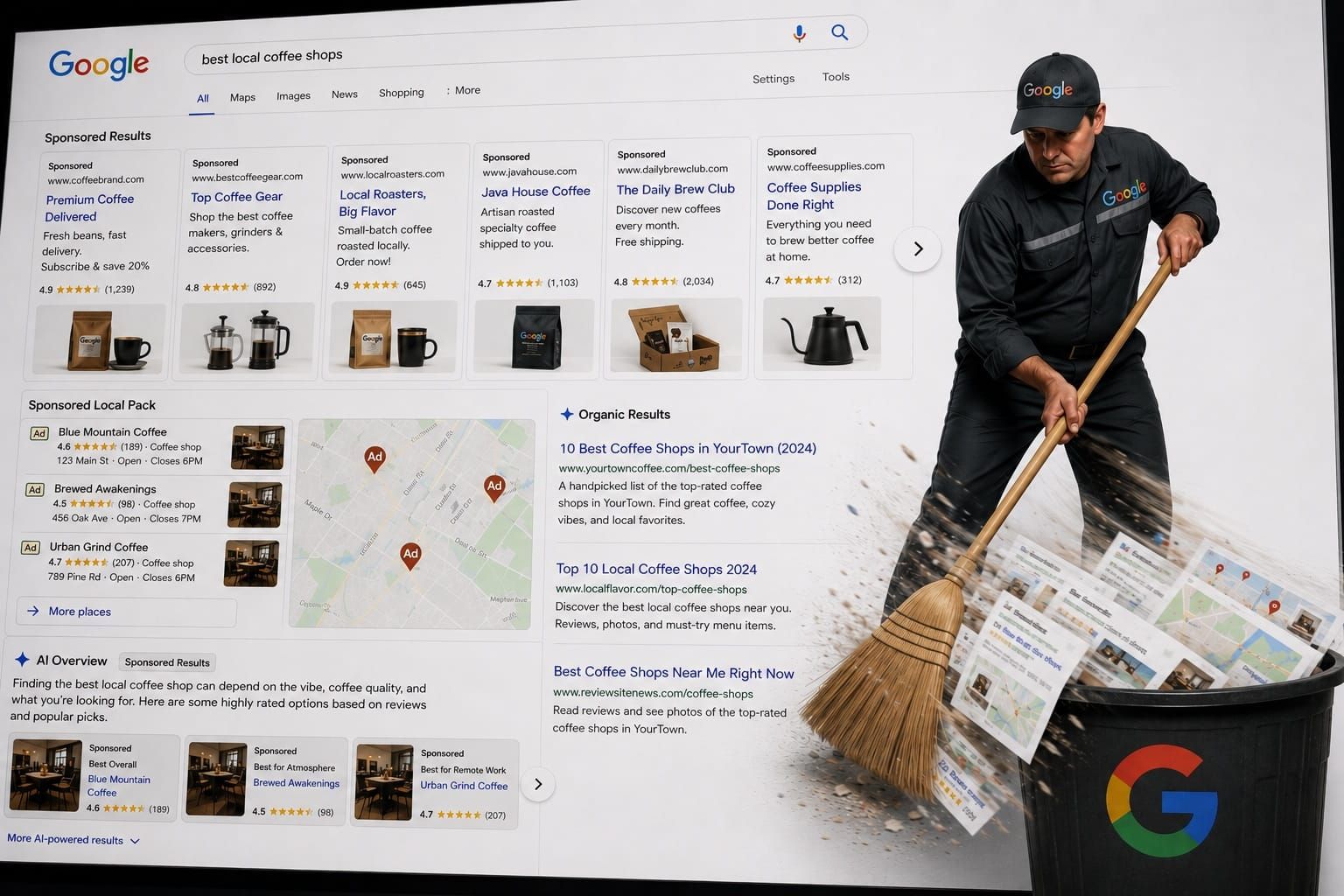
Brand in legal is reputation and recognizability — so in a market where every firm has 700 reviews, a 4.9 rating, and the same "we fight hard" ad, the decision is won before the direct-response moment, through intake, service delivery, and demand you manufacture in the real world and route back through Google.
Gyi's Growth-Stage Segmentation
Gyi's advice is gated on where a firm sits in its growth journey — "that's question number one for me always" (22:25). The playbook is different at each tier.
| Tier | The problem it answers | Primary lever |
|---|---|---|
| Startup ("hung my shingle last week") | No compelling message, no reviews, no recognition — can't win the auction | Stay out of the "most-reviews-wins" contexts entirely; spend where recognition isn't the deciding factor |
| The 5-to-10 (most AttorneySync clients) | Can't outspend the top firms, but has a competitive review base | Differentiate on brand positioning + service delivery; manufacture recognition before the LSA moment |
| Top 3 (saturation advertisers) | Capturing knee-jerk, first-name-that-pops decisions | Hundreds of millions in offline spend — a game the other tiers shouldn't try to play |
Takeaways
-
Brand in legal is two words: reputation and recognizability. Recognizability is whether your name pops into someone's head; reputation is what that name makes them feel. "It's the thoughts... what they think about you." (03:12–03:49)
-
You can't outspend a bad intake experience. The internet democratized reputation — unhappy people leave reviews and post on social. Amplifying bad service delivery with ad spend just "hurts your reputation and your conversion rates." Invest in intake before dropping money on Google Ads and LSAs. (07:21–11:37)
-
Race to the phone is table stakes in PI. LSAs prompt the consumer to contact several firms at once, so speed is baseline — but "race to the phone with amazing service experience" is the real bar. Firms lose won cases in the first intake interaction. (19:42–20:11)
-
Get reviewed for your intake — even by people you reject. A prospect you can't sign will still post "they didn't hire me, but they listened and pointed me in the right direction." Mike cites a firm that put a lawyer on non-active cases purely to deliver "sophisticated rejections," and it generated a stream of five-star reviews. (13:29–15:00)
-
Sign them up first, qualify later. Gyi's deliberately controversial take: after a few basic qualifiers (accident within ~2 years, injuries), "text them a retainer and get them signed up now," then investigate and turn down later. Cherry-picking upfront loses the client — "by the time you've done your research, they've already contacted a couple other firms." (16:25–17:07)
-
Response-time tolerance is per-channel and demographic. Text, web form, call, and email each carry different expectations; miss the window and the lead moves on. Google/LSA also watches back-end response time and dings slow responders — a point reinforced by ex-Google LSA specialist Eric Levine and by Aaron Weiche's mystery-shopper research on slow lead handling. (18:20–19:42)
-
The choice is made before the LSA, not inside it. When every listing is a middle-aged white guy with 700 reviews, a 4.9, and 25 years in business, "by the time someone's looking at the LSAs, it's already too late." The winner is the one who "did backpacks at my school" or "spoke at my event." (26:23–28:42)
-
Manufacture brand demand and route it through Google. The opt-in play: a community booth or restaurant co-marketing giveaway where the only sign-up path is a Google Business Profile post linking to an unindexed page — "search for us, find our GBP, click through." It drives a brand search, drops a retargeting cookie, and builds an email list. Gyi and Mike concede it's "borderline click manipulation," but "it works very well." (31:00–34:11) [See editorial note.]
-
Track leading indicators, not last click. Brand-building has no last-click attribution. Watch brand queries in Search Console and Google Ads, and run consumer-recognition surveys, instead of demanding an ROI number the channel can't produce. (29:06–33:22)
-
Content strategy is reprioritized SEO, not new SEO. Long-tail blog pages are deprioritized; short-form video is up, because "no one wants to read" and Google cites its own YouTube in both classic results and AI. Turn lawyers into creators: record an hour, cut it into FAQs and positioning clips, distribute across YouTube, LinkedIn, Reddit, Quora, and legal directories — the sources the machines cite. (35:38–38:23)
-
Make the invisible work into content. Michigan Auto Law's "3K for Free" campaign packages a state mini-tort rule (up to $3,000 for vehicle damage) into "three things you need to know." Josh Hodges, the Hamilton, Ohio "hometown lawyer," interviews local business owners until "everybody knows him" — digital PR as local celebrity. (38:48–41:28)
-
AI optimization is a PR game. For AI answers, "it's mentions" — get people publishing about you, reviewing you, talking about you. But contextualize the hype: most local consumers still use Google, not AI, for bottom-of-funnel lawyer lookups, and GEO "visibility tracking" is shaky because OpenAI doesn't release the actual prompts. On July 30, a logged-out ChatGPT query for "car accident lawyer near me" returned Google Business Profile reviews and URLs still carrying GBP UTM parameters — "you don't think Google matters in ChatGPT world? Take another look." (43:58–49:56)
-
If you're a one- or two-channel marketer, your days are numbered. CPA is climbing and PE-backed national players have the operational efficiency to tolerate higher cost-per-client. Diversify so you're "not beholden to any single channel." (50:43–51:27)
Related Reading
- EP 265 — Decoding Local Branding with John Jantsch — Part 1 of the series: what "brand" means in the general context.
- EP 266 — Cyrus Shepard: What Local Brand Actually Means to Google and AI — Part 2: the technical side of how Google and AI model a local brand.
- AttorneySync — Gyi Tsakalakis's legal marketing firm and a partner in the Near Media legal research program.
- Michigan Auto Law — "3K for Free" — the short-form-video campaign Gyi cites as a model.
- Kruger & Hodges, "The Hometown Lawyers" — Josh Hodges's local-celebrity content strategy in Hamilton, Ohio.
- Google's ATLAS study — Google research on how people use AI for local discovery, then switch to search to act.
- Lunch Hour Legal Marketing Summit — the Nashville event where Greg is presenting new lawyer-discovery data.
Concepts
- Reputation and recognizability — Gyi's two-word definition of brand: whether your name comes to mind (recognizability) and what it makes people feel when it does (reputation).
- The 5-to-10 — the tier of firms just below the market's saturation advertisers; can't win on spend, so must win on differentiation and service. AttorneySync's core client.
- Sign-up-first intake — routing prospects to a retainer after minimal qualification, then investigating and declining later, to cut "breakage" between first contact and signed client.
- Get reviewed for your intake — treating the intake and even the rejection experience as a review-generation surface, not just the representation itself.
- Brand-demand routing — manufacturing a branded Google search (via a GBP-only giveaway or "Google me" billboard) so offline attention converts into on-Google brand signals and retargetable website visits.
- Reprioritized SEO — the same digital-PR and content fundamentals, reweighted: less long-tail blogging, more short-form video and third-party mentions the machines cite.
Practitioner Notes
-
The intake-quality thesis maps directly onto Near Media's legal research program. AttorneySync and Conrad Saam are partners in it, and Gyi credits the user-behavior research with reprioritizing his own thinking — the survey and behavior data on how consumers judge firms is the evidence layer under his "you can't outspend bad service" argument. (01:16–02:03)
-
"Manufacture the brand search" is a testable claim, not a slogan. Greg and Mike tie it to Google's own signals — brand queries in Search Console, satisfied-website-visit behavior, and the ATLAS finding that people research in AI but convert in search. That's a measurable sequence a firm can instrument.
-
Editorial note: the GBP-only giveaway funnel is described on-air as "borderline click manipulation" by the sGyi. We don't view it that way. Driving clicks to Google and having consumers engage with your GBP is a legitimate way to drive brand queries and rank. You can decide for yourself.
Full Transcript -->
Near Memo EP 267
You Can't Outspend a Bad Intake Experience: Brand-Building for Legal
Greg Sterling & Mike Blumenthal, with guest Gyi Tsakalakis (co-founder, AttorneySync)
Editor's note: This is a lightly cleaned reading transcript. Stutters, false starts, and clear transcription errors were removed; backchannel ("yeah," "right") was folded into the speaker's turn; and wording is otherwise left faithful to what was said. Speaker-side factual claims are left as spoken.
Greg (00:10)
Hey, welcome back, everybody. This is the Near Memo, episode 267. We're here today with Gyi Tsakalakis, who is the co-founder of AttorneySync, a legal marketing firm. This is the third installment in our series on branding and brand building in local. The previous two episodes I thought were really great — if you haven't watched them, go back and watch them. John Jantsch, whose last name I can't say correctly, and Cyrus Shepard. They talked about what brand means in a general context, and then Cyrus got into a lot of technical detail: How does Google see brand? What's the difference with AI? Both of those were really valuable sessions, but we wanted to bring it back down to earth a little bit in this professional-services context — specifically legal, but this also applies to real estate and some other kinds of services. So welcome, Gyi. Great to have you here.
Gyi Tsakalakis (01:05)
Thanks for having me. Great to be here. And I'll also give a plus-one to both of those episodes — I thoroughly enjoyed both of your recent episodes. Great work. Learned some things.
Mike B (01:16)
And I would add, too, that Gyi and AttorneySync, along with Conrad Saam, are partners in our research program. They've helped us develop it, refine it, and understand how consumers are finding lawyers. So thank you for that support.
Gyi Tsakalakis (01:31)
And let me tell you something. I'm here on the Near Memo, so this is going to sound like a total shill, and obviously everybody can recognize my biases. But I've got to tell you: in the last almost 20 years of doing this, my sense right now is that the user-behavior research we've done in partnership with you guys has been some of the most insightful and perception-changing work — reprioritizing things, which I think we can talk about today — more than anything else we've really done in the last seventeen years. So I'm super grateful for that partnership.
Greg (02:03)
Right, and I was going to talk about that. So thanks, Mike, for bringing it up. Just to complete the picture, we do three kinds of things in that program. We do user behavior, where we actually watch people search. We do surveys, where we ask people about their path to purchase, their attitudes, and which messaging and channels are most effective for them. And we do brand-awareness and creative research, where we test different ad creatives against other ad creatives or competitors. It's pretty interesting because we get a holistic picture of user behavior and the psychology and mindset of users. So if you're a law firm out there, feel free to hit us up. It's really good stuff — and I'm not just saying that because I'm one of the people involved. It's really super interesting.
Greg (02:50)
All right. With all of that self-promotional stuff aside: you've seen these other two episodes, you've heard them talk about brand and the components of brand. What does brand mean to you? I know you're a big advocate of brand, and in legal — if somebody says "brand," what does that really mean as a practical matter for lawyers?
Gyi Tsakalakis (03:12)
There are two ways I think about it. If I really wanted to be concise and say two words, it's reputation and recognizability. It's the thoughts — and I think John mentioned this too — it's what your customers, or clients in the legal context, think about you. When your name pops into their head — one, does your name pop into their head? That's the recognizability. And two, what does it make them feel? Part of that is reputational, and part of it is traditional notions of trust. But that's how I think about brand.
Greg (03:49)
One of the things that's interesting about this market — and real estate as well, and certain other professional services like financial advisors — is that these are not frequent transactions. If you're hiring a personal injury lawyer, you're probably doing that once in your lifetime. You're not routinely looking at reviews of personal injury lawyers the way you might for plumbers or electricians or car-repair places, where you have some regularity. So how does that infrequency play into reputation and awareness, when people aren't necessarily looking for your business — even though your business might be in front of them twenty-four-seven on billboards and TV, and Cellino and Barnes are everywhere?
Greg (04:38)
That's an important aspect of this. Go ahead, Gyi.
Gyi Tsakalakis (04:41)
The thing I think about is, as you mentioned, it's not a frequent thing. And the second thing is it's a high-stakes decision. People have a sense that making a good choice about your lawyer is important, but they don't know much beyond that. As our researchers talk about, they don't know much about pricing, and it's very hard to distinguish the quality of a lawyer. How do you know this lawyer's better than that one? So it's a different consumer context than a lot of the ones you named. And even within professional services — when you talk about PI, you're talking about contingency fees, so there isn't really price shopping to the same extent.
That dynamic has created two different camps. Camp one, which I think is the overwhelming majority of firms, is performance, non-brand, direct response. Now that there's Google and you can advertise to people actively looking for personal injury lawyers, that's what's driving cost-per-clicks through the roof. And lawyers, especially depending on your growth stage, are very short-term focused — I need leads now, I need clients now — so they gravitate to non-brand direct response. It's got high intent. The other camp is the folks who've kind of figured it out; they're leaning more into brand. But brand takes time, especially if you're brand new — it's not going to fill up your pipeline tomorrow. And then you get into: well, what does brand mean? For a lot of lawyers, traditionally, branding has meant offline media buying.
We've been trying to get the word out that the amazing thing about the internet is you can actually build brand digitally. At the risk of stating the obvious, I'm a big believer in diversifying: you should have investments in direct response where it makes sense, and you should have investments in brand. But lawyers think they know that. They're like, "I want to get in front of people who are in a car accident, or family members of people in car accidents, right now." And the way to do that is direct response — which is why it's so competitive in legal on Google.
Greg (06:58)
You work with a variety of firms, and some are more well known than others. What do the firms you'd consider to have brands — even just local awareness, or especially local awareness — have in common, versus those that have yet to develop that? Is it just a life-cycle or growth-trajectory thing, or something else?
Gyi Tsakalakis (07:21)
The sustainable brands, especially locally, are really focused on service delivery and client experience. They've figured out that you can advertise as much as you want, but if you're not answering the phone, not following up, delegating clients to associates and paralegals and case managers who aren't providing an exceptional experience — the internet has democratized that. People leave negative reviews, they post nasty things on social media. My view is you can't outspend that. If it's coming out that you're not great at what you do, you're just amplifying bad service delivery. That hurts your reputation and your conversion rates.
We talked about this in the prep for this conversation. When we look at the firms that are maybe not the top three — the top three in a market tend to be saturation, offline, spending hundreds of millions on advertising, trying to capture the audience that makes a knee-jerk decision based on the first name that pops into their head. But the five-to-ten firms are the ones that are interesting to me, because they know they're not going to win on spend. They've got to get more creative and lean into brand positioning and service delivery that helps them stand out — to maintain and grow market share beyond just spending as much as they can.
Greg (08:57)
Elaborate on that. What does that mean tactically?
Gyi Tsakalakis (09:04)
Step one is this. It sounds cliché — everybody talks about how it's all about user experience, customer experience, client experience. Those are easy things to say, but tactically, in the context of a law firm, you have got to invest in your intake process. You've got to invest in reducing the friction for people to contact you. How many law firm websites, even today — you call the firm and it might go to voicemail, or IVR, and the new hotness is AI. But when someone calls up and says, "My brother was just killed in a truck accident," and they're met with "press one" — if you have a really powerful brand, if you're known as the person in your community who does this thing, you'll get a lot more latitude. People will leave a message; they'll give you more time to respond. If you don't have that brand equity, forget about it.
We see so many firms buying LSAs who don't have a sufficient number of competitive reviews, spending money on local SEO without a significant number of reviews, even running Google Ads — and it's fly-by. They click-call, you don't answer, and they're on to the next law firm. So I tell our lawyers all the time: before you drop a bunch of money on Google Ads and LSAs, you'd better have intake locked down. It has to be a frictionless experience. You'd better have people trained to empathize and help guide people through their journey to hiring you. Even the firms that are good at it still lose a bunch of business in that process, because for whatever reason the consumer chooses somebody else.
Mike B (10:58)
Part of the issue is that these cases can be complicated, and they may not be the right case for that lawyer. So there are backroom processes that have to assess the case. It's one thing to have the call answered quickly and get a case description — but do the better lawyers have a good system for rejecting the obvious no-cases they don't want? And then, on the edge cases, how do they put in place a system that's fast enough to really respond, when it might require more technical savvy than a phone person has?
Gyi Tsakalakis (11:37)
Yeah, totally. One: you have to meet clients where they are. You have to give people options. I'm not saying you have to respond to Facebook Messenger spam, but you'd better give people options, because not everybody wants to use the phone, not everybody wants to fill out a web form, and not everybody wants to engage with a chat. If you don't have those basic options, you'll have a lost opportunity.
On the intake side of the house, I tell people all the time: this is a place not to skimp. This is where you should be investing — whether it's full-time dedicated people or working with a virtual receptionist. There should be somebody at your firm managing the intake experience. That's not the place to go low-budget, because we see it over and over again, whether it's missed calls or — we're a big fan of CallRail — when you hear the conversations and the sentiment coming out of them, cases and clients are won and lost in that initial intake process. So reduce friction, be fast, and provide great experiences.
And by the way — tactically, and I know people are going to push back on this — I can't tell you how many times it's the situation Mike just described: a prospective client comes in, the firm decides it's an unqualified client. But if you invest in still giving that person a good experience, they'll go online and say, "So-and-so didn't hire me, but they listened to my issue, they helped guide me in the right direction, they sent me to another law firm." You want to talk about a way to get reviewed beyond just for your clients? Get reviewed for your intake.
Mike B (13:29)
I think it was you that shared with me a lawyer who was doing just that — they actually put a lawyer on these non-active cases and were getting a ton of great reviews just for that. They had invested in somebody to reject people and give them additional advice in the rejection, and it was a sophisticated rejection.
Greg (13:49)
This is a huge point, because if you give people — people often don't think about it. They think about maybe the first part of what you said, the intake process. But if they're going to reject somebody, as Mike is suggesting, it's worth thinking that through and having a process where maybe there's a referral, too. Because if you botch that process, you might get flamed online: "They were rude to me, they were arrogant, they didn't help me." There's this idea of the brand promise — what your marketing projects into the world, and then the experience of it. If you're out there saying "We'll fight for you, we'll win big for you," and somebody comes in and gets summarily rejected or someone's rude to them, that creates a real chasm between the two. And that shows up in these reviews and other online statements.
Gyi Tsakalakis (14:54)
That's right. There are law firm brand empires built on exactly that model. They've invested in call center and intake. They don't try to work cases at all — they refer everything out — but they're the ones who have the relationship with the prospect. So they follow up: "Hey, we wanted to check in on the law firm we referred you to. Are they giving you a good experience? Are they keeping you up to date?" You can see it online, because when they come into a new market starting at zero against local competitors, they're able to scale positive reviews. Now, don't get me wrong — as we've talked about many times, there's a huge review-fraud and fake-review-buying problem too. But there are huge law firm brands that come into a market, provide a great intake experience, partner with a local firm, refer the cases to them, and nurture that relationship throughout. Those clients, even though they're not being represented by them, end up referring and reviewing that business online, because that's who the experience is with — the front lines and the relationship.
Mike B (16:02)
So that model refers off quickly to known entities. But what happens when you're an employment lawyer and you don't deal with unions, or there's a case on the edge — maybe a pregnancy case you're not sure is quite right for you? How do you get them through the pipeline quickly?
Gyi Tsakalakis (16:25)
I have a controversial opinion about this, and I know a lot of lawyers aren't going to like it. I'm of the mind: sign everybody up, and then do your research and investigation and turn them down later. We see so much breakage between the time someone contacts a firm and the retainer. Reduce the friction, get them signed up. You can always do more investigation and always do a turn-down later. This idea that you're going to cherry-pick — by the time you've done your research, they've already contacted a couple of other firms, and it's a crapshoot whether you'll win.
Mike B (17:03)
So sign them up for a quick interview with a lawyer to make that decision, or —
Gyi Tsakalakis (17:07)
No — I mean send them a retainer. I think there are some basic qualifications you've got to hit first. If someone calls and says their car accident happened 25 years ago, you're going to go down a turn-down route; you're not going to sign that up. But if they hit the basic qualifications — a car accident in the last two years, injuries, a couple of other qualifying questions — for those folks, when they say yes, text them a retainer and get them signed up now, then decide if there's actually a case down the road. People will hear that and say there are trade-offs, and there's no question there are — what experience you give them and what expectations you set through that process really matter. But the alternative is you sit around, and even with good follow-up you say, "We're really sorry you're dealing with this situation; we'll get this in front of a lawyer as soon as possible." The lawyer reviews it — and if that process takes twenty-four hours, four to eight hours — we see it take several days to weeks with a lot of firms — you're toast, you're cooked. They're already on to the next firm.
Greg (18:20)
The failure to respond quickly enough is a problem throughout the local business world. Aaron Weiche did that mystery-shopper research, Mike, where he found people were taking a very long time to respond to really good, high-quality leads. That's a pervasive problem. And our research in this legal program shows — to the point about contact method — the channel where you reach out (text, online forms, calls, email) carries different tolerances. It's not all the same, and it's also demographic. If somebody texts you, emails you, or calls, they have different expectations about response time. Very clearly, our research shows that if you don't meet that expectation, they move on to somebody else. Final point: something we talked about with Eric Levine, who was at Google and now runs a marketing firm specializing in LSAs — Google watches response time and the back end of that. Are you responding to that lead in a timely way? You'll get dinged if you don't.
Gyi Tsakalakis (19:42)
A hundred percent — especially in the LSA context. The way the LSA system prompts a potential client to choose a couple of other lawyers to reach out to, it is a race to the phone. And race to the phone is table stakes in PI. It's really race to the phone with an amazing service experience. I keep coming back to the same thing: do not waste money amplifying your reputation for bad service experiences.
Mike B (20:11)
My input on this — and I've had this experience numerous times — is that the first way a consumer can judge the quality of your firm is this, and it's a judgment about your brand that's very real to them. They don't have a lot of other ways to judge; they don't know if you're good, compassionate, empathetic, or get big results. They have two ways: they can go to the website and see what it looks like — maybe it looks professional — or they can call and see how you handle the call. Both are really strong signals about whether you're somebody they want to do business with. When I get ghosted by a handyman for three, four, five days and have to call them back, there's a limit to how much you'll put up with. And in law, I think it's a really quick measure.
Greg (21:02)
Especially when you've got something like the LSA system, where they're actively sending your inquiry out to other people. It's like the old — I think it was a Head & Shoulders commercial, the dandruff shampoo — "you never get a second chance to make a first impression," if I'm remembering that correctly. Let's talk about LSAs.
Mike B (21:21)
How did dandruff ever become a problem? Now there's an interesting branding issue.
Greg (21:26)
They created that to market a solution — created a social problem to get people to buy the solution. Let's talk about LSAs, because in a lot of service-business areas, especially law, LSAs are huge. We've seen this in our research: when LSAs appear, especially on mobile, they have a profound impact on the choices people make. They swallow up the real estate on mobile in particular, and people sometimes disappear into that LSA/GBP world and never come back to the organic listings. So what do you tell clients about the need to advertise on LSAs, and how do you compete? Because what we see is that the top three or top two firms typically have some huge number of reviews and are almost always 4.8, 4.9, five —
Gyi Tsakalakis (22:25)
That's question number one for me, always — maybe question 1.1 or 1.2. The first thing I tell people is you've got to assess where you are in your growth journey. If you're a startup — "I hung my shingle last week" — forget about all of this stuff. There's no way; you're going to spend a lot of money in a place where you don't have a compelling message to compete. Part of that message — the second question — is: do you have a competitive number of reviews? If you don't have a competitive number of reviews in your local search ecosystem — so if you're a personal injury lawyer looking at other personal injury lawyers somewhat near you (obviously it depends on geography and how big that radius has to be) — don't go throw money to compete in a place where it's not going to matter. You can show your ad there, but you're not going to get chosen.
Couple that with one of the big things the Near Media research really drove home for me: people, even in a non-brand search context, still come to the table with recognition. You hear people say, "I'm choosing this firm because I know them, or I've heard of them" — whether it's because they do TV advertising, backpack giveaways, or they're in the local community another way. That's what you're up against. So if you come in with your little ad that says "free consultation," no reviews, no brand recognition — forget about it. Go spend money in contexts where it's not a most-reviews-wins game.
That's the startup. Now, most of the AttorneySync clients fall into what I was saying earlier — the five-to-ten. Maybe they're not the number-one national or regional advertiser, but they're in the top echelon. For those firms, number one, there's a presumption you've got reviews, which isn't always fair. But if you've got the competitive number of reviews — based on my experience and the Near Media research — I don't see how you can't be there. You have to be. The ad spaces on Google take up so much of the choice market share.
Mike B (24:43)
Right, and now with Performance Plus and AI, they're integrating those ads into the AI answers. We're seeing ads that are equally compelling to LSA ads. The reason LSA ads have been so successful is they have the information people are looking for — reviews, ratings, picture, contact information. And now, if you want a contact button on your listing there, you've got to pay for it. Otherwise you might not even get your phone number shown, let alone your website.
Greg (25:16)
So if you're in this group of competitive lawyers — and this probably applies to realtors equally — you're spending money on ads and you've got a bunch of reviews. Those ads are pretty standardized. It's maybe a little different with PPC ads versus LSAs, but a lot of those LSA ads look identical, or almost identical. There are a number of things that can be changed, but not much — it's reviews, it's picture, it's years in business.
Gyi Tsakalakis (25:47)
Years in business, yeah.
Greg (25:49)
So everybody's ad looks the same. We see this in the research: people are struggling to differentiate, to figure out how to make a choice when everything looks the same. Sometimes that's when brand awareness comes in and people say, "I've seen this guy, I've heard of this guy." What do you say to your clients about differentiating? What do you do in an environment where everything looks the same — a bunch of middle-aged white guys with seven hundred reviews, a 4.9 rating, twenty-five years in business, and so on?
Gyi Tsakalakis (26:23)
Exactly right. My answer, and the question I always pose, is: when you're in a world where you're inundated with billboards, TV, social, and lawyer advertising, what can you do to cause somebody to actually choose you? You alluded to one of them. One: don't try to appeal to everybody. Stand out. Maybe that's an identity thing, maybe a demographic thing — if you're not a middle-aged white guy, you're at a competitive advantage in that context. Maybe there's some cause or charity you're passionate about that you can make more prominent. But the truth is, the only way to really do it is to do it in a different context. By the time someone's looking at the LSAs and they all look the same, it's already too late. It's the firms that have already given people a reason to choose them. When I see a list of middle-aged white guys who all have five-star reviews, have all been around a hundred years, and all fight as hard as the next person, it's the one where I think, "This person did backpacks at my school," or "I saw this person speak," or "There's some philanthropy they do in my local community." Those are the things that win that game.
Truthfully, in LSAs, what are you really going to do? You want to provide great service to get more reviews — number-one priority. We can talk about other ways firms have gotten creative about generating reviews, because a lot of the filter is what the reviews look like. If you don't have that, focus on it. But once you've got it, you can't do much there, you can't do much on years in business, you can do some imagery. Everybody's open 24 hours, seven days a week. The truth is you've got to give people reasons to choose you before they're in that direct-response context. That's the thing I keep coming back to: you need to shift resources — not be a hundred percent in non-brand, bottom-of-the-funnel performance marketing. Diversify and give people reasons to think about you and choose you beyond what they're seeing in an LSA ad.
Greg (28:42)
Let's talk about the community stuff a little bit. A lot of firms are doing charitable contributions or sponsorships — the backpacks at the school, the local sports team, whatever it is. In our experience dealing with these firms, many of them are doing this but aren't entirely sure it's working. They don't have an immediate sense of ROI. It's not a direct-response thing; they can't track it. You're advising them — what do you say to the people who are doing it but aren't clear whether it's a good use of resources?
Gyi Tsakalakis (29:22)
Totally. This comes back to starting at the top — big-picture strategic guidance. Essentially this is a component of brand building; you're not going to have last-click attribution to show this stuff. So you've got to partner with people — or, even if you're not working with an agency, your CMO, or if you're just a firm owner, you've got to have long-term strategic thinking. Once you're in that mindset, there are plenty of things you can do to track leading indicators of brand growth. You can see the number of brand queries showing up in Search Console. You can see it in Google Ads. You can do consumer-research surveys to see if people recognize your brand. Those are the front-end leading indicators.
Then take one touch point — I'll use a local community event. I think we've talked about this before, but this one hits me so hard. You've got a little booth at whatever it is — a farmer's market, a concert, whatever's popular in your local community — and your messaging is maybe a giveaway or promoting a charitable cause. You get people to opt into something, whether it's scanning a QR code or signing up for the giveaway list, because you're taking those brand impressions. Everybody's thinking just awareness and impressions, but it's really about getting people to take some kind of action so you can continue to market to them over time. I love the stuff where you opt in. Maybe you do a co-marketing thing with a local restaurant — a very popular one. You do content around a giveaway to buy dinner for folks. Whether they come to you in person or you make it available online, they sign up, and you've got opt-in permission to send them giveaway information and updates about the firm. Then you're nurturing those relationships through email and retargeting, and your messaging there isn't any of the things we talked about. It isn't "we fight hard, we've been doing this forever, we're super experienced." It's "We're so proud to partner with this local restaurant. We're so proud to support our local community." Because now, go back to the LSA: they've got that list of law firms and they think, "Yeah, this is the firm that shows up with the local pizza shop," or "This is the firm I'm already on the giveaway list for. I recognize them." People say, "Is that enough of a reason to choose you?" But in an environment where everybody has five-star reviews and everybody's fighting hard and everybody looks the same, those are the things that can actually cause someone to make the choice. Tactically, those are the campaigns we really think are effective.
Mike B (32:09)
So one of Cyrus's points was that demand on Google often dictates rank. This raises the question of whether this joint exercise with the restaurant becomes a three-way exercise: using the QR code to drive a brand search, find your website there, and click through to fill out the form — so you get not only the benefit of the backpack or free dinner, but the benefit of the brand search, and possibly somebody staying on your website. We know Google looks at website visits and satisfied website visits — they stay on the website, they don't come back to search for more. Have you explored that cycle as part of these exercises?
Gyi Tsakalakis (32:58)
Yes. Maybe people don't think — this is borderline click manipulation, but it works. Let me take your idea one step further. You do your giveaway. You're out there promoting it, but the only place to sign up is a Google Business Profile post that takes someone back to your website. That page isn't indexed; it's not accessible anywhere else. You tell people: go online, search for us, find our Google Business Profile, look for the giveaway post, click through to the website — because now you've got cookies, you can do retargeting — and sign up for the giveaway on the website. But the only access point is the Google Business Profile, from a brand search.
Mike B (33:45)
Right — that's what I was envisioning.
Gyi Tsakalakis (33:49)
It works very well.
Mike B (33:50)
Every one of these offline things needs to be conceived of in this context: as long as you have their attention, and as long as you're the brand that has their attention, you want to create demand on Google for your brand — whether it's artificial or not. I don't see it as artificial. It's as good a path as any. They have to get there somehow.
Gyi Tsakalakis (34:11)
I tell these guys: get rid of your website and phone number off your billboards, and just say, "Search for my name. Go Google me." Put that on your billboard.
Greg (34:21)
I've never actually seen that, but it's a good idea.
Mike B (34:24)
There is a car dealer regionally that does something similar — they say, "Go look at our five thousand reviews on Google." They don't remove their phone number, but they create a sense that you should go double-check that they're not bullshitting you.
Greg (34:42)
I've seen something comparable to that — "X number of reviews on Google." Let's talk, in our final handful of minutes, a little about content, and then we want to touch on AI. You alluded to content a couple of minutes ago. What do you tell people about content strategy? These things substantially overlap — this local promotion is a content play. But there are SEOs out there who say the top of the funnel is dead because AI is going to answer all those questions, so you shouldn't even bother with that kind of content. If you're in a context like PI law where somebody is only going to choose you once in a lifetime, how do you think about content? Do you educate people? Do you do novelty things? What's the right approach — and how do you enhance it to deal with AI?
Gyi Tsakalakis (35:38)
Yeah, totally. I know there are differing schools of thought, but with some exceptions we can talk about, really what we've done is reprioritize a lot of the traditional SEO ideas. In the past — even prior to many of the updates — we were much more in the mode of: if you're a newer firm without a lot of authority on your site, you do long-tail blog content and pages, because you can actually show up. You can hit a home run off a very specific thing — a type of injury, a type of diagnosis — and if there's not a lot of competition on that long tail, you could rank for it. Those days — it still happens, but a lot less; that's been deprioritized.
On the other hand, what we're prioritizing from a content standpoint — and I think it's largely a sad reflection of our society in general, but no one wants to read — is short-form video content. And guess what? Short-form video shows up on Google, because Google owns YouTube and they love to cite YouTube, whether in traditional results or AI. So from our reprioritization standpoint, if you're talking content strategy, I'm thinking we need to get these lawyers to be essentially creators. I say YouTube if I had to pick one, but really across all these platforms — LinkedIn, and every one of these research reports keeps coming back to the same thing: the forum sites, Reddit, Quora, LinkedIn, the legal directory sites where you can publish. Those are the places the machines are using — or at least citing. So we tell people: diversify your content. And because it's not limitless resources, I'm a huge fan of recording an hour of video content with audio — whether a podcast format or interview style — then cutting it up and distributing it: answer frequently asked questions, talk about your positioning, educate your community. A lot of it's the same stuff, but it's a reprioritization: we're not doing X number of pages a week; we're much more focused on creating content people are actually going to want to engage with, then finding ways to distribute and promote it so other people tag their friends and share it.
Mike B (38:23)
Do you — I do a lot of shorts for every one of our podcasts, two or three, and put them on YouTube and elsewhere. But it's so erratic what takes off on Google. So, two questions. One: is there a length you find optimal, under three minutes — thirty seconds, one minute, two minutes? And two — I lost my thought, so go ahead.
Gyi Tsakalakis (38:48)
We recommend all time-length versions, but I'll say this: there's a lot of — who knows why it's happening; the algorithm is choosing to show it, and what resonates with people, and virality. But thirty seconds — I'm a 30-second guy. People are moving on. And again, the idea here is —
Greg (39:08)
But Gyi — what do you talk about? If you're a personal injury lawyer, what do you talk about for thirty seconds on a YouTube Short or TikTok?
Gyi Tsakalakis (39:20)
I'll give you a real-life example. People can go look this up right now. There's a firm, Michigan Auto Law — they're here in Michigan. Go search Michigan Auto Law. They're doing this campaign around "3K for Free." In the state of Michigan, by state law, you're entitled to up to three thousand dollars for repair damage to your car. But as a consumer, there are a lot of hoops to jump through, and if you hire a lawyer, they're going to charge you — you pay a lawyer a third on your $3,000. So here's a short-form video: "Three things you need to know about 3K for Free in Michigan." This firm happens to be doing it for free. But it's all the content we're talking about — go promote your giveaways, your charitable contributions, your community activities, your co-marketing with the restaurants. That's the stuff people want to engage with.
Greg (40:09)
That's a great piece of advice, because people don't know if that stuff is working; it seems to exist in some sort of black hole or void. Make it a piece of content that then goes online. I think that's great.
Gyi Tsakalakis (40:24)
I'll give you another example — a plug to Josh Hodges. He's in Hamilton, Ohio, the hometown lawyer. Just search for any of those things and go see what he's doing. He interviews business owners, goes to all the restaurants, all the local attractions, and he's in a small community. People are going to look at this and come back to you, "Well, what's the ROI on this?" And you can hear it from him: it's not because he's tracking someone who clicked his Instagram link and showed up in his CRM with last-click attribution. It's because everybody knows him. People call up and say, "Hey Josh, I saw you at such-and-such business last week." They just know him. He's become — that's true digital PR. Local celebrity. To me, that's the type of personal branding that has tremendous value. Being a good lawyer is table stakes. Knowing how to represent people is table stakes — everybody's doing that, and consumers can't tell the difference anyway.
Mike B (41:29)
So there was an idea that came up at Local U years ago that's germane here, and it segues into a slightly different topic: you're doing this giveaway, or working with a nonprofit you're funding, but you help them write the press release so it shows up in the local newspaper. Have you explored local press and coverage?
Gyi Tsakalakis (41:53)
Love local press. And again, people laugh about this, but even the traditional press-release networks that have been spammed beyond belief — if you put something in there that's a solid local, newsworthy story, to the extent that maybe you're doing a local scholarship, all of a sudden it gets picked up. It's not the press release everyone else is doing — "anchor text, best car accident lawyers Detroit" — it's an actual story of something you're doing in your community. And that was originally the whole point of press releases: something press-worthy. A brand mention.
Mike B (42:31)
Right — in fact, without a link, but with a brand mention.
Gyi Tsakalakis (42:36)
And then people start talking about it — you get that snowball effect, or flywheel, whatever metaphor you want to use, where other people start talking about it. The other big thing — we're running out of time and I'm ranting — is find ways to get your audience to create user-generated content on your behalf. When you're doing these giveaways on social, maybe you do a "share your 3K for Free story," or "share your favorite pizza place memory" if you're doing a co-marketing thing with a local spot. Then they're mentioning your business, tagging their friends, it's actually getting shared, local press picks it up. It works really well.
Greg (43:19)
I want to ask a couple of questions to close it out about AI, because obviously that's a big topic. We don't have time to go into it in depth, but I'll say this. In our research, people are still very focused on Google for PI law — very focused on finding lawyers using Google. But what's grown in our surveys is the use of AI to do background research: to assess the strength of a claim, to understand the process. So AI is making its way into that discovery process. What are you telling your clients about AI these days, and what's your attitude toward it?
Gyi Tsakalakis (43:58)
Again, there's a lot of overlap with what we've done traditionally. We could go deeper on ways to make your content more retrievable — express snippets about what the page is about earlier on the page, things like that. But for the most part, it's mentions. If you look at how these machines are supposed to work — forget about grounding and fan-out queries, which are relevant — the fundamental technology is: does this firm show up in a bunch of different contexts, a bunch of different training data, for this prompt? So what's the answer? Get people talking about you, publishing about you, writing about you, sharing their great experiences. We know reviews are playing a role in this. People say, "That sounds like a lot of what we were doing for digital PR and SEO." Historically you wanted to get that link — and I was big on links; I think links will still play some role, especially given the overlap with grounding and fan-outs — but get people talking. It's a PR game.
Greg (45:07)
You also, I think, should think about advertising, because ChatGPT now has ads [see Corrections], and that might give you exposure in a situation where somebody's saying, "If so-and-so hits me in this context, do I have a case?" — and then they'll see that firm. And one thing that needs to be said is there isn't a bright line between Google and AI, because more and more of what's going on in Google is AI. The local pack is frequently shown in an AI Overview these days. You've got AI Overviews, and more and more people using AI Mode. So you're going to have to think about AI, because that's going to ultimately define much of the Google search-result experience.
Gyi Tsakalakis (45:52)
A hundred percent. And don't get me wrong — the challenge I have right now is, like everything else, there's so much hype about AI and GEO. A lot of small businesses that don't know any better think, "This is the new shiny thing; I can't compete in Google because it's so saturated and everybody's got reviews, so I'm going to change my strategy and redeploy all my investments to AI." And I'm like, folks, let's contextualize this first. You don't have to take my word for it, or Near Media's research — go research the number of people using AI on a daily basis for these things versus Google. Even if the three of us are using it more, we're not indicative — especially in a lot of local communities, people are not turning to AI for bottom-of-the-funnel lawyer lookups to the levels they are on Google, period. Even if there's more of that growing — and being forward-looking, what are you going to do differently, really? Are you going to create some listicles across all these sites because it happens to be working right now? It's largely the same thing. The AIs are using reviews. And by the way, in ChatGPT, go look at where they're sourcing reviews from.
Mike B (47:07)
They just signed a deal with Yelp, by the way.
Gyi Tsakalakis (47:09)
There you go. And I think that's a good tactical tip — go see, for the very local prompts that might be relevant to your firm. Which, by the way, is another fake-news thing: all these GEO people are selling you on visibility tracking in AI. What's it based on? OpenAI isn't releasing the actual prompts being used. People who model this and are smarter than me say it doesn't really matter. In any event, the point is: it's a good tactical tip to anecdotally identify, the best you can, what the AI is using, and then focus on those profiles to try to get reviews there.
Greg (47:47)
The bottom line is you have to understand audience behavior, user behavior — and it's a more complicated proposition today than it's been. Google remains the last click for the foreseeable future. Sometimes it's the first place people go. But AI is in the mix in a lot of verticals, either at the top of the funnel or at the comparison stage, and then people go to Google. So it's playing in the brand-discovery context. We haven't seen it show up yet other than in this research environment where people are doing background research.
Mike B (48:25)
Google released a fairly large study of how people are using their AI in terms of local discovery and more advanced things. What they're saying is that people are using Google's AI for background research — to understand if they have a case, to understand who the players are in their market — but subsequent to that they're using search to actually find them.
Greg (48:48)
Right. They use search for reviews, to get contact information, all of that. Google will remain the last click, so you have to do all that stuff. But where people are learning — it's a version of what we said about offline advertising and other promotional tactics. Often people come into a Google search with some pre-existing awareness. So AI becomes another channel where you can potentially learn about lawyers or professional service providers in your area. It's not what everybody's doing, but it's what some people may be doing.
Gyi Tsakalakis (49:26)
Just for fun, anecdotally — folks, today's July 30th, so you can see this trend continues. ChatGPT, non-logged-in user, "car accident lawyer near me." Guess what they're showing? Google Business Profile data. It's Google Business Profile reviews, and the contextual URLs to the firms. Guess what they include? UTM parameters from Google Business Profiles — because they're scraping the Google Business Profile and pulling it in. So you don't think Google matters in the ChatGPT world? Take another look.
Greg (49:56)
It totally matters. In fact, SerpApi, which was the scraping provider for OpenAI, just won a case against Google that was trying to stop them from scraping. It's not completely over, but they won. So it seems like scraping Google will go on, and the biggest thing you need to do is focus on getting that Google Business Profile managed, built out, populated —
Gyi Tsakalakis (50:19)
Reviewed.
Greg (50:20)
Populated, reviews. Exactly. All right, this has been a great discussion — a lot of really good advice and provocative talking points. What's your last advice for people on this expansive subject of branding, or anything we've covered in this hour?
Gyi Tsakalakis (50:43)
Go diversify. Take a look at what your all-in marketing plan looks like, and look at what resources you're dedicating to short-term, non-brand, direct-response performance marketing versus what you're doing to invest in brand — and start spreading those assets out. Again, I'm an old-fashioned SEO person, local SEO person — we love SEO, I love local SEO. But in today's environment, if you're a one- or two-channel marketer, your days are numbered. The cost per acquisition is going through the roof. You're going to be competing with private equity and national players who have operational efficiency, so they have a higher cost-per-client threshold. You need to find ways to get people to come directly to you, and you should be doing that in a diversified approach so you're not beholden to any single channel.
Greg (51:27)
All right, great. Mike, anything you want to add?
Mike B (51:30)
No, just want to thank Gyi for being here.
Greg (51:33)
Absolutely. Thank you.
Gyi Tsakalakis (51:33)
Thanks for having me. And I'll give a little plug: I look forward to seeing you, Greg, in Nashville in a couple of weeks for the Lunch Hour Legal Marketing Summit.
Greg (51:41)
Where I will be — exactly — exposing new data, fresh research never before shown, on lawyer discovery, and talking about brand, this very subject. So I'm looking forward to that. Thanks, everybody, for listening.
Gyi Tsakalakis (51:54)
Can't wait. Thank you. Thanks for having me.
Greg (51:57)
Yes, thanks, Gyi, for being here. We'll see you next time.
Interested in sponsoring this podcast or our newsletters please reach out to mblumenthal@nearmedia.co