
EP 256 P2 - The Death of Keywords: How Google’s Personal Intelligence is defining the future of Local Search
In Part 2, Garrett Sussman joins Near Media to explore how Google’s AI personalization could transform local search, reviews, SEO, attribution, and marketing strategy — and what businesses should start doing now before AI-driven discovery becomes dominant.


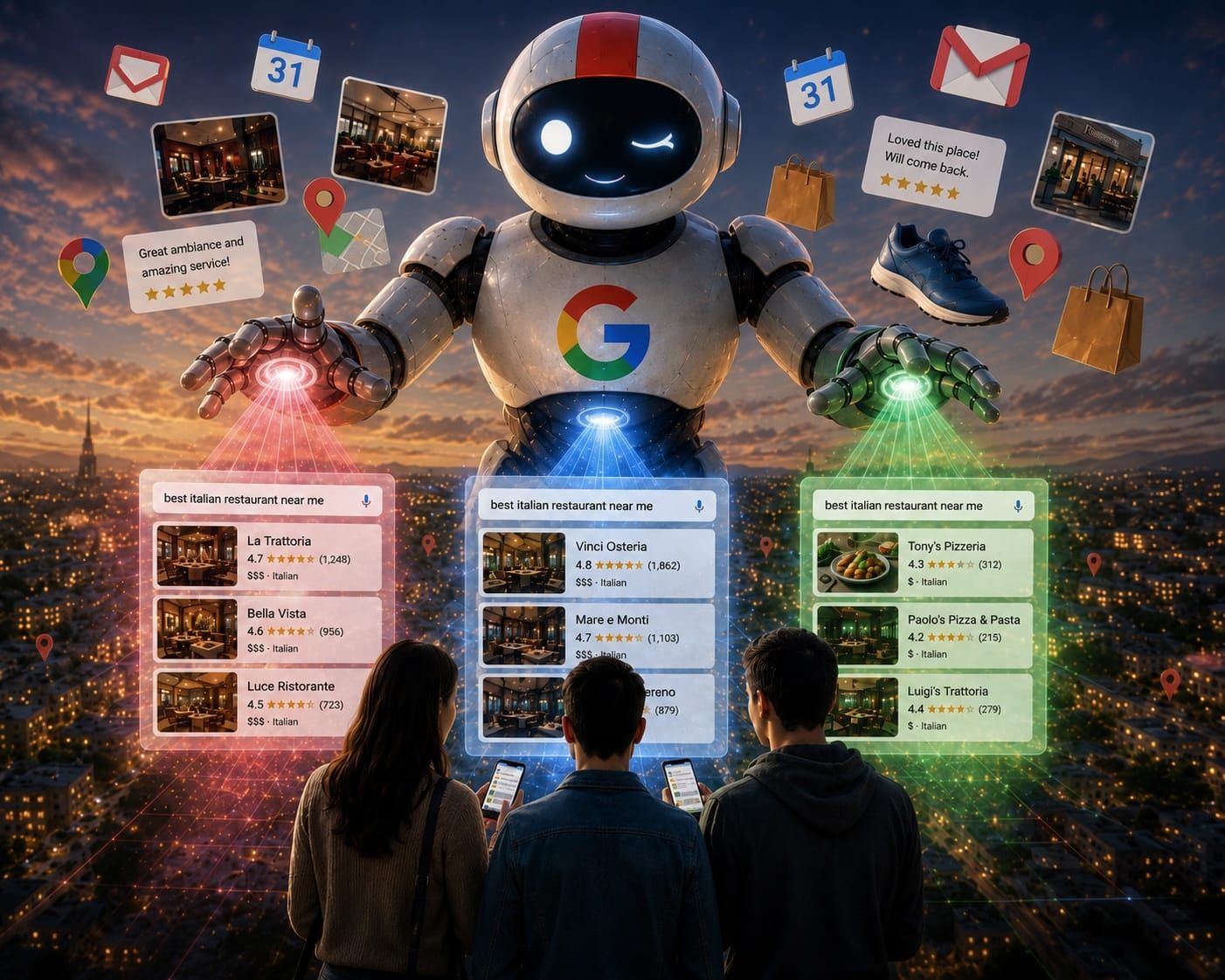
In this second installment of Near Media’s conversation with Garrett Sussman, the discussion moves from theory into practical implications as the group explores how Google’s “personal intelligence” systems may reshape local search, SEO, customer discovery, reviews, attribution, and reputation management. Garrett explains how behavioral data, Gmail, direct mail, calendars, reviews, and customer affinities could influence AI-driven recommendations, while Greg Sterling and Mike Blumenthal examine the broader implications for marketers, privacy, and the future of SEO measurement. The episode argues that traditional keyword-centric SEO is giving way to a far more holistic model centered around customer understanding, omnichannel presence, and AI visibility.
The Podcast Deets
1. How AI Personalization Could Transform Local Search (00:00–18:30)
The episode opens by connecting the themes from Part 1 — personalization, Gmail influence, and AI Mode — to local search and real-world commerce. Garrett describes a striking example where Google surfaced a shoe recommendation based on a USPS mail digest email containing a scanned postcard from a local running store. The group explores how AI systems could combine Gmail, Maps, Calendar, reviews, behavioral patterns, and location data to create highly individualized recommendations for restaurants, lawyers, retailers, and local services. The conversation also explores how Google may increasingly shift from explicit location intent (“near me”) to implicit behavioral understanding.
2. Why SEO Is Becoming More Holistic & Less Deterministic (18:30–36:00)
The discussion then turns to the future of SEO and measurement. Garrett argues that AI search is forcing marketers to move beyond keywords toward broader audience understanding and omnichannel visibility. The panel debates whether GEO/AEO differs meaningfully from traditional SEO and concludes that while SEO fundamentals remain important, marketers must now think far more holistically. The episode also examines the collapse of deterministic ranking tools and the growing importance of citations, brand mentions, reviews, PR, YouTube, and social influence in AI-driven discovery systems.
3. What Marketers Should Do Right Now (36:00–48:42)
In the final segment, Garrett outlines practical next steps for businesses preparing for AI-driven search. He emphasizes direct customer research, usability testing, persona modeling, and building “search twins” that simulate customer behavior across Gmail, social media, newsletters, and search. The group also discusses why businesses should obsess over consistency, structured business information, visual storytelling, and reputation management. The episode concludes on an optimistic note: despite the uncertainty and ethical concerns surrounding AI personalization, local SEO may actually become more strategic, creative, and customer-focused than ever before.
Key Takeaways
- Google’s AI systems may increasingly personalize local search results using Gmail, Maps, Calendar, reviews, browsing behavior, and even direct mail signals.
- Traditional keyword-centric SEO is becoming less important than holistic customer understanding and omnichannel visibility.
- Reviews may gain even more influence in AI-driven search experiences because LLMs can consume and synthesize large amounts of review sentiment.
- Businesses should begin building “persona search twins” to simulate customer behavior and test AI search outcomes.
- Measurement is becoming probabilistic rather than deterministic — marketers must think in terms of trends, visibility, citations, and influence rather than exact rankings.
- Breaking down silos between SEO, PR, email, social, and branding is becoming increasingly critical in AI search environments.
- Customer interviews and usability testing may become one of the most valuable competitive advantages in local marketing.
- Visual storytelling, signage, images, menus, partnerships, and real-world brand presence may all become stronger AI signals over time.
- Reputation management is becoming harder because AI systems may surface historical narratives and context in unpredictable ways.
- Despite privacy and regulatory concerns, AI-powered personalization is likely to become a major force in local discovery over the next few years.
- 👇 Watch by topic:
00:00 Intro & recap of Google’s “personal intelligence”
02:20 Direct mail influencing AI recommendations
05:00 Local search implications of AI personalization
08:00 CRM, email marketing & behavioral targeting
10:40 Building “persona search twins” for AI testing
11:10 Google Business Profiles, reviews & AI discovery
15:00 Location, behavior & implicit personalization
18:30 AI recommendations, bias & consumer discovery
20:20 Why classic SEO thinking is breaking down
23:10 Is SEO becoming GEO/AEO?
26:00 Privacy, antitrust & AI personalization risks
31:00 Why keyword research is changing forever
34:00 Measuring AI visibility & citations
36:00 Breaking down marketing silos
38:20 Customer research & usability testing
41:00 The three things marketers should do now
45:00 Reputation management in the AI era
48:00 Final thoughts: why local SEO is entering a new era
Related Links
 Near Media
 Garrett Sussman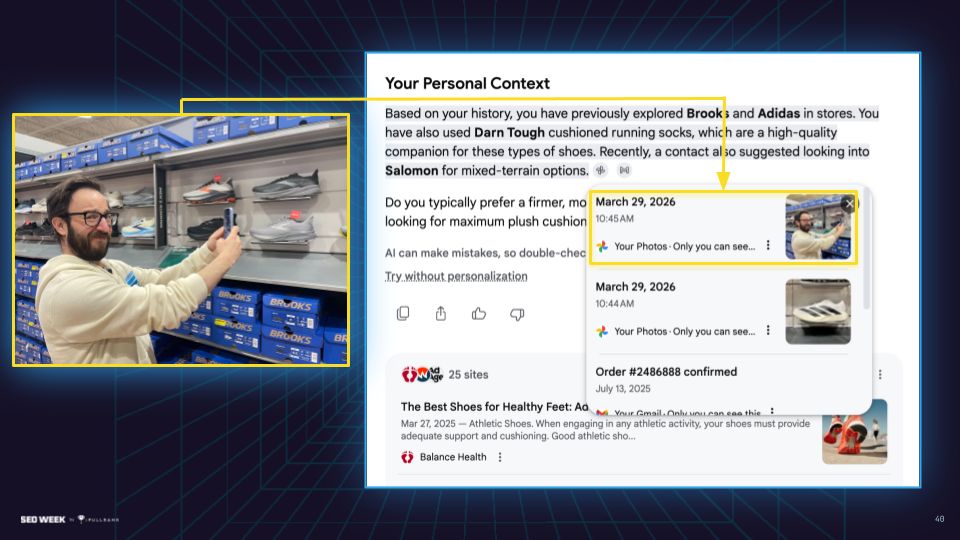
Interested in sponsoring this podcast or our newsletters please reach out to mblumenthal@nearmedia.co
Near Memo Transcript: -->
The Future of Personal Intelligence and Local SEO -
Local Implications of Personal Intelligence
Greg Sterling: Hey everybody, welcome back to episode two of this exciting discussion about personalized intelligence or personal intelligence in Google with Garrett Sussman, Mike Blumenthal, and me, Greg Sterling. This is a week later in truth, but it's just moments later because we started recording this after we concluded the last episode. We're going to get into the local implications of personal intelligence, talk about the impact on SEO and measurement, and what marketers should be thinking about and doing now, given the inevitable trajectory of search and AI answers toward a more personal and variable set of responses.
Greg Sterling: So Garrett, welcome back. Last time we talked about Google's introduction of personal intelligence, which asks you to opt in to sharing Gmail, photos, and YouTube. We talked about explicit versus implicit personalization—where Google takes search history and other information to personalize even without an opt-in. We also discussed your cluster of studies around personalization and the 'seeding' tests using different Gmail accounts. Email emerged as the most powerful influence, which has big implications for email marketers. It expands what SEO becomes; it's no longer just a narrow silo. One thing we didn't cover last time is the impact of physical direct mail.
Garrett Sussman: Yeah, I know exactly the anecdote you're talking about, which shocked me. The USPS has a daily digest email that scans your mail. In my experiment, I asked for best running shoes in AI mode, and it recommended a 3D rendering service from a local shoe retailer. The citation came from that USPS email digest with a scanned postcard I received months ago. The AI copy said, 'Hey, you got this in the mail the other day... why don't you check them out?' That's a fascinating use case for the implications of this.
Greg Sterling: It ties back to email since it had to be scanned and emailed to you, but it makes direct mail an influence on AI recommendations. Historically, marketers struggled to connect online and offline dots. Now, demographic targeting from direct mail can combine with online recommendations. Let's talk about local. Most commerce is local—researching online, buying offline, finding a plumber or restaurant. How does personal intelligence, including Google Calendar data, factor into local marketing?
Garrett Sussman: That's huge. There's a difference between potential and reality. I highly recommend people start running local query studies. If you have time constraints in your calendar or take photos of your meals, Gemini knows your routines and preferences. Anecdotally, when I looked for a lawyer after a fender bender, if the AI has context from my chats or emails about a court summons, it will take that into consideration. It knows where you live, too.
Garrett Sussman: There's significant impact on local—practically keeping your Google Business Profile (GBP) up to date, but also thinking about specific personas. How can you show up in your marketing holistically to influence those recommendations?
Greg Sterling: I worked on 'location intelligence' years ago. Your physical footprint—how often you go to the gym, the airport, or a dealership—creates a behavioral profile. It's the real-world equivalent of clickstream data. Google has this for Android users and can combine it with calendar info to trigger powerful profiles. For a local business with a CRM and email list, how does that factor in?
Garrett Sussman: Hugely. This touches on relationship building—connecting with local chambers of commerce, libraries, or anyone with a newsletter. If you have a CRM with emails, you can use tools like SparkToro to see which newsletters or podcasts your audience subscribes to. I recommend building a 'persona search twin.' Create a Gmail account, subscribe to those newsletters and podcasts, and test local searches to see if your brand is in the conversation.
Greg Sterling: We've discussed 'Ask Maps' before—putting a conversational UI on top of local data. The future involves managing GBP much more actively—adding freshness and linking to sources. What about reviews and Google Posts?
Garrett Sussman: You have to maximize those. The probabilistic nature of LLMs means reviews heavily influence results. AI can consume much more review data than traditional search. We're moving away from specific keywords toward relevant content. Everything matters: posts, reviews, even owner responses. Google recently changed rules to prevent soliciting specific content in reviews, but I'm skeptical about enforcement at scale.
Mike Blumenthal: We're already seeing review takedowns for things like repeating employee names too many times. But in local, Google was always localizing to an extreme degree. Now, AI is better at mapping deep query intent, like 'restaurants between here and there.' Location remains a driving factor but is becoming more nuanced based on user preferences.
Garrett Sussman: Exactly. Location might be weighted differently if the AI knows you're willing to drive further for a better burger. It moves from explicit geographic mentions to implicit preferences based on device history.
Greg Sterling: If Google sees I buy on Amazon, will it route me to e-commerce? Or will it use Merchant Centers to show local inventory? That's the agentic stuff. It's making assumptions that might obscure certain choices.
Garrett Sussman: It's problematic. If I want to support local, I hope it recommends local. But my experiment showed AI can over-index on what it already knows, recommending brands I've already bought when I'm actually in 'discovery mode.' We're all learning to navigate these gaps.
Mike Blumenthal: Your research is forward-looking. Marketers have suggested personas and 'being where customers are' for years. While bombarding emails with products won't work immediately, the basic advice remains: know the customer.
Greg Sterling: Exactly. People get fixated on tips and tricks, but the basics—understanding behavior—are more important than ever. AI Overviews are now the default; we can't turn them off. We have to deal with whether we're being recommended and why.
Garrett Sussman: SEO is the foundation, but Google is automating more. Your responsibility is the narrative, the positioning, and the visualization. We see this with PMAX and LSAs drawing directly from websites to build ads. Marissa Mayer's vision of a search engine that anticipates needs is finally here.
Mike Blumenthal: But there will be pushback via privacy lawsuits. Google is 'breaking the dams' now because there were no penalties in recent antitrust cases, but individuals and litigation will eventually create pressure.
Greg Sterling: It's different in Europe with stricter controls. But regardless, keyword research is changing. What replaces it?
Garrett Sussman: It's not replaced, but the framing shifts. We measure three tiers: Input (discoverability/GBP), Visibility (how often are you recommended?), and Performance (revenue). Tracking will be a 'hellscape' because journeys are multi-touch. We need to focus on topic-level research and the questions customers actually ask.
Greg Sterling: What should marketers do right now?
Garrett Sussman: One: Interview your customers. Two: Over-index on critical information—ensure your phone number, address, and specific attributes are everywhere. Three: Don't underestimate brick-and-mortar visuals and signage. Marketing is more holistic than ever.
Greg Sterling: Content is storytelling—why should people choose you? Reputation management is also harder because you can't just 'bury' bad content in AI. You have to handle objections head-on on your own pages. It's an exciting time to be in local SEO. Run experiments and have fun with it.