
EP 272 - The Verification Loop: How People Really Find Local Businesses Now
Damian Rollison, Senior Director of Market Insights at SOCi, joins us to walk through SOCi's third annual consumer study whose headline finding is that local discovery no longer runs in a straight line, and that AI just posted the single biggest behavior jump the survey has ever recorded.


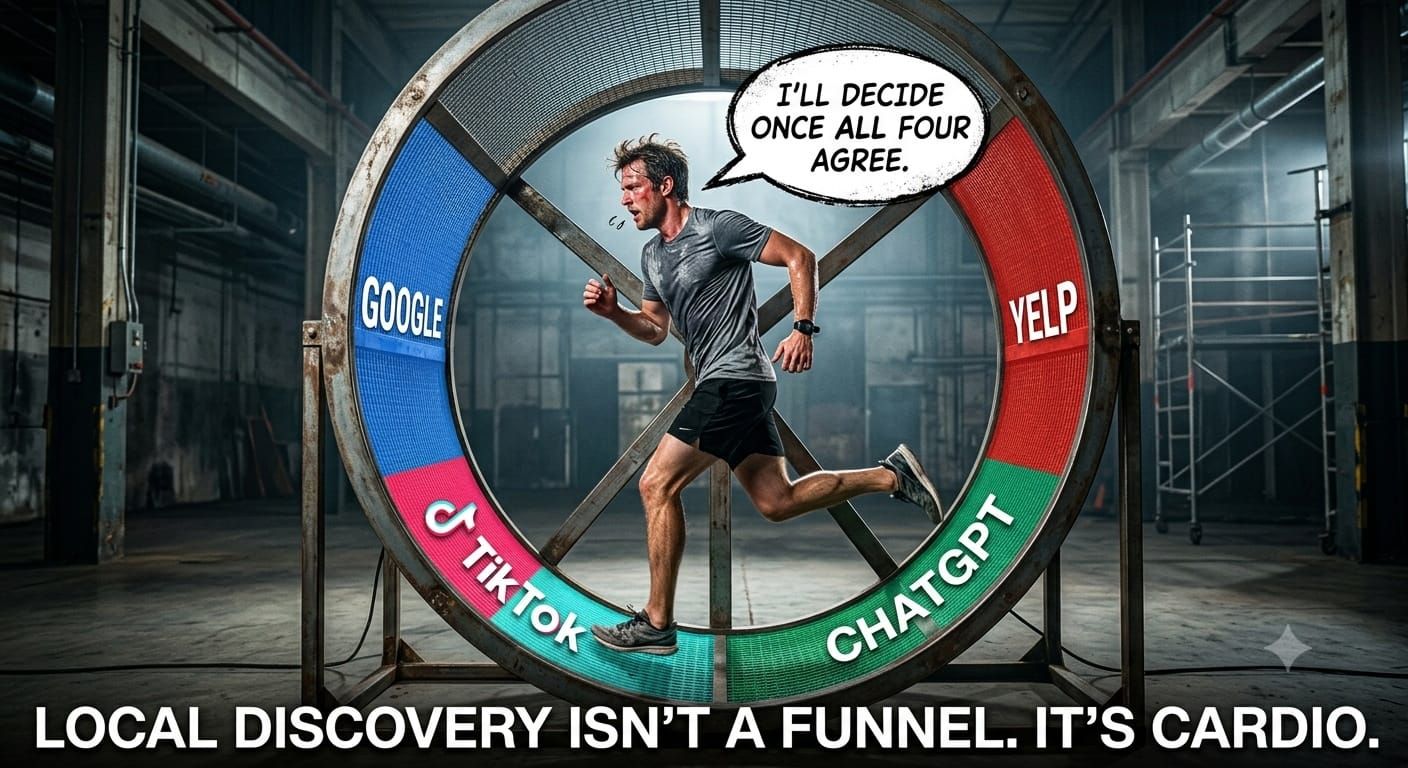
Local discovery has become a loop, not a funnel — consumers now rotate through search, social, AI, and reviews to corroborate a choice before they act, so the brand that wins is the one present and consistent at every station, not the one that ranks first at any single one.
The verification loop
Rollison frames this year's report around a single idea he calls the verification loop (19:17–22:37). Instead of a linear path from awareness to action, each channel is a station on a circle; consumers hop between them — sometimes once, sometimes several times, exiting at different points — and the data bears it out. When an AI tool recommends a local business, almost nobody just goes:
| Station | What the consumer is doing there | Why they leave for the next station |
|---|---|---|
| AI | Getting a fast, conversational shortlist or an orientation to a category | It "can't be trusted yet" — only 19% act on the recommendation directly |
| Search (Google) | Verifying: photos, reviews, hours, directions, contact info | Still the default utility layer, but increasingly the checkpoint, not the start |
| Social | Wanting a visceral, media-first sense of the place (TikTok/Instagram) | A recommendation you watch rather than read; then confirm elsewhere |
| Reviews | Cross-checking reputation on dedicated sites (Yelp, TripAdvisor) | Consistency across sources is the thing being tested |
The loop only exists because every station is still missing something the others have — and that gap is the story.
Takeaways
-
AI usage for local just broke the survey's records. The share of consumers who used an AI tool to research a local business in the last 30 days jumped from 9% to 52% year over year — "the biggest leap we've seen in any question since we've been running the survey." Monthly AI usage of any kind climbed from 19% to 60%. (10:14–13:00)
-
Consumers don't trust the AI answer — they verify it. After an AI tool recommends a local business, only 19% would contact the business directly. The rest go checking: 33% read reviews, 20% look at social, 16% re-run a search engine, 12% consult multiple sources. In total ~81% verify before acting. (21:35–22:37)
-
Search didn't lose — it changed jobs. Search as a channel actually ticked up, from 83% to 84%. People aren't trading search for AI; they're adding AI on top. Google increasingly functions as the verification checkpoint after discovery happens elsewhere. (14:20–15:03)
-
No single channel wins the start of the journey. Across nearly every vertical, a majority of consumers begin somewhere other than a search engine. Restaurants: only 40% start with search; the other 60% is spread across social, AI, maps, and review sites. Property was the one vertical where search held the majority. (25:49–28:34)
-
The starting line is vertical-specific. Financial services was the category most likely to start on social; fuel & auto skewed to mapping apps ("gas station near me"). The fragmentation argument is really a per-industry argument. (26:00–29:18)
-
Social is now a mainstream local channel, not a Gen Z quirk. 78% of all consumers use social networks regularly and 55% use them to search for local businesses — the maturation of the "40% of Gen Z would rather find lunch on TikTok than Google" finding from a few years ago. (13:00–14:17)
-
The AI user skews affluent and millennial. Millennials led AI-for-local at 63% (Gen Z and Gen X sat around 48–49%), and adoption rises "basically in a straight line" with household income — roughly 65% at $100k+. If you're targeting AI users, you're targeting affluent millennials. (16:13–17:43)
-
Decision factors don't transfer across categories. Reviews and word of mouth edge out the field as the top decision driver, but the mix shifts hard by vertical — so pick your battles. Property, restaurants, and hospitality should over-invest in visual content; other verticals can weight it less. (34:33–37:49)
-
Surveys tell you attitudes; behavior tells you truth — watch the gap. Only 18% said visual content matters in healthcare, yet primary-care behavioral research shows patients "scrolling and scrolling" for doctor photos. A survey captures what people think they do; don't let a stated preference override observed behavior. (38:00–40:08)
-
Last-click attribution is blind to the loop. Marketers see the Google referral clearly but not the discovery that led to it. In a multi-channel journey, where the search starts often matters more to the brand than where it ends. (22:37–23:30)
-
Local demand is lumpy and habitual — not everyone is searching. As Blumenthal notes, much local behavior is habitual (people already have "one in every category" they trust); real digital local search spikes on emergencies, a move to a new city, or a "blank-canvas" category like finding a handyman. (40:38–43:25)
-
You don't have to be everywhere — you have to be in the few places that matter. SOCi's AI-visibility work points to a short priority list for most brands: your own website, Google Maps, Yelp, and Facebook, with Gemini/AI Overviews and ChatGPT the AI surfaces that carry weight. Reddit gets attention but under-delivers for local transactions. (46:00–48:09)
Related Reading
- SOCi — "The Verification Loop" webinar (Sept 2, 2026) — the deeper, systematic walk-through of this study; register for the replay if you missed the live session.
- SOCi Consumer Behavior Index — background on why SOCi built its consumer-side research and how "fragmented local discovery" became the throughline.
- SOCi 2026 Local Visibility Index - Local discovery has become a loop, not a funnel — consumers now rotate through search, social, AI, and reviews to corroborate a choice before they act, so the brand that wins is the one present and consistent at every station, not the one that ranks first at any single one.
- Damian Rollison at SEL — his ongoing writing on AI and local search.
Concepts
- The verification loop — SOCi's name for the current shape of local discovery: consumers rotate among search, social, AI, and review sites to corroborate a choice, rather than moving down a single funnel. The loop persists precisely because no channel is yet trusted or complete on its own.
- Local discovery — behavior in digital channels where the ultimate intent is a local transaction; broader than "local search" because it spans AI, social, and maps, not just search engines.
- Fragmentation — the finding that, for nearly every vertical, the majority of consumers start somewhere other than a search engine, so no single channel "wins" the journey.
- Last-click attribution's blind spot — the gap between the referral a marketer can measure (usually Google) and the discovery, higher up the journey, that actually created the demand.
- Zero-click era — Rollison's shorthand for the decade in which Google absorbed the directory traffic that once went to sites like CitySearch and YellowPages.com, becoming the default before social and AI reopened the field.
- Habitual vs. one-time local use — Blumenthal's distinction: much local behavior runs on an existing roster of trusted providers; digital local discovery is triggered by the exceptions — emergencies, relocation, and unfamiliar categories.
Practitioner Notes
- Category-level research beats generic benchmarks. As Blumenthal argues, the pathway for a personal-injury lawyer differs from an employment lawyer, and both differ from a plumber. Use industry data like this to frame the questions, then interview your own customers about how they found you — the only reliable way to know where to deploy resources.
- Instrument for discovery, not just conversion. If last-click attribution is all you watch, you'll credit Google for demand that TV, social, or an AI shortlist actually created. Where a brand's search starts is often the number worth chasing — build the measurement to see it.
- Prioritize a short presence list, then keep it consistent. For most local brands the high-leverage surfaces are the website, Google Maps, Yelp, Facebook, plus Gemini/AI Overviews and ChatGPT. Being accurate and consistent across those few beats spreading thin across every niche AI tool and directory.
- Match content investment to the vertical's decision factors. Property, restaurants, and hospitality should treat fresh, locally sourced visual content as a priority; a healthcare brand may say photos don't matter and still lose patients who are silently scrolling for a face — weigh observed behavior against the survey.
) — the sibling brand-performance study benchmarking multi-location brands across search, social, and AI; see also SOCi's finding that AI recommends only a fraction of brand locations.
Pick your starting point:
- 00:11 Meet Damian Rollison (SOCi)
- 02:48 Local Visibility Index vs. Local Discovery Index
- 04:49 The consumer study: method & sample
- 09:53 Google's more nuanced picture
- 10:14 AI explodes: 9%→52% for local
- 13:00 Social goes mainstream (78% / 55%)
- 14:17 Search gained, didn't lose (83%→84%)
- 16:13 AI-for-local skews millennial & affluent
- 19:17 The verification loop, defined
- 20:55 Only 19% act on the AI directly
- 25:45 "Where people start" by vertical
- 34:20 Decision factors by category
- 40:38 Habitual vs. one-time local use
- 46:00 The short priority list that matters
- 48:09 Final thoughts + close
Full Transcript -->
Editor's note. This transcript has been lightly edited for readability: stutters and false starts removed, clear transcription errors corrected, and backchannel ("yeah," "right," "mm-hmm") folded into the main turn. Wording is otherwise left faithful to what was said.
Greg (00:11)
Hey, everybody. Welcome back to the Near Memo with Mike Blumenthal and me, Greg Sterling, as always. Today we're joined by Damian Rollison, who is the Senior Director of Market Insights for SOCi. We're going to be talking about some hot-off-the-presses new consumer research they've just done that's very interesting — it raises a lot of questions and adds to the body of knowledge of how consumer behavior is changing and the path to purchase. So welcome, Damian.
Damian (00:40)
Thank you so much, Greg and Mike. Happy to be here. I'm joined by my dog as well, but hopefully she'll be quiet soon.
Greg (00:48)
Damian is a veteran of this local search world, as we are. You've been around for a very long time. Give us a little taste of your career path, if you would.
Damian (01:01)
I'll try to keep it short. My earliest memory of Mr. Sterling is the Screenwerk blog. During that period — about 20 years ago, I hate to say — I was at a company called Moon Valley Software, and we were trying to develop, among other things, one of the first platforms for managing your online reputation as a small business owner: gathering reviews from Google and various places and pulling them into one interface. That was supposedly an amazing thing, at least it seemed that way at the time. So I've been in the space for about 20 years with a few different companies, and for the last five years I've been running a research division inside the marketing department at SOCi. Although my early history is more SMB-focused, SOCi is more on the multi-location brand side — although there's some SMB in there as well — and so that's been a bit of a mind shift for me.
Greg (02:03)
Well, franchises are the hybrid version of that.
Damian (02:08)
Franchises are definitely the hybrid version. It's interesting how franchise owners are — because they're themselves small business owners, they have the same kinds of needs and challenges. So there's definitely some overlap there.
Mike B (02:23)
And neuroses.
Damian (02:24)
Yeah, absolutely.
Greg (02:27)
That's a whole different conversation — the structural challenges of being in a franchise, who controls what, who makes what decisions, who's responsible for execution. But SOCi has done a lot of great research over the years, and this piece we're talking about today is now branded the Local Visibility Index, I believe. Is that correct?
Damian (02:48)
Local Discovery Index — it's an easy mistake to make, because we now have two things with parallel names. When I joined SOCi I inherited a project that actually had yet another name, but I won't dwell on that. We now call it the Local Visibility Index, and we publish it every year — it's coming up on its eighth year. That's basically an aggregated measurement of about three thousand multi-location brands in the US, where we benchmark their performance in search, reputation, social media marketing, and now in AI platforms too.
Greg (03:28)
Now in AI, yeah.
Damian (03:30)
From the beginning — again, about five years ago when I came on to start this research division — I noticed we had a gap when it came to consumer-feedback research. There are two pieces of the same thing: you can look at brand performance, but you also want to know what consumer behaviors are driving the priorities brands need to pay attention to. We'd done similar research before, when I was at Brandify, which was acquired by SOCi. So about three years ago we finally put together our first consumer research study, which is what we now call the Local Discovery Index — emphasis on local discovery, the phrase we use to describe consumer behavior in digital channels where the intent is ultimately some kind of local transaction. It's a big, comprehensive survey. It isn't just about reviews or just about AI; it covers the gamut of questions you'd want answered if you were advising brands across all the channels consumers use for local-discovery behaviors. So it's pretty broad.
Greg (04:49)
So tell us about this year's survey — the methodology, the sample, who's in it, the kinds of questions you asked — and then we'll jump into some of the specific findings.
Damian (05:01)
This is our third annual survey, and every year the population has been about a thousand US consumers. That's the case again this year. We did try a slightly different take this year: we got back our thousand initial responses, then weighted them to make an equal distribution across age and income demographics, and ended up with 625 responses. This was an exercise to make sure there wasn't any lopsidedness in the distribution. It turned out the 625 versus a thousand didn't make a big difference, but it was an exercise we went through to see what difference it would make. Again, it's a mirror image of the Local Visibility Index in the sense that it asks a comprehensive set of questions across AI, search, reputation, and social — rather than surveying just one topic, it tries to cover the full range of behavior. Many questions repeat year over year, but every year we introduce some new ones. This year one of the areas we leaned into — probably not surprising — is behavior around AI-based searches.
Greg (06:36)
Just on the point about over-representation in the sample: I've done a whole bunch of surveys on AI adoption, and one of the things I discovered is that in a couple of cases we got Android-heavy samples. In other ways they looked representative of the US population as a whole, but there were a lot of Android users in the mix, and those folks were heavily biased in favor of Google services and Gemini in particular. So that was a really interesting thing that came out of that. But that's a quick aside.
Mike B (07:17)
I was just going to say, it's characteristic of bundling and how monopolies maintain themselves. It's what we've been talking about for two years here. Of course Android users love Gemini, right?
Greg (07:30)
Right — because it's right in front of their nose all the time.
Mike B (07:32)
Right. Anyway, sorry for the diversion.
Greg (07:36)
I'll add another diversion, apropos of Google and its shenanigans. I got into a bit of a flame war with somebody on social media today, because I was very publicly saying, hey, Google's making a mistake by renaming Lake Ontario "Lake America" — and Apple did the same, unfortunately. This guy was really staunchly defending it. You should never get involved in those kinds of things; let it be a lesson to everyone out there. Just block, or go do something else. Okay.
Damian (08:10)
I bet you won't take your own advice. I'm just going to predict that right now.
Greg (08:14)
I try not to get too involved in that kind of stuff, because it's a fruitless exercise. But the way this guy was so smugly presenting — "they're just following proper procedure, and you should do the research and understand what's really going on" — was condescending, and so I took the bait.
Mike B (08:33)
Did you give him my take on it? Which is: the proper procedure is to take USGS base data and ingest it into their digital system automatically. The USGS base data has not been changed yet by declaration of the government — it will be changed at some point in the near future. In the meantime, they did a proverbial Google hand job on the data.
Greg (08:56)
There you go. Our rating goes from PG-13 to R. Okay. Back to the survey.
Mike B (08:59)
So that's why this broadcast is not for children. We're talking about mature topics — arguing on social media.
Greg (09:10)
One of the findings — and I should point out there's going to be a webinar on September 2. Today we're recording on September 1, so tomorrow, September 2, at 10am Pacific and 1pm Eastern. We'll put the link in the show notes. If you're seeing this after the webinar is over, I guess you could see a replay.
Damian (09:37)
If you visit that link after the webinar has gone live, you can fill out a form and get the recording. So you'll still be able to get it.
Greg (09:53)
Right, so that'll be a deeper dive into the data. But let's talk about Google. Most local marketers are still predominantly focused on Google, and there's justification for that — Google has been the alpha and omega for local search for a long time. But you found something slightly more nuanced. Why don't you tell us about that?
Damian (10:14)
You can talk about it in terms of a Google lens, or you can split things into channels, and neither is a perfect picture. But one of the things we've asked year over year is a couple of related questions. We ask consumers which of the following channels they use on at least a monthly basis. Traditionally we've asked about search engines, social networks, mapping apps, and review sites. Then last year we added AI tools — because, if you recall, this has all happened so quickly. AI search is still only about two years old as a phenomenon. Before that, AI tools were around, but they didn't have a reliable connection to search engines; you couldn't really do local search in them. So a lot of the behavior we're seeing around AI has emerged within that two-year time frame. In our report last year, in answer to "which of these do you use at least once a month," about 19% of consumers said they used AI tools. That number has climbed to 60% — 19 to 60 in overall usage. And we have a sibling question: which of these channels have you used in the last 30 days to conduct a search for a local business? There it's a similar trend — last year 9% of consumers said they'd used an AI tool to conduct some kind of local search, and this year that number has climbed to 52%. It's the biggest leap we've seen in any question since we've been running the survey — this growth in AI usage. So that's a phenomenon worth talking about on its own. But one thing I'd point to in parallel is the growth in usage of social networks for similar use cases. You alluded, Greg, to the Google finding several years ago that about 40% of Gen Z would rather use Instagram or TikTok to look for a place to have lunch than Google search. You could call that moment zero — year zero — of recognizing that trend emerging. Well, now we find that 78% of all consumers use social networks on a regular basis, and the majority of consumers — 55% — also use social networks to conduct local searches. Those numbers went up in a period a little bit before AI. What's now established is a picture where, although search is still the dominant channel for local — about 80% of consumers still name search as a channel they use regularly and for local searches — these other channels are taking place alongside them as alternatives. The majority of consumers say they also use AI, they also use social networks, 59% use mapping apps, 36% use dedicated review sites like TripAdvisor. So a majority of consumers said they've used most channels to conduct a local search. There isn't just one place people go.
Mike B (14:17)
Did any channels drop significantly in this?
Damian (14:20)
No channels have dropped. That's an interesting question, because although there was a lot of discussion in the last couple of years about search losing market share to AI — this is partly a Google story; AI experiences are embedded inside search now, so it's hard to even make a clear distinction — search as a channel has not lost ground. In fact it gained a little in overall usage, from 83 to 84% in this year's survey. So I don't think people are necessarily turning to AI instead of search. It's more in addition to search.
Greg (15:03)
At this level of abstraction — what are you using? — you get a sense of a wide range of things. But if you drill into verticals and demographics, into specific use cases, the picture starts to get different. It's not that everybody's using this tool or that tool; people sort themselves into different buckets. And there's also the idea — you address this too — of where people start, what happens in the middle, and what happens at what used to be called, and still is called, the bottom of the funnel. So there's a lot of variation in there. That's a comment, but it invites another comment from anybody who wants to respond.
Mike B (15:56)
It's different by category, I'm sure. It's not just these channels and age and demographics — it's depending on what it is you want or need.
Greg (16:06)
For the industry, yep.
Damian (16:13)
To speak to some of those variations, in case it's interesting: the share of consumers who used an AI tool to research a local business in the last 30 days breaks down by age group in an interesting way. The group that answered in the affirmative most often was millennials — 63% of them. Gen Z and Gen X were both around 48, 49%.
Mike B (16:47)
AI usage for local.
Damian (16:50)
Yes, AI usage for local. 63% of millennials said they had done that, the highest of any age group. We also found that AI adoption for local discovery rises with household income. It's about 76% adoption of AI usage overall; 65% for local for households at an income of $100,000 or more, whereas it's down to 56% — or 48% for local — at $50,000 to $99,000. So it's basically a straight line: adoption goes up as income goes up. You could say, if you're trying to target AI users, they're more likely to be affluent millennials. That's one of the takeaways.
Mike B (17:43)
What's the age range of a millennial? I lose track of all these.
Greg (17:47)
I think millennials are now late thirties to somewhere in the fifty-plus range. I'm not sure — let me look it up.
Mike B (17:55)
So they're in their prime earning years, is what you're saying.
Damian (17:59)
Yeah, thirty to forty-five years old, I believe, is the age range right now.
Mike B (18:05)
Gotcha.
Greg (18:05)
Born in the late nineteen-eighties to two-thousands, it says.
Damian (18:11)
There are different ways — that's one of the problems, there are different ways to define those age groups that don't all agree with each other.
Greg (18:19)
And they're really only directional, because it's a crude generalization for millions of people that doesn't take into account other variables like where they live, their incomes, their education level, in some cases ethnic background, and gender. There's still a gender disparity in AI usage, even though that gap is closing. So there's a lot going on here. One of the things you talk about in the study is that local discovery no longer runs in a straight line. I want you to talk about what that means. And let me challenge the premise: is this a new behavior, or is it something we're just getting clearer on — something that's always happened with consumers, this mix of influences on their shopping decisions? Go ahead.
Damian (19:17)
The title of this year's report is the verification loop. The verification loop is a concept we came up with to describe the behavior we thought we were seeing in the survey results. I don't think it's necessarily new to say the funnel is dead — stop talking about the funnel; we've been hearing that for a long time. But what's notably different this year is that the rise of AI usage for local means there are now at least three different channels — search, social, and AI — and we also looked at mapping apps and other things, so you could split it up in different ways. Let's say several legitimate channels that consumers use to conduct local search and local discovery. The verification loop describes how, if each channel occupies a station in a circle, consumers move from one to another — maybe once, maybe multiple times, maybe exiting at different points; it depends. It isn't a linear process anymore. The data bears it out: when consumers conduct an AI search, we asked how likely they are to just go visit the business as a result of what AI recommends, and the rate is pretty low. Let me quote it accurately.
Greg (20:55)
It's now time for the commercial break.
Mike B (20:58)
We see something similar in our user behavior, where when they interact with Google's AI, they typically use it more as a brand reference point or an education point, and then move on to ads or the local pack to make a decision.
Greg (21:15)
That's this process in miniature — it's within the session itself.
Mike B (21:19)
Right. Which is Google's goal: to gain AI market share and control at least some aspect of the entire funnel.
Greg (21:26)
The entire funnel, yeah. And that's what their addition of transactions is all about, too. Go ahead, Damian.
Damian (21:35)
Just to cite the step I was referring to: we asked people, after an AI tool recommends a local business, what are you most likely to do next? Only 19% of respondents said they would contact the business directly — in other words, trust what the AI is telling them and act on it to complete a local transaction, is how I'd interpret that answer. The other answers were: I'd go check reviews somewhere, 33% of the time; 20% would check out the business on social media; 16% would use a search engine to verify the information AI provided; and 12% would check multiple sources to make sure what the AI provided was accurate or needed to be corrected. So in total, 81% would do some kind of checking before taking action on an AI answer.
Greg (22:37)
And Google dominates that. I've done surveys that echo that exactly — Google is the place people go after using AI: to look at pictures, look at reviews, get directions, get contact information, stuff they don't feel AI accurately reflects. And the thing that's relevant for this larger discussion about the straight line versus the crooked line is that many marketers are still very much involved with last-click attribution, and they don't see the behavior higher up in the process. They'll see that referral coming from Google very clearly, but they don't really understand what influenced it or led to it.
Damian (23:30)
That's absolutely true. Attribution for local marketing has always been pretty difficult, but last-click attribution certainly isn't the right answer in a scenario like this, where a brand might be most interested in where the search starts as opposed to where it ends, and where the journey in between can go through so many cycles, stages, channels, and apps. One answer is that you simply need to be engaging, available, informative, accurate, and consistent in all of these places, in order to meet the consumer wherever they happen to be looking for you, whatever answer they need.
Mike B (24:19)
This speaks to why you need user research at the category level, the local level. It's different between a PI lawyer and an employment lawyer. It's different between any lawyer and a plumber, as to what these pathways look like. It speaks to why you need to take this data and then hone down to whatever category you're working in and understand behavior there.
Greg (24:45)
All research is valuable and instructive, but it's really the case that if you're in a particular industry, you need to do a deeper dive into that industry and understand what consumers are doing. For example, in legal — which we do a lot of work in these days — traditional media has a powerful influence on which organic listings and which ads get clicked, and that's totally invisible to all these attribution models. We see the brand awareness of TV, radio, and outdoor advertising translate into online behavior. We did a whole series on the brand effect — how you build your brand and why it's so important. It's pretty fascinating. But you said "where people start their search" — that was the magic word to bring up this slide. Take us through the slide and what it means.
Damian (25:49)
Essentially we asked consumers a pretty complicated question: for all of these verticals — restaurants, hospitality, retail, and so on — where are you most likely to start a search for a business of this type? We gave them six options: search, AI, social, maps, reviews, and vertical sites. This is a simplified representation of how we actually asked the question — we gave examples of each. For instance, search engines like Google also have reviews, but when we said "a review site," we meant sites like Yelp and TripAdvisor — we were trying to get people to think about sites more dedicated to reviews as a medium, as opposed to just happening to have them. For vertical sites, we said things like DoorDash or Hotels.com — sites that specialize in a given vertical. So you can see the distribution of answers. They had to choose just one most-likely starting place, and the darker the color, the more votes that channel got. You can quickly see that across all the verticals, search was indeed the most likely starting place. However, for restaurants, for example, 40% of consumers said they were most likely to begin with a search engine — but the aggregate of all the other answers adds up to 60%. So one view of this data is that for none of the verticals we asked about — except property, at the very bottom — did the majority of consumers choose a search engine as the most likely starting place. There's a lot of disparity in how the different verticals broke down. Financial services was the vertical where people were most likely to start on social — it'd be interesting to make sense of that. Another that makes a little more sense: for mapping apps, the greatest number of votes was fuel and auto — "gas station near me" type searches, which stands to reason. But there's a lot of diversity. Another reason we say no one channel really wins the battle anymore is that search is not the majority decision for most verticals when it comes to a starting place.
Greg (28:34)
And these proceed in order of priority as a starting point, right? Is it correct to say it goes search, AI, social, maps, reviews, and then vertical sites?
Damian (28:54)
You mean in order of which got the most votes?
Greg (28:56)
Popularity, yeah.
Damian (28:59)
It depends on the vertical — you have to read it across. For example, financial, in the middle, has more users saying they'll start on social than in AI. Generally speaking it goes down from left to right, but there are discrepancies.
Greg (29:18)
Right — or fuel and auto is maps. So this is the fragmentation argument in one slide. I'd imagine that if we did cuts of this by age, income, and gender, we'd see differences, even though directionally it might be similar.
Mike B (29:40)
And even within categories. If you're looking at coffee shops or snack restaurants versus sit-down restaurants, snack restaurants are going to have a much higher presence in maps, and sit-down restaurants probably a higher presence in reviews or search. This tends to average things out a little bit, but it's important.
Greg (30:07)
I would argue that the aggregate number being higher than Google in almost every single case — except property — is a reflection of two things: the utility, and personal preferences in some cases, of using other tools as a starting point in some instances; and an overall decline in trust of Google results, or at least the need to find alternative sources to validate or verify Google. Or the combination — the verification-loop idea: I'm going to start over here, then go to Google, and if these things are aligned, I'll trust the result. I think that's a relatively recent behavior. We saw it in some of the BrightLocal consumer-reviews research — people going to one review site and then another to see if there's consistency. I do that in my own shopping, depending on the category. I don't always do it. What are your thoughts on the idea that Google is not as solid a resource as it might once have been seen as? Is that a fair interpretation, or no?
Damian (31:28)
I think it's worth remembering that Google didn't always have a monopoly on this kind of behavior. There was a before-time, when there was a lot more diversity in the space. You could talk about sites like CitySearch and YellowPages.com being sites people went to deliberately to answer these kinds of questions. And Google progressively —
Mike B (31:53)
Do you think people went to MerchantCircle deliberately?
Damian (32:00)
Maybe not all of —
Greg (32:00)
Not MerchantCircle.
Mike B (32:03)
For those of you who are new listeners or younger than the age of forty, MerchantCircle was one of the early local sites that pulled every trick in the book to get visitors.
Greg (32:13)
They were doing SEO arbitrage and selling leads to local businesses.
Mike B (32:17)
Building fake websites and so on.
Greg (32:20)
They ranked very highly and then resold that traffic to local businesses.
Damian (32:26)
And why did they do that? Because there was perceived to be —
Greg (32:29)
Because it worked.
Damian (32:30)
— a huge market opportunity. In fact, some of those guys are still in business, chugging along somehow, running their little directory sites.
Greg (32:40)
Like HomeAdvisor and Angi are examples of that today.
Damian (32:45)
Totally. And if they get really good at one corner of the universe, then they do have this reason to exist that lets them persist. But progressively, it's the zero-click story — Google just ate up all of that real estate and became the default. That lasted for a period of time; I don't know if you'd call it a decade or so. Then we saw what I was alluding to a minute ago — the encroachment of social media as an alternative method. I think that actually spiked and tailed off a little; maybe it's plateaued at this point. But it was because TikTok and Instagram provided a different medium for discovery that was more visceral and gave you the experience of actually being in the restaurant — recommendations you didn't have to read. You could just watch something.
Greg (33:44)
Right — and these were theoretically real people, not spam.
Damian (33:52)
The potential of it was very powerful, and I think it's now a contender for the eyeballs that used to only use Google. And now the story is that AI has taken its place alongside those two. All of these channels — they may not get equal share, and it's complicated by the fact that Google has its fingers in at least two of them — but they're all viable.
Greg (34:20)
I'm going to ask what the implications for marketers are, but let's leave that for the end. Here's another fascinating slide from this research. Tell us what it says.
Damian (34:33)
We asked consumers to rate the decision factors that mattered most, by category. This is the same list of industry categories as the previous slide, along the left-hand side. But here we're asking: what are the factors — wherever you encounter them, in social media, in search, in AI — that make the most difference when you're actually trying to decide which business to choose among a list of alternatives, or whether to visit a business you encounter? The options are: reviews and word of mouth; visual content; basic contact information like location, hours, and address; offers and deals presented by the business; their brand or credentials — what do you know about them, what do they represent about themselves in terms of being trustworthy; and, did you see a recommendation in AI? Here the consensus is not as clear — the votes differ across the board. You can see reviews and word of mouth slightly edging out the other choices as decision factors chosen by the plurality of consumers for most industries, but it really does differ. There's real actionable advice we can give if, at SOCi, we're talking to a company in the property space versus hospitality versus a restaurant, as to which kinds of content they might want to lean into most to appeal to their target consumer. It's going to differ significantly by vertical. I wouldn't say any of these columns should be neglected by anyone, but you're going to pick your battles. Visual content is a good example. We were talking about franchises before — one of the real challenges in working with a franchise brand is adoption of strategy. At the corporate level there may be a very clear vision: every store needs ten locally sourced, recently taken photos populated in their Google profile and everywhere else. But actually sourcing that content from franchisees can be really challenging. They say they don't have time, they don't understand the priority, they don't answer your email. Getting all of that corralled is something you either prioritize or you don't, because of the difficulty. Well, if you're in property, restaurants, or hospitality, you should make that a priority — emphasize it more heavily than you might in some of these other verticals. So that's the kind of decision-making you can do with data like this.
Greg (37:49)
As you were reading the column headings, I was thinking, "I'll take location and hours for 100, please." The short version is you really have to do almost all of these things. It's a question of emphasis and where you deploy resources, but all of them have to be addressed. AI recommendations — one of these things is not like the others; that's kind of an outlier. But you have to pay attention to all of it: reviews are really important, images are important, you've got to get your basic business data right. Offers can be very powerful — the doctor isn't necessarily going to say your first exam is free, but in most cases offers can be a difference-maker. We've done research in self-storage, and that's significant: "first month free" goes in the title tag. Those kinds of things are very powerful. One point, because Mike was talking earlier about the difference between what you see in a survey and in behavioral data — it's not always distinct, but sometimes it is. In healthcare, only 18% said visual content is important. But we've seen in primary-care research people scrolling and scrolling, looking for doctor pictures, because they want to see who that person is. So in the abstract you might get people saying it's not that important — "I'm more concerned about other things," and that's valid, other things may take precedence — but don't underestimate the importance of images and conveying the experience to people.
Damian (39:41)
It's an excellent reason to re-emphasize that any survey only represents what consumers remember doing or think about themselves. It's a very perception-driven result, and their actual psychological motivations might be more complex. Different types of research can reveal those things.
Greg (40:08)
Right — but in defense of surveys, you do get a lot of insight into people's attitudes and psychology that complement other kinds of research. We hear clickstream advocates saying surveys are worthless, that it's clickstream data you really need to pay attention to, and that's not entirely true, because clickstream data does not reveal many things about the "why" question that surveys give you insight into. Mike, you've been strangely quiet all along here.
Mike B (40:38)
One point I'd make is that in local, many behaviors are habitual and not search-driven. The only time I extensively use local is when I'm traveling. I may occasionally use it if I'm visiting my son and daughter in Buffalo, which is seventy miles away. But for the most part, groceries, financial, healthcare, retail decisions, hospitality — all those things are either already known to the bulk of people or aren't relevant. So the set of people doing this in local is not a hundred percent all the time, and people need to realize that. Again, it comes down to the vertical people are working in, understanding how consumers make a choice. And there's a difference between habitual use and one-time use. If you just need a plumber for an emergency job, you may use local even though you don't regularly use local.
Greg (41:45)
Home services is a good example of a huge mega-vertical with hundreds of categories underneath it, where local is used all the time — because, unlike you, Mike, where you have a roster of people you can contact, most people don't.
Mike B (42:04)
I don't have a roster — I have one in every category that I trust. If it were a Rolodex, that's what it would look like. It's in my phone.
Greg (42:12)
That's right. But it's a blank-canvas problem almost every time, because these things are infrequent, and you don't remember the name of the person, or you misplaced the card, so you go back to do a recovery search, or you're trying to find a new person.
Mike B (42:30)
For me, the situation was a handyman. I spent almost a year finding a handy person. I initially worked off referrals, then I went to Google, and inevitably either they didn't return the call, or they did and then ghosted me. Finally it ended with a referral. But it took me almost a year — which is the difference in a local market. You probably could have solved that problem more quickly, but it took me almost a year to find a handy person.
Damian (42:57)
I'd also raise that the other use case that causes you to start over and build your list using digital tools is when you move — which is something I just did. I moved from Southern California to near Folsom, near Sacramento, and all of your list of handymen and plumbers goes out the window, and you've got to start over. How are you going to do that?
Mike B (43:25)
Knock on the neighbor's door. In home services you're taking your life in your hands if you go to Google — at least garage doors, locksmiths. Whoa.
Greg (43:33)
That's why Google's no longer seventy-five or ninety percent in that left column.
Mike B (43:36)
Could be.
Damian (43:37)
But I've used it a lot to reestablish habits I had in the other geography — everything from grocery store, bookstore, a place to get electronics repaired. The list is very long.
Greg (43:53)
There's no question. In some of our surveys we asked: where did you start, what did you rely on most, if you had only one to use, what would it be? There's no question Google is perceived to be the most useful of all the tools available if people are forced to rely on one. But they're not — and that's the point of this slide.
Greg (44:17)
Let's talk, for the last couple of minutes, about anything you'd want to say about this data that you didn't get to, but also some very concrete things for marketers, who constantly hear "you've got to do everything, you've got to be everywhere." What do you think the concrete, tactical takeaways are?
Damian (44:42)
Let me answer the first question first. One overall takeaway is that, as you said, most people think of Google most of the time when it comes to providing reliable information, or information that's easy enough to verify for searches like these. But Google is also, especially in the current atmosphere, missing a lot when it comes to the kinds of experiences people want online. With social, they want an experience that's more visceral, based on images and videos and people speaking to them. In AI, they want a conversational experience. There's a lot of promise AI has yet to fully fulfill — the dream that it's going to make your life easier because you can describe your needs and it already knows you really well and just offers up the answer. But that dream isn't fully manifested yet, and we don't fully trust it because it can't be trusted yet. So the full ecosystem, every step along the way, is missing some big piece. That's a picture of fragmentation, and that's why consumers are impelled to go to more than one place to get the answer. As long as that's true, marketers — to answer your other question — do need to worry about not being everywhere at once, but being in the most prominent places consumers favor. We didn't get into this much, but there's a lot more importance in being present in Gemini AI over AI Overviews, AI Mode, ChatGPT — maybe Claude is an emerging one — as opposed to something like Grok.
Greg (47:01)
Or Perplexity.
Damian (47:03)
You could waste your time literally trying to be everywhere. There are marketers who'll tell you that being in all those tiny niche places is just as important as the larger ones, but you can in fact prioritize the places that matter most. We're in the midst of redoing some research we did a few months ago that showed that for AI visibility, the places most brands need to worry about are your own website, Google Maps, Yelp, and Facebook — not a whole lot else. Even Reddit, which gets a lot of attention for AI visibility, doesn't pop up that much when it comes to local transactions. It may be relevant for some brands, but for the bulk of brands you can come up with a much shorter priority list — but it does have to include AI, search, and social. Those three channels are maybe not equally important, but they're all critical.
Greg (48:09)
And, to go back to a point Mike made earlier, it's really critical for people to understand their own customers — the differences, the choices, the paths to purchase that customers in those industries are making. So do customer research, ask customers how they found you — even though that's not entirely reliable — and don't rely on assumptions or generic data. General information is really important and helpful to surface trends, but you have to go deeper with your own customers. That's really the only way you'll answer some of these questions and figure out where to deploy your resources. We don't have time, unfortunately, for the whole attribution discussion, which is a fascinating one in the wake of all this — we'll do that later. Mike, any final thoughts before we adjourn?
Mike B (49:03)
No — I just appreciate Damian taking the time to join us, and I appreciate the work he put into the survey. It's no small task.
Greg (49:09)
Right. It's fascinating data that contributes to the conversation about where the industry is going, which is really important. So thank you for being with us. And if you want to tune into that webinar — if you're listening in time — or register and watch it after the fact, I'm also going to be participating. It'll be a much more systematic unpacking of the data and what it means than we've been able to do here today. Good discussion. Thank you very much for listening, everybody. We'll be back next week.
Interested in sponsoring this podcast or our newsletters please reach out to mblumenthal@nearmedia.co