
EP 271 - The Path of Enshittification: Apple Ads, Google's Toll Booth, and Meta's $18B Escape Hatch
We connect three stories that are really one story: Apple's launch of ads in Maps, Google's move to charge for more Local Services Ads leads and expand ads across the results page, and Meta's ~$18 billion youth-safety settlement with state attorneys general.


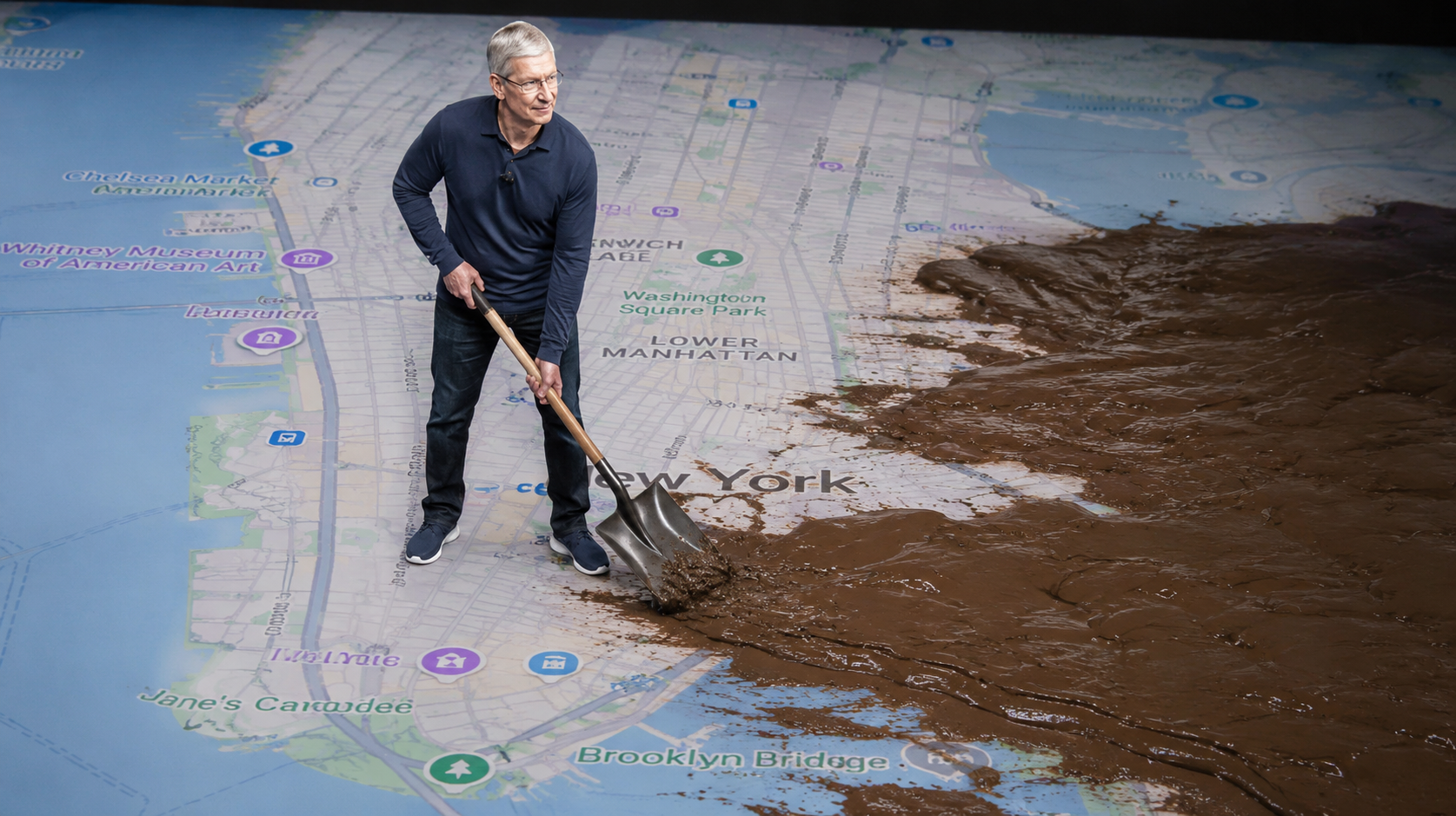
Apple, Google, and Meta are all reaching for the same lever — more ad and services revenue from every surface they control — so the pattern that actually matters isn't AI eating search traffic but ads doing it, privacy and child-safety promises bending to the P&L, and businesses paying an ever-larger toll to reach customers they used to reach for free.
Takeaways
-
It's the ads, not the AI, eating clicks. The hosts' recurring point: Near Media user-behavior research keeps showing that ads — not AI Overviews — are absorbing the clicks that once went to organic and local, as Google blurs the ad/organic line with weak labeling and richer ad units. "All of the traffic allegedly being stolen by AI Overviews is really about ads." (17:38–22:03)
-
Apple Maps ads launched with no way to turn them off. They're contextual and largely on-device rather than personalized, but there's no opt-out — Mike's complaint is that even a top-tier subscriber who'd happily pay can't buy their way out. (01:43–05:33) Independent coverage confirms there's no toggle to disable them.
-
The "$150 to start" is really a 15% credit. Setup is trivial — pick a business, add a card, 25-character promo text — and Apple seeds it with a credit worth up to ~$150/month (15% of up to $1,000 in spend). Home services, crypto, and bail bonds are excluded; personal-injury lawyers likely aren't. (06:25–09:36)
-
Apple Maps skews young and high-intent. Apple markets ~1B relevant searches, a one-in-two action rate, and 57% Gen Z/millennial users. Mike's own client data puts Apple at ~5–7% of last-touch referrals (equal to or above Facebook), and "knocking it out of the park" in hospitality, where Apple partners with Yelp, TripAdvisor, and Hotels.com. (02:01–09:35)
-
The privacy brand is the casualty. Apple built its brand on "you're not the product"; monetizing Maps quietly undercuts that, and the on-device-privacy explanation is too complex for most consumers to internalize. "Whether it undermines the reality, we don't know — but it undermines the message." (10:56–13:23)
-
Google will now charge for 20-second missed calls. Starting Oct 1, missed LSA calls during business hours become billable leads if the caller stays on the line more than 20 seconds — and this lands after Google already stopped allowing most lead disputes. The hosts read it as a straightforward money grab that makes fast, human call handling a direct cost lever. (13:31–17:38)
-
LSAs have moved into the main ad org. Google rolled Local Services Ads out of its standalone local unit and into the broader ads organization — both an income play and a tell about where local monetization is headed. (17:38–18:12)
-
"Paid search is getting bigger" means pixels, not market. Greg's read of Tom Capper's Moz piece: the growth isn't the paid-search market, it's the ad real estate — the pixel height and share of the page ads consume, which Near Media's research sees translating into a rising share of clicks. (18:12–19:40)
-
Even ad-skeptics now say "these are ads I like." Rich local ad units — photos, a map image, reviews, stars — out-inform the local pack, and users who claim to ignore sponsored listings still click them, partly because Google's block-level labeling makes ads read less like ads. (19:09–20:50)
-
Ranking now feeds on ad-driven visits, too. Mike's sharper point: through Chrome behavioral signals, a successful visit lifts organic rank no matter how the user arrived — ad, organic, or third party — so "if your whole search result is ads, you'd better predicate your ranking algorithm on ads as well as organic." (23:17–24:15)
-
Meta's $18B settlement is cheap, contingent, and admits nothing. No admission of liability; the top-line only lands if YouTube and TikTok adopt matching terms; and spread over a decade it's a rounding error against Meta's ad revenue and AI spend. "This eighteen billion doesn't mean eighteen billion." (24:15–30:55) [1] [2]
-
The shared discovery pool is the real exposure. Because the state cases were coordinated as a multidistrict litigation, depositions and documents can flow to the thousands of individual suits still pending — so the deal buys Meta out of this case and case law, but not the paper trail that will fuel the next ones. (34:36–36:11)
Related Reading
- Google Local Services Ads will charge for some missed calls starting Oct. 1 — Search Engine Land on the LSA policy.
- Apple Maps Ads Are Here, and There's No Way to Turn Them Off — MacRumors on the Apple Maps rollout.
- Meta settles social-media addiction claims with states for up to $18 billion — NBC News on the settlement; see also CNN and Time.
- "Paid Search Is Getting Bigger: How SEOs Can Respond" — Tom Capper, Moz.
- "EU wants Meta to extend US teen safety restrictions to Europe" — France24.
Concepts
- Enshittification — the predictable decay of a platform as it shifts value from users to itself; the hosts' "path of ads."
- Brand conquesting — bidding on a competitor's brand keywords so your ad appears on their name.
- Pay-per-call & lead disputes — billing per phone lead rather than per click; the long-running fight over which leads are "valid" and disputable.
- SERP real estate / pixel height — measuring ad dominance by the vertical space and share of page ads occupy, not by the count of ad units.
- Contextual vs. personalized ads — targeting from the immediate query and location versus a cross-session profile of the user.
- Product-defect ("big tobacco") theory — a liability theory that routes around Section 230 by treating the product's addictive design, not third-party content, as the defect.
- Multidistrict litigation (MDL) / shared discovery pool — coordinated federal litigation in which depositions and documents are shared across all plaintiffs, so discovery need not be re-gathered case by case.
Practitioner Notes
- Test Apple Maps now, while it's cheap and uncrowded. Geo-critical, deal-driven categories — storage, hospitality — look like the early-mover advantage, and the 15% credit funds a low-risk test. This is exactly the kind of channel question Near Media's attribution and user-behavior work is built to answer.
- Fix intake before Oct 1. The LSA missed-call change turns call answer speed and handling into a direct billing lever — the operational other half of EP 267's "you can't outspend a bad intake experience" with Gyi Tsakalakis.
- Arm clients with the "it's the ads, not the AI" counter-narrative. Near Media's user-behavior research is the evidence that ad real estate — not AI Overviews — is what's compressing organic and local; showing that to clients reframes where the lost traffic actually went, and what to do about it.
Pick your starting point:
00:00 Intro
01:43 Apple Maps ads launch
03:17 What the ads look like
05:04 Why Apple's doing it
06:25 Building an Apple Maps ad
08:35 Attribution & hospitality
10:56 The privacy brand undermined
13:31 Google's LSA missed-call charge
15:20 The history of pay-per-call
17:38 It's the ads, not the AI
19:09 Why ads now beat organic
22:03 Ranking feeds on ad visits
24:15 Meta's $18B settlement
26:55 The contingent structure
34:36 The discovery-pool problem
36:18 Upbeat albeit idiosyncratic close
Full Transcript -->
Near Media Podcast — Apple Ads, Google Ad Changes & the Meta Settlement
Hosts: Greg Sterling and Mike Blumenthal (no guests)
Corrected transcript (Master Transcript Audit applied)
Greg (00:10)
Hey everybody, welcome back to the Near Media Podcast with me, Greg Sterling, and Mike Blumenthal. Today we have no guests. We're taking a break this week after our fabulous series on building your local brand. We'll have more guests in the future, but we're just going to go old school today and talk amongst ourselves about Apple's ads launch and then the ad changes at Google — based on a couple of different pieces of information: Google's new policy around charging for LSAs, and then the expansion of Google ads on the SERP and what that means, in the larger context of Google trying to squeeze as much ad revenue out of every nook and cranny it can. And then finally we'll talk about the Meta settlement. They were in the midst of a trial that was going badly for them, sued by a bunch of attorneys general, and they made a proposal — there's a seventeen or eighteen billion dollar settlement that they arrived at, which is merely a fraction of what their potential exposure was had the case gone to a verdict against them.
Mike B (01:20)
But according to them, they did nothing wrong.
Greg (01:23)
Yes, exactly. But we'll talk about that. So, Mike — well, I have a lot of—
Mike B (01:27)
I just wanted to get it in there, that's all. All right.
Greg (01:31)
Very, very negative views of Meta, which I will probably try and restrain myself from expressing on this podcast. But we'll see. So let's talk about Apple Ads.
Mike B (01:43)
Sure. So Apple had told us that ads were coming with iOS twenty-six. They also said it would be available early-to-late summer. So it actually has rolled out in a later version of iOS and Mac twenty-six.
Greg (01:58)
And they're starting to email customers about it, right.
Mike B (02:01)
They're starting to email customers and market it aggressively. This is from their website, but it's very similar to the email they sent. Some interesting stats: over a billion relevant searches. We know from Google that they have a billion monthly active users on Google, so clearly they're several orders of magnitude less than Google Maps. Interestingly, they note a very high conversion rate — one in two searches results in a user taking some action — and they claim to have a very desirable demographic: 57% Gen Z and millennials make up map users. So those are interesting stats. We don't get a lot of stats from Apple about Maps use, although we know that in the United States — because it's not widely used on the desktop — it probably has 25% or something of total Google Maps usage. So it's nowhere near search. But I was able to discover some ads in real life, so let me just show you those real quickly. We'll call those up. Boy. We've done it. Here we are, right here.
Greg (03:15)
Where's the Jeopardy music when you need it?
Mike B (03:17)
Yes, where is it? So these ads are contextual ads, they're not personalized ads. There is some on-device analysis of location and language, which clearly could be used to identify you, and there is some on-device intelligence. They say local on-device processing may be used to select which ad to display, leveraging information about your usage, including your searches, the ads, and the content you view when you interact. So there is some on-device personalization. It doesn't appear to be global, and it's mostly contextual. So in theory it's more private than Google. But here's what an ad looks like. There are two places it shows: when you first put your cursor into the search bar, they might show up then, but typically they're going to show up on keyword searches. So this was a search I did yesterday for sporting goods in Chicago.
Greg (04:28)
This is a category search.
Mike B (04:30)
A category search in Chicago. They show first on the list and they get a highlighted map listing, obviously, which isn't even in Chicago. So, you know, I don't know — they don't have a lot of usage at this point. When you expand the list, it's clearly marked as an ad. So at this point, at least, they have not stooped to the level of Google, where they obfuscate ads from organic.
Greg (04:58)
Did they say anything about how many ads would appear in any given search result? I don't recall that.
Mike B (05:04)
I don't think they've said, but you know, the path of ads historically has been the path of enshittification, right.
Greg (05:13)
The path of enshittification — it is what it is.
Mike B (05:16)
Exactly. So that calls into question why Apple is doing this at all. I think there are many better ways for them to make money. Even if they gave me the choice — with my deluxe Apple subscription plan, I'd buy the biggest plan possible, because I need the storage, I want the TV+, all that stuff — I should be able to opt out of these ads, but they don't even provide that option. Sorry, go ahead.
Greg (05:40)
Is there any brand conquesting? I mean, I guess by definition in a category search you're conquesting, but if there's a brand search, will ads appear for a competitor? Do you know the answer to that?
Mike B (05:56)
That's a good question. I don't really know if ads will appear for a competitor.
Greg (06:03)
I mean, for example, can you bid on your competitor's brand keywords — you know, that kind of thing, which has been so historically controversial in Google.
Mike B (06:12)
Right. I don't know the answer to that, but it's fairly easy — let me just show you how easy it is to do an ad. Let me share the screen here real quickly.
Greg (06:22)
Again, if we only had the Jeopardy music.
Mike B (06:25)
There it is. So let me get over to this screen real quickly and I'll show you how this works. You pick a business, you click next. You have to have a credit card in there — this is in there, the same place where you add your brand, add your location. You can click into add an ad. Fairly trivial. They're giving people a hundred and fifty dollar budget to start with.
Greg (06:54)
And we should say, without going into a lot of detail, there are a bunch of exclusions — home services businesses and others can—
Mike B (07:02)
Well, yeah, home services, crypto, those sorts of things. I don't— well, sorry, go ahead.
Greg (07:06)
Yeah. Go ahead.
Mike B (07:10)
Well, I think personal injury lawyers can advertise. I don't think there's a restraint to that. So creating an ad is fairly trivial. Once you've entered your credit card, you give it a name. You can select some photos to upload, some promotional text — it's limited to twenty-five characters. And they then show you what the ad's going to look like; you establish a budget. And they do allow you to spend the 150 — only the credit — to see what they look like. I guess I would recommend that folks spend it and see if it generates. I'm not sure what categories would be best, but off the top of my head I would think something like storage, which is such a location-relevant decision — where geography is so critical, and where deals are so critical. And I think being early into Apple Maps might offer some advantage. I don't see it particularly in—
Greg (08:11)
What—
Mike B (08:13)
—many legal categories, for example, although a personal injury lawyer—
Greg (08:16)
Yeah, well—
Mike B (08:17)
—might be a branding exercise. I don't know.
Greg (08:19)
We don't have any visibility on the breakdown between brand or navigational search — I need to go to this particular business or this particular destination — versus business discovery, like best brunch in New York or whatever.
Mike B (08:35)
Right. They do show you individual stats on a local business if you're in Google that indicate that. And last I did the comparison of last-touch attribution — Apple versus Google — it was running five to seven percent of total. So it was equal or greater than Facebook on last-touch attribution, but I think it's much—
Greg (08:59)
You're saying overall — your overall referrals.
Mike B (09:02)
Overall referrals, but I think that in hospitality — hotels, restaurants — it is much, much higher. Because I have a few hospitality clients in Apple Maps and they are just knocking it out of the park in terms of everything from bookings to reservations, all that stuff — fairly large engagement. So I think that, to some extent, speaks to the fact that they partner with Yelp and TripAdvisor and Hotels.com for reviews and stuff. But also I think when you're traveling, when you're using maps, is when it's most likely—
Greg (09:35)
Right.
Mike B (09:36)
—to be valuable. And I think those are likely categories. I don't see it as useful in rural areas for discovery.
Greg (09:42)
Well, it contributes to the whole — searches fragmenting; different groups and different vertical contexts are using different tools to discover businesses. It's something that people should test out and determine if it's going to be effective for them.
Mike B (10:01)
Yes.
Greg (10:01)
And then more data will emerge, obviously, after that happens. But the idea that Apple is pushing — they have ads in news, they have ads on the App Store, and Maps, and I don't know if there were other properties that they were going to put ads into, but they obviously see ad revenue as a growth area, as part of their services revenue, I believe, is how they account for it. And it says to me — putting aside the efficacy for marketers or the success of ads in the App Store — it says to me that Apple is really sort of scrambling for sources of revenue that historically have been provided by hardware. Now, they obviously have a ton of revenue, and they have an event coming up where they're allegedly going to announce a foldable phone and the new iPhone, right. But I think their chief message—
Mike B (10:56)
And their phone sales have been going up by twelve to twenty percent a year. I mean, it's not like they're not generating revenue.
Greg (11:02)
—their chief message against Android has been a message of privacy protection: we don't monetize you. Their message used to be, for Facebook and Google, you're the product — they're selling you and your data. And this really fundamentally undermines that message and makes Apple—
Mike B (11:19)
It does undermine the message. Whether it undermines the reality, we don't know. But clearly they're using on-device intelligence to tailor searches for you. The real danger—
Greg (11:27)
Yeah, but the—
Mike B (11:28)
—danger is that they use that globally, right. The one point in ads' favor: look at the App Store. It's so many things, almost impossible to find things. In terms of a way of surfacing some things as opposed to others, having developers pay for that is not a crazy idea.
Greg (11:48)
No, it's—
Mike B (11:48)
I mean there's—
Greg (11:49)
It's good for marketers — it's potentially good for marketers. But I'm saying, for the consumer and for Apple's brand and public reputation, it's not as good. It's somewhat corrosive of those things, because—
Mike B (12:01)
Right. And the danger is it gets worse. That's the big danger with it, right.
Greg (12:05)
Yeah, and there's this kind of creep that happens, because if they succeed — if they're generating meaningful revenue — then we'll see more ads in more places. And—
Mike B (12:14)
Right. The other place that has ads is Apple TV. Although it's mostly ads for Apple TV, but it's still ads.
Greg (12:18)
Right. Although I don't see any ads on Apple TV. You're saying third-party ads on Apple TV?
Mike B (12:25)
No, not third-party ads — Apple ads on Apple TV. Apple TV is somewhat intrusive on your phone, where they're advertising F1 or Formula 1 races or whatever on your phone. It's like, I don't want it on my phone, you know.
Greg (12:34)
Yes. Yes. They're out there, yeah. I was thinking about third-party ads, but you're right. You're absolutely right. All right. And then they have all these tortured explanations about how their approach to targeting and privacy are different. But those—
Mike B (12:53)
Yeah, it becomes a complicated message. That's right.
Greg (12:57)
It's too complicated, and people don't internalize it. "We protect your—" like what they're doing with their AI: we've got the cloud server and the on-device processing and this and that. It's just too complex. All right, so let's—
Mike B (13:13)
It's true. The difference with AI, though, is it is encrypted, and as encrypted communications it's not visible to them or anybody else. So—
Greg (13:23)
Yes, but you're a sophisticated consumer, and most people are not.
Mike B (13:28)
That's true.
Greg (13:28)
So let's move on now to—
Mike B (13:30)
Including my children.
Greg (13:31)
—let's move on now to changes with the LSAs, and how they are trying to broaden the number of occasions for which they can charge businesses who are on the receiving end of the calls.
Mike B (13:44)
Do you have that screenshot? Why don't you just read it.
Greg (13:47)
Okay, so it says — this is under "upcoming changes to lead charge policy," went out to Local Services (LSA) customers as of October 1st this year. They're updating how and when you can be charged for leads coming from an LSA. In particular it says missed calls during business hours — and I wonder if that applies to twenty-four-seven businesses that are trying to exploit that. But anyway: missed calls during business hours will now be charged as valid leads if a user stays on the line for more than twenty seconds, with a few exceptions that are defined in other areas.
Mike B (14:25)
This speaks, first and foremost — this speaks to Gyi's point he made in the brand series: if you have bad intake, there's no—
Greg (14:33)
You're going to get screwed.
Mike B (14:34)
You're going to get screwed. It speaks to the need for quick answers, because Google is measuring it. Google is tracking you, and it's going to become increasingly— exactly.
Greg (14:43)
Well, you want to capture the lead. You're going to get charged, and you want to get that lead, and you want to talk to that potential customer. You don't want to get charged for somebody who happens to stay on the line because of your voicemail or IVR or whatever, but doesn't get through to you.
Mike B (14:59)
Exactly. That's first and foremost about this decision. It is obviously a money grab by Google. I don't know what twenty seconds means in the real world — what kind of things happen. It could be that your phone rings twice, it goes, you know, whatever — customer doesn't hang up. I don't know what it means in real life. In other words—
Greg (15:20)
Yeah, I mean it's clearly— in the most ethical version of this, Google would exclude more calls than it charges for, because there are a lot of bad calls, a lot of calls that get stuck in some IVR system or go to voicemail or whatever. And Google would give advertisers the benefit of only charging for calls that are answered. Just to zoom out a little bit: in the history of call tracking, when pay-per-call came into being as a business model — or as a billing model, which was, I don't know, fifteen years ago maybe, I don't remember precisely — everybody said, well, this is great, because you're only going to get charged for valid leads, and this is much more transparent to the business, and this is a much higher-quality lead, and so on and so forth. And what wound up happening was there were business rules, like we just described, around when the business would be charged, and people started disputing the quality of the leads — this isn't a real lead, this is my existing customer. And it got very problematic for some of these companies that were in this business — and there were several of them, it wasn't just Google. There were just a lot of customer-service issues that arose when people started questioning the quality of the lead. If I'm going to be charged ten dollars, twenty dollars, whatever the leads were — some of them were quite expensive — I really want confidence that this was a good lead, and I'm going to dispute every lead that I don't think was good. And Google has just—
Mike B (16:58)
And initially Google allowed disputes of leads, and then they decided you had— that the businesses had trained their AI well enough, they weren't going to allow disputes anymore. When was that — two years ago, eighteen months ago? They ended it, you know.
Greg (17:10)
Well, people— so there's bad-faith disputes, but there's also a lot of good-faith disputes. And a missed call, or a call that wasn't genuinely answered, is obviously not a bona fide lead for that customer — or probably not a bona fide lead, because the call wasn't received, et cetera. And Google is in a position to unilaterally impose these rules on people because it's a monopoly.
Mike B (17:38)
And this is occurring in a bigger context. Google has rolled LSA from an independent division — sort of coming out of local — into their bigger ad organization, which is a big change. And this is also an income play, but it also comes at a time when — we see in our user-behavior research that ads are what is stealing users' clicks. It isn't AI, it's ads. And I know you read that report that was on LinkedIn, from — who was it, from Tom—
Greg (18:12)
Right. So that brings up a related point, which is: Tom Capper at Moz wrote a piece called "Paid Search Is Getting Bigger: How SEOs Can Respond." On first glance, if you were to just see that headline, you would infer the market for paid search is growing — more revenue for Google, perhaps. But what he's really talking about is the height, the pixel size, the real estate that paid-search ads take up, which we have seen, as you just alluded to, in our user-behavior research. We've seen two things: the size of ads increasing in many cases — PPC ads — and the volume of clicks that are being consumed by ads growing, because of the way Google is presenting them, because of the way Google's blurring the distinction between ads and organic. Go ahead.
Mike B (19:02)
Right. Well, I was just going to say they're blurring the distinction between ads and organic with bad labeling, and they're—
Greg (19:08)
Yes.
Mike B (19:09)
—making ads more attractive than any other element in the SERP. It used to be local was the best-looking thing on the page and people would click on it. Now local packs often don't have as much information as an LSA, or even the new Google ads with local assets look better — they have photos, they have a map image, they have reviews, they have stars. And we've seen a number of cases in our research where users comment, "Gee, I didn't know— this has everything I need, this looks great. I'm not an ad user, but these are ads I like." We've seen those comments.
Greg (19:43)
Well, there is an objection — some subset of the audience, I don't know what the numbers are, that we've seen expresses skepticism: "I never click on the sponsored listings, I usually avoid them, I usually ignore them." And many of those people who have a philosophical objection to ads, as you say, are responding to them, because the ads are information-rich, their placement is higher up on the page — or they're just encountering so many ads on the page: LSAs, PPC ads, ads in the pack, another PPC pack below. And the labeling — this labeling change that Google made, wherever it was, a year ago or six, eight months ago, whenever, where you could collapse the paid listings at the top of the page, which nobody does — made those listings look more and more like organic. And the labeling was not on a per-ad basis, it was the ad group or the block, and that makes that ad label less prominent and less of an obstacle for people. They have very carefully—
Mike B (20:50)
I would contend also, though, that Google has trained users that ads are not bad. In addition to all of the deceptive things Google's doing, the other thing — maybe it's deceptive, but they've convinced more people that ads are less objectionable than they used to be, in some way. We've seen comments from people: "These people advertise, they must have more money," or "are better funded," those kinds of things.
Greg (21:12)
Well, yes. Google's refrain — this is a paraphrase, but their mantra is "ads are useful content." And there are, I will acknowledge, circumstances where, in a commercial context where you're looking for a particular item to buy, that may well be true. But what is bad is the degree to which Google has manipulated the page to drive eyeballs and clicks to ads at the expense of local, at the expense of organic content. And this is the real story. Many people have pointed it out, and we have as well: all of the traffic that was allegedly being stolen by AI Overviews is really about ads. It's really about ads taking that traffic that would have otherwise gone to organic listings.
Mike B (22:03)
Right. And just one minor example of this: we saw in our user-behavior research an example where a map pack had an ad at the top of the map pack and an ad at the bottom. So it became a five-pack — ad top and bottom, three free listings in the middle. So it's everywhere, and you know—
Greg (22:21)
And the consumer doesn't necessarily care about whether the—
Mike B (22:27)
And the algorithm doesn't care.
Greg (22:29)
Right. Google's system is trying to maximize the relevance of the ad. So the consumer may not care — the consumer may benefit. The business, however, because of Google's dominance of search, is now paying a toll for traffic that they didn't have to pay for before. Very often they're having to, to protect their own brand name, and bid — because of the conquesting that goes on, people have to buy their brand. Even a brand search may generate revenue for Google. So it's all part of Google's kind of hunger for more and more revenue — partly to fund AI, and partly to keep their stock going up. I mean, you know—
Mike B (23:17)
Right. But when I said the algorithm doesn't care, what I meant was the ranking algorithm. Google, obviously, through the use of Chrome — ads are going to generate site visits, and if the site visits are successful, where the user accomplishes the task they set out to accomplish, then that's going to help your organic rank as much as any organic listing would, in one level-abstracted way, because Chrome is watching behavior. It doesn't matter how somebody gets to your site — it could be an ad, it could be organic, it could be from a third party — but somebody gets to your site, Google sees on Chrome how long they're on your site, that the task is accomplished, and all of those contribute to your brand quality score, whatever it is that Google's tracking, and help you with ranking generally. So I guess if your whole search result is ads, you damn well better predicate your ranking algorithm on ads as well as organic, right.
Greg (24:15)
All right, so let's move to our final item here. We have tons of stuff that we talked about in the green room, some of which we're going to save. Let's talk about the Meta settlement. So there was a case involving social media — Snapchat, YouTube, TikTok, and Meta — that went to trial in Los Angeles. Snap and TikTok had settled, so they didn't go through the trial, which was a jury trial, but the jury found against YouTube and Meta, and it was a product-defect theory of liability.
Mike B (24:52)
Individual trial. It was for around an individual, right.
Greg (24:55)
For an individual, yes. There are thousands of — or maybe hundreds, not thousands necessarily, but maybe—
Mike B (24:59)
Thousands. There are thousands, yeah.
Greg (25:01)
There are thousands of cases pending. Section 230 has historically protected big tech companies against individual lawsuits based on content. So the idea is that they're totally immune against liability for any of the content that appears on their platforms, and that has been a get-out-of-jail-free card, literally, for them. But the recent innovation on the plaintiff's lawyers' side has been to use a big-tobacco theory of liability: product defect. That these products are defective, they're intentionally designed that way to be addictive and defective, they cause harm, and the companies know about it. And so this case involving Meta exclusively was happening in federal court in Northern California, in the Bay Area. And the potential exposure was basically Facebook's market cap, if everything went — and they were found liable and there were maximum damages. And they just yesterday, I believe, reached a settlement of roughly 18 billion dollars. This case was brought by state attorneys general from 29 states, I think — 34 states, okay — it was the majority of states.
Mike B (26:10)
Thirty-four states, but doesn't matter. It was a lot, yeah.
Greg (26:13)
And it was the same theory: that this was an addictive product that was defective inherently, was designed to be addictive; they ignored harms that it was actually causing, all in the name of making more revenue. And the case was going badly for Meta. It looked as though they were going to lose — because why would they settle if they were going to win? So they did settle, to avoid creating case law, and to avoid the massive damages that they could be exposed to if everything had gone against them. And they came up with this eighteen-billion-dollar settlement, which I'll briefly describe, and then we can talk about it.
Mike B (26:55)
Well, I'll describe it, because I am much more skeptical of it than you are. The settlement — this eighteen billion doesn't mean eighteen billion, right.
Greg (26:59)
Well, wait, wait. You're jumping to the editorial part of this. Let me just describe what it includes, and then you can critique it. So it's — seventeen to eighteen billion was what Facebook announced. It's contingent — Mike will describe that — and there's no admission of wrongdoing, and there's a bunch of complicated contingencies in here, which Mike is now going to talk about.
Mike B (27:26)
Well, they also put in limits — child-based limits, terms of usage, nighttime usage, a bunch of things. So eighteen billion is—
Greg (27:31)
Yes, there are going to be a bunch of protections, and they're supposedly implementing—
Mike B (27:35)
—the maximum. The minimum is eleven billion. So the way that the states get the other seven billion — first, all fifty states divide this number. So the base number of eleven billion gives a state like Alabama a hundred and seventeen million over ten years; in California, one-point-five billion.
Greg (27:55)
Yes — and this is a very important point. They're not paying it all at once, they're paying it over a decade, essentially.
Mike B (28:00)
Ten years. So a state like Alabama gets whatever — eleven million a year. Bupkis, right. Not much. So that's one issue. The other is that they only pay the whole 18 billion out if the state attorneys general manage to get YouTube and TikTok to agree to the same constraints on youth usage — verification of youth, time limits, nighttime limits, all that stuff — have to be agreed to, and YouTube and TikTok have to pay at least $2.5 billion each; then the total payout goes to $18 billion. Obviously, though, YouTube has higher teen usage than Facebook, and one would presume that the attorneys general are not going to let them off easily, and that the settlement numbers for YouTube could be equally high or higher than Facebook's — although, given that it's over ten years, it really doesn't amount to a whole lot.
Greg (28:58)
Yeah. So while this looks like a big number at first glance, and Facebook can say "we're interested in protecting kids and we're going to make these changes to blackout periods and so on," it's really cynical and disingenuous. The litigation was an existential threat to Facebook, because — I mean, there are still more suits out there, so this is not resolving all the potential litigation. This theory can be used again and again and again. But this particular suit was very threatening to them. And $18 billion paid over 10 years is not a lot of money compared to their ad revenue, and compared to the kind of money that they're throwing at AI. Their critics — presumably you included, but others — who are saying this really does not achieve a level of protection, doesn't address the harms sufficiently, doesn't address the problem with the platforms... I mean, Facebook is a bad actor. It's a corrupt company that intentionally— there's all kinds of evidence that would have also come out, this is another reason for the settlement — that they knew exactly what was going on, that their safety protocols and safety measures were really a performance more than effective tools, and that they prioritized revenue growth over child safety, knowing that there were harms happening, knowing there was harassment and bullying on the platform, knowing that there was porn and not-safe-for-work content being seen by kids. And there was a time when you could give Facebook the benefit of the doubt and believe them at their word. That time is long past. They are really a bad actor that needs to be constrained, if not punished, for their bad behavior — and this settlement does not really do that.
Mike B (30:55)
Doesn't seem to — although, if there are thousands more individual cases, it could ultimately amount to something significant. But as it stands, what we don't know is whether the safety standards implemented — strict youth safeguards including daily usage limits, expanded nighttime lockouts from 10 p.m. to 7 a.m., and robust age-assurance measures — whether those will actually work or not is unclear. The EU today—
Greg (31:24)
Well, okay—
Mike B (31:24)
—announced that they expect Facebook to implement the same safety standards in the EU, so this will theoretically become worldwide.
Greg (31:32)
Well, the EU is much less accepting of bullshit than the US is.
Mike B (31:38)
Right.
Greg (31:39)
And so they will be more dogged in their pursuit of actual changes. That's my belief.
Mike B (31:47)
And the way I look at the settlement: it was largely crafted by Facebook to minimize the competitive disadvantage that a loss would have caused, and to limit the financial obligation. But—
Greg (32:00)
Limit the impact on the product, limit the financial fallout, limit—
Mike B (32:03)
—and to prevent a competitive disadvantage. You know, if YouTube doesn't have the same obligations and teens can use it freely, then Facebook is—
Greg (32:10)
But they have the same vulnerability. They have the same legal vulnerability. They were held liable in the Los Angeles trial. They could be held liable again.
Mike B (32:15)
Perhaps more.
Greg (32:15)
What's very clear is that these platforms know exactly what's going on. They've reduced their safety teams, their red-flag teams, in the last few years — because they could, and because it was a barrier to certain kinds of revenue, ultimately; it was a cost center and a hassle for them, and they have alternatively used algorithmic systems and community notes and things like that in lieu of in-house teams. And they are very, very cynical about all of this. They protest, "We're of course interested in the health and welfare of children and vulnerable populations," but the evidence shows time and again they know the harms are happening and they do very little to address them.
Mike B (33:14)
And just one note — I looked up teen reach. Meta has a 63% teen reach, with high minor volume, high usage of those minors. And YouTube has a 92 to 95% teen reach and almost constant usage. So even this number, 18 billion, could be higher — assuming you apply the same logic and YouTube settles in the same way, which would make sense. In other words, eighteen billion over ten years, it's nothing for them, right.
Greg (33:45)
Well, so what happens if Google balks and says, you know, "we're going to slug it out in the courts and we're not going to join this settlement"? So the settlement holds, but the number goes down for Meta, and then—
Mike B (34:00)
Number goes down for Meta, and then it goes up for Google, one presumes. Although I have to—
Greg (34:04)
Well, I mean, Google—
Mike B (34:05)
—believe that the way they structured it, this was done with Google's connivance. I don't— well, awareness—
Greg (34:13)
Awareness, yeah.
Mike B (34:15)
Yes. And Google's agreement, even. This, to me, indicates that Google's ready to settle. We'll see — I'd bet you a beer on that.
Greg (34:22)
But the real question, though, is: if Google comes in and does join this settlement, what is the prophylactic effect, if any, on future litigation? I haven't looked at this closely enough to know. Because there must be—
Mike B (34:36)
It doesn't— none, because it still requires full discovery. In other words, there was no adjudication of guilt, and I think most of the findings are locked behind closed doors. So I'm not sure how much of it can be used in other trials. That's the question.
Greg (34:54)
Well, that's the really interesting question, because if there are thousands of suits in the queue lined up to advance the same theory of liability, this doesn't do them a lot of good. It helps them in this particular situation, but it doesn't protect them against future lawsuits, which will only keep coming, because this theory has already been proven successful. And they'll have to—
Mike B (35:17)
So apparently there was a fair bit of discovery gathered during this litigation, and it can be used, so — yeah.
Greg (35:23)
Yeah, there's tons of discovery. But the discovery is not public, obviously.
Mike B (35:32)
According to Gemini — I don't know if this is right — it says that much of it can be shared, because it's a multi-district—
Greg (35:38)
It is— it—
Mike B (35:40)
—litigation. It—
Greg (35:42)
So it is public.
Mike B (35:44)
It can be shared, yeah. So we'll see. The state AG lawsuits—
Greg (35:47)
It can be shielded, or cannot be shielded — shared.
Mike B (35:52)
—were part of a broader federal coordination known as a multi-district litigation, and there's a shared discovery pool for the common benefit of all plaintiffs. That means that depositions taken and documents produced during the state-level and federal investigations are accessible to attorneys representing individual teens and parents, and do not need to be duplicated.
Greg (36:11)
Okay. All right. Well, that's very bad news for them.
Mike B (36:16)
Yes.
Greg (36:18)
All right, so let's find some upbeat note to end on.
Mike B (36:22)
I have my "May the Fourth Be With You" t-shirt on. I'm both a Star Wars fan and a fan of the day, because it was the day my son was married. So I bought everybody in our family "May the Fourth Be With You" t-shirts, so on his wedding day we celebrate both Star Wars and his marriage. So — is that upbeat enough for you?
Greg (36:43)
All right, that's good. Yes, that's a good note. And somewhat eccentric, which is a bonus.
Mike B (36:48)
Well, I cannot claim normalcy in any traditional sense, you know. So—
Greg (36:56)
All right. Well, thank you, everyone, for listening once again. We're contemplating doing at least one session, if not a series, on attribution in the wake of all the changes in the market, which should be pretty interesting. And, as always, like and subscribe, tell your friends, and we'll see you next time. Yes.
Mike B (37:17)
And before we say goodbye, I would ask that if you're listening to this and you've made it this far into the podcast, and you have things that you would like us to explore with experts in the field, let us know what they are, and we'd be glad to consider adding them to the program.
Greg (37:35)
Very good. All right. See you next week.
Interested in sponsoring this podcast or our newsletters please reach out to mblumenthal@nearmedia.co