
EP 270 - The Hidden Advantage: How Brand Awareness Decides the Click in Legal Search
We end the brand-building series with Greg walking through our original research: the "Choosing a Lawyer" study of the Atlanta personal lawyer market. Survey data, ad-creative testing, and a user-testing combine to show how prior brand awareness steers online behavior and the final hire.


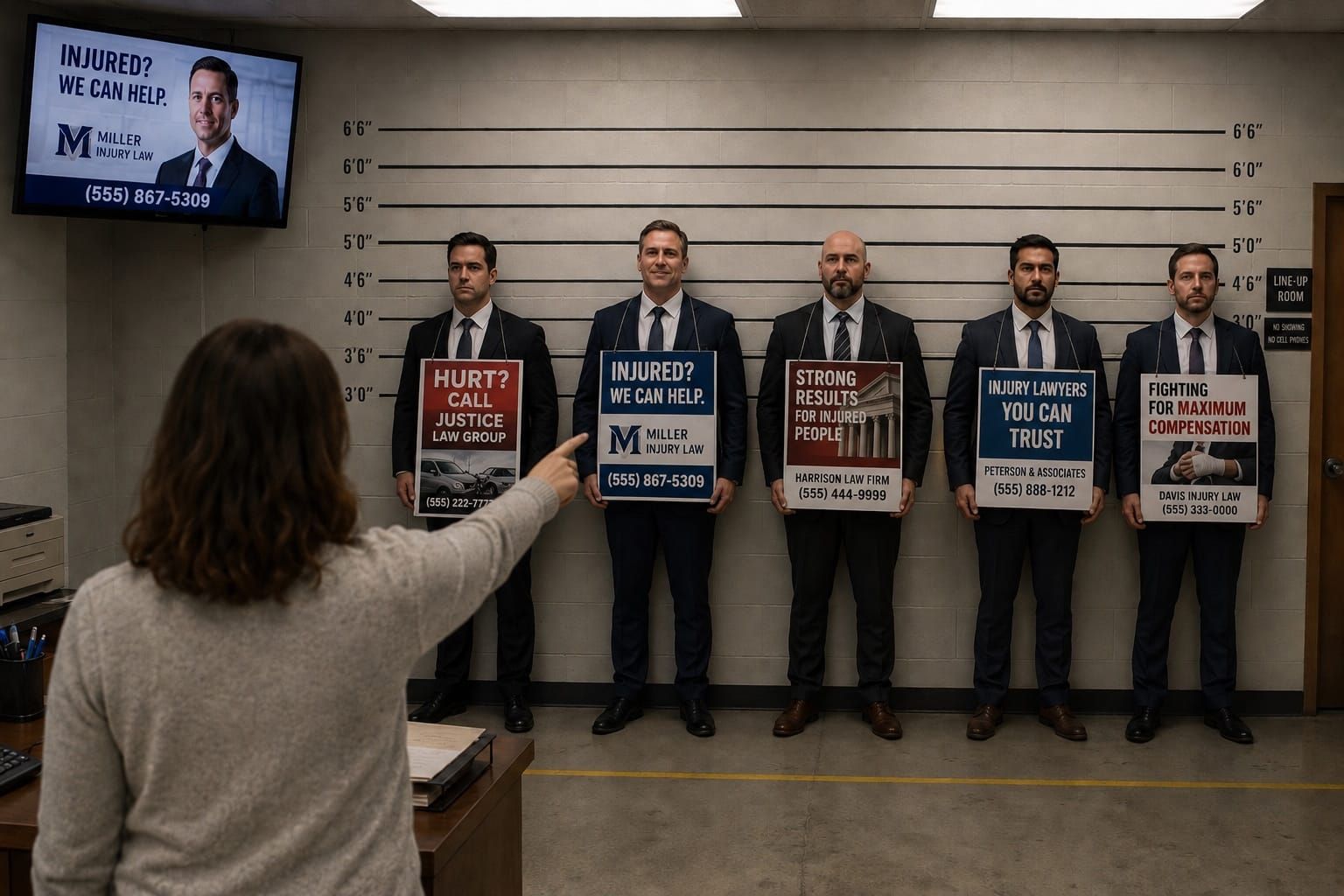
Sample User Behavior Research Result
Brand awareness is a pre-existing advantage that decides which lawyer gets the click long before anyone compares options — so as search fragments across Google, AI Overviews, and third-party sites, the firm people already recognize keeps winning, and a challenger's only real lever is creative strong enough to close the recognition gap.
Takeaways
-
Recognition, not position, drives the click. In the user-testing video the searcher skipped the local pack, fixated on the Local Service Ads, and zeroed in on the one firm she already knew — Montlick. She then used the firm's BBB page (not accredited, but an A+ rating) only to confirm a choice prior awareness had already made. (~03:30–05:30)
-
Fewer than 2% go to AI first to find a lawyer. Near Media's 2025 national survey found under 2% would turn first to a tool like ChatGPT; Google is the default entry point. AI's real job is background research — understanding the case, prepping consultation questions, comparing options — not sourcing the firm. The 2026 number ticked up but the pattern held. (~09:00–10:00)
-
People will still consider an AI-surfaced firm. Majorities said they're open to hiring a lawyer they saw in an AI Overview or AI mode (roughly 78% would consider one), and ~18% would use AI somewhere in the process — so brand presence in AI matters even while direct referrals sit at 1–2%. (~10:30)
-
Two things decide the hire: proven experience and fear of cost. Ranked decision factors collapse into experience with my kind of case and the financial terms (contingency, free consult). Both are really one thing — minimizing risk and buying trust in a high-stakes, hard-to-judge purchase. (~15:30)
-
"We support the community" is a tiebreaker, not a closer. Respondents say local involvement matters, but in the message test "we support the community" ranked at the bottom of what would actually make them contact a firm — a nice-to-have, not persuasive on its own. It's the classic survey-attitude-vs-observed-behavior gap Near Media keeps finding. (~17:00)
-
TV built the awareness — not digital. Asked where they'd heard of the firms, respondents overwhelmingly said television; traditional media (TV, radio, outdoor, street furniture) far outpaced digital as the source of brand awareness, with ~55% recalling brands from TV. Greg flags this as unusually strong in legal, where firms spend on traditional media at a scale doctors and restaurants don't. (~20:00)
-
Known brands get the "local" benefit of the doubt. Four of the five firms are Georgia-based; the one that isn't — Morgan & Morgan, headquartered in Florida — was most often assumed to be the Georgia firm, purely because it's the most recognized. Awareness overrides fact. (~21:00)
-
Great creative can close a 20-point awareness gap. Montlick trailed Morgan by ~21 points on awareness, yet its ad scored ~10 points higher and lifted Montlick to near-parity on consideration. "If you have powerful messaging, good creative, you can close the gap with a better-known rival as a challenger." (~22:00–25:00)
-
…but forced to pick one, people revert to the best-known firm. At the final single-choice question, Morgan won on brand strength (~38% chose the best-known brand). Strong creative narrows the gap; brand strength still closes the sale. Everyone gets business — brand decides who gets the largest share. (~25:00)
-
When brand is absent, reviews are the single biggest factor. Greg's clearest answer to Mike: if you must name one lever that moves behavior, it's reviews. Not everyone carries brand awareness, and undifferentiated searchers "lean on and rely on" reviews to both qualify and disqualify. (31:24–33:04)
-
Brand and performance marketing are interdependent, not rival budget lines. The either/or framing — all-in on performance, brand is soft and unmeasurable — is the mistake. Brand lifts performance, and both Google and AI favor brands because consumers click brands and Google reads that behavior as signal. (~26:00)
-
Offline demand routes back through Google as branded search. Mike's "full circle," echoing Cyrus Shepard: community and offline activity build awareness that shows up as branded queries, and branded-search demand itself lifts rank — so cheap, local, real-world work compounds online. (35:22–36:03)
Related Reading
-
EP 269 — Tactics for Building a Local Brand in the Age of AI Search (Agency Panel) — Part 4; the panel (French, Hawkins, Shotland, McGee) that name-checks the very Atlanta PI study Greg presents here.
-
EP 268 — AI Overviews, Brand Search & Local SEO: Cyrus Shepard on Earning the Click — why brand search correlates with rankings.
-
EP 267 — You Can't Outspend a Bad Intake Experience: Brand-Building for Legal — the legal-vertical deep dive with Gyi Tsakalakis; the conversion side of the brand front door.
-
EP 266 — Cyrus Shepard: What Local Brand Actually Means to Google and AI — the technical, brand-as-entity view behind "Google and AI favor brands."
-
EP 265 — Decoding Local Branding with John Jantsch — Part 1; "you have a brand whether you build one or not."
-
Lunch Hour Legal Marketing Summit — the Nashville event (run by AttorneySync and Mockingbird Marketing) where Greg first gave this talk.
-
Impact of Brand Awareness on Consumer Choice Presentation (PDF)
Concepts
- Unaided vs. aided awareness — open-box recall ("name a PI firm") versus recognition from a supplied list. Both produced the same firm hierarchy; aided simply lifts the totals.
- Benefit-of-the-doubt effect — a recognized brand is assumed to have attributes it may not have (e.g., being a local Georgia firm), because familiarity substitutes for knowledge.
- Qualify vs. disqualify — reviews, websites, and BBB pages used on the front end to build a shortlist and on the back end to eliminate a tentative choice.
- The say-do gap — the divergence between survey-stated attitudes ("community involvement matters") and observed behavior (it rarely closes the deal); why Near Media pairs surveys with user testing.
- Brand–performance interdependence — treating brand and performance marketing as mutually reinforcing rather than competing line items; brand lowers the cost and lifts the yield of performance spend.
- Local Service Ads (LSAs) — Google's pay-per-lead units atop local results, styled nicer than the local pack (photos, reviews, Google Screened badge); the module that repeatedly captures attention, especially on mobile.
Practitioner Notes
- The user-testing video is the proof layer surveys can't provide. The say-do gap and the discover-in-AI/validate-on-Google pattern both argue for Near Media's user-research methodology — watching a real searcher move from LSAs to website to BBB is what exposes behavior a survey would miss, and it's a differentiated deliverable for firms drowning in attribution noise.
- Ad-creative testing is a shippable service, not just a study. Montlick's ~10-point creative lift over a far-better-known rival is measurable, market-sourced feedback — exactly the "we use the market to give feedback to our clients" offer Greg describes, and a way to de-risk media spend before a firm commits to it.
- This episode is the front door; EP 267 is the conversion. Brand awareness wins the click and reviews carry the undifferentiated searcher — but "you can't outspend a bad intake experience." The awareness findings here only pay off if the intake and review engine behind them holds.
Pick your starting point:
00:00 A different episode: original brand research
02:30 The video: how one searcher chose a lawyer
04:00 Debrief: LSAs, recognition, the BBB check
06:30 The SERP changed — ads crowd out organic
09:00 Under 2% start with AI — where AI fits
11:30 The study: 350 respondents in Atlanta
15:30 What matters most: experience and cost
18:30 Brand awareness: unaided vs. aided
20:00 TV builds the awareness, not digital
22:00 Ad-creative testing: Montlick tops Morgan
25:00 Creative closes the gap — brand wins the pick
26:00 Brand and performance are interdependent
31:24 When brand is absent, reviews decide
33:19 Would the findings hold elsewhere?
35:22 Full circle: demand drives rank
36:47 Wrap and next week (EP 271)
Full Transcript -->
EP 270 — Choosing a Lawyer: Search, AI, and the Hidden Power of Brand
Near Media Podcast · Greg Sterling & Mike Blumenthal
Editor's note: This is a cleaned reading version. Stutters, false starts, and clear transcription errors were removed; backchannel ("yeah," "right") was folded into the speaker's turn; and brand/name errors were corrected (see the Corrections list at the end). Wording is otherwise left faithful to what was said. Speaker-side factual asides are left as spoken and noted at the end rather than rewritten. Timestamps inside Greg's opening presentation are approximate, because Riverside logged the monologue as a single turn.
Greg (00:15)
Hey everybody, welcome back to the Near Media Podcast. It's me, Greg Sterling, with Mike Blumenthal. Today we're going to do something a little different. We've been running this series on brand — building a local brand. What does it mean, from a technical standpoint and from an operational standpoint? Last week I was at Lunch Hour Legal Marketing, a legal marketing conference in Nashville run by our partners, AttorneySync and Mockingbird Marketing, and I gave this presentation, which I'm about to give — to give some context about how people choose lawyers.
What's really interesting for our purposes today is the way it illustrates how brand and prior awareness impact online behavior and ultimate decision-making. This is something that's largely hidden, and many marketers are not fully conscious of it, or at least not aware of how powerful the impact is. We've seen this in much of our user-behavior research.
So I'm going to take you through these slides. It's a slightly altered version of the presentation — I've taken out a couple of slides — but basically the one I gave. There's also a video that sets up the whole thing, which we'll watch. It's only a couple of minutes, but it's really powerful, and it also shows the kind of user research we do, so you get a little taste of that. Okay, so: "Choosing a Lawyer: Search, AI, and the Hidden Power of Brand." This should only be about twenty-eight minutes, and then Mike and I are going to have a conversation.
We'll lead off with this illustration of the user-behavior research we do. It's just a couple of minutes, and it's going to set up the rest of the deck.
Okay — what's very interesting about that video, and it's relatively short (I chose it to present because there are a number of things going on that we see again and again in much longer user-testing cases). She did her search. She was instructed to search for a lawyer; we didn't give her the keyword, she chose her own. She hit the page and immediately focused on the LSAs. She really didn't even look at the pack. She scrolled down the page in a very cursory way and concentrated all her attention on the LSAs. The ones that got her attention were ones she'd heard of, and there was one of the two — Montlick — that had a stronger brand in her mind. That's the one she focused on.
What was also interesting is that she looked at one of the LSAs and the rating was good — a 5.0 — but there weren't enough reviews. So she disqualified that attorney because he didn't have enough reviews compared to some of the other competitors. Then, after looking at the LSA profile — the GBP — she clicked through to their website. For people who don't think websites matter: there are a lot of people still clicking through and looking at websites, not to qualify, but to potentially disqualify. She's got her tentative choice, and now she's looking for supporting information — verifying that they're a good firm. Then she goes off to the BBB site looking for further validation. They're not accredited, which concerns her — she says so — but she sees an A+ rating, and that comforts her. And she then decides this is the firm she's going to go with.
So that's a very concentrated version of what happens frequently. What it illustrates is that people are not hitting that page cold — in most cases. In some cases they are, but in many cases they're not. If there's some prior brand awareness, some familiarity, that is the thing that guides people to the click, or often to the choice, which is what happened here.
Just to give a little context before we get into the survey data and ad-creative testing: for years, people really focused on Google and the Google ecosystem, which was very stable. You could get traffic with organic links, and ads were not essential. That's all changed. Two things are happening on Google. Organic is being crowded out by ads and by different Google modules that are sucking up attention, as you saw with LSAs in that video. And there's a lot of fragmentation — people go to many different sites, apps, and tools to understand their choices and then make decisions. It's almost never the case that people rely exclusively on Google. She didn't — she went to the BBB. So you've got to deal with this fragmenting market, where Google is a critical piece but not the only influence on behavior.
The SERP has really changed over the years, as everybody listening or watching knows. The page now is just full of ads. This is a typical page: LSAs, then a traditional PPC ad — sometimes multiple ads in that slot — then some organic directory listings, a Reddit pack, the local pack (which is invariably below the fold these days, with an ad, and we've even seen two ads), then a couple more organic links, and another PPC pack after that. You've got very few slots to get attention. LSAs are very compelling because of all the information they contain.
In our research — and many people have validated this — when people generate longer queries, you get AI Overviews, often leading to AI mode these days. Here's a query somebody might ask in a legal situation: "I slipped and hurt myself, should I contact a lawyer?" What you see above the fold is an AI Overview, but it goes directly into AI mode. People have been debating for two years how influential AI is on consumer decision-making. In 2025, in our national survey, we found that less than 2% would turn first to an AI tool like ChatGPT to find a lawyer. The first place they go is typically Google. In 2026 that increased, but it hides a more complicated story: the way people use AI is for background research — to understand their case, or whether they should contact a lawyer. It's increasingly part of the mix.
We asked people whether they'd consider hiring a lawyer they saw in AI Overviews, and the same for AI mode. People are pretty open to it — the majority seem open to considering lawyers that appear there. So you can't dismiss AI. It's not the first place people go, but it's filtering into the mix, back to that fragmentation point.
So we asked 350 respondents in the Atlanta metro area 39 questions about how they'd go about choosing a lawyer, and we also showed them ad creative. We asked: if you need to find a personal injury lawyer, what tools or channels would you use? Google is number one, word of mouth is number two, but AI is in the mix — 18% would use AI as part of the process. A review site (probably also Google) and, interestingly, traditional media rank pretty high — that's people drawing on memory and familiarity from exposure through traditional media.
Then we asked: if you had only one tool or resource to choose a lawyer, what would it be? Of course it's Google — it's perceived to be the most complete, and in a local context that's true. We asked how they might use an AI tool when looking for a personal injury lawyer — not whether, but how. This was an aided-response question. About 24% wouldn't use AI at all in the process, but the majority would look at a lawyer's qualifications, prepare questions for a consultation, understand the financial terms, compare lawyers, and do background research. A smaller number would go to AI for contact information — but typically, even after doing AI research, people transfer over to Google for that last-mile data.
We asked what matters most — rank the decision factors in choosing a lawyer. On the right you see the hierarchy: general experience and credentials, experience with similar cases, understanding fees, reputation (which is reviews), contingency fee, and free consultation. Basically two categories: experience — especially with the kind of case I have — and financial issues. People want confidence that the lawyer knows what they're doing and will likely generate a favorable outcome, a settlement or a victory at trial. And they want to know it won't cost them money to talk to a lawyer. Both are really about minimizing risk and building trust.
We asked how important it was for a firm to be based in Georgia — not specifically Atlanta — versus being headquartered in another state with a local office. The majority said it's extremely or somewhat important. Then we asked: if a firm had a track record of giving back — community work, charitable contributions — how much would that impact your decision? Something similar: fewer in the highest category, but combined, a majority said it would have some influence.
Here's the interesting thing. We do both surveys and user testing, and we often see discrepancies. In surveys, people express attitudes and respond to hypotheticals from memory; in user testing, we give them concrete situations and watch what they actually do. In this survey we said: which of these messages would make you most likely to contact a lawyer? At the bottom of the choices was "we support the community." People like the idea of local lawyers and community involvement, but when push comes to shove it's not persuasive — it's a tiebreaker at best, not as impactful as the earlier slides suggested.
Now the brand-awareness stuff, which is the whole point. We picked five prominent firms in the Atlanta metro — no client relationships here, purely based on visibility and prominence. We asked: when you think of a personal injury firm or an accident lawyer, does anybody come to mind? Open comment box, no suggested names. The top three far outpaced the others. Then we followed up: do you know any of these firms? — and suggested the ones we'd chosen. The hierarchy was the same. The unaided and aided awareness questions show the same hierarchy; aided just means more people recognize the firms once suggested. So Morgan was number one, Montlick number two, and so on — consistent.
We asked where they'd heard about the firms. TV was overwhelmingly the answer. A lot of lawyers do TV, outdoor ads, radio, street furniture, and so on — but what's interesting is that traditional media far outpaced digital as the source of brand awareness. This may be somewhat unique to legal, because you don't have doctors, restaurants, or other categories making the same investment in traditional media. Traditional media still has a powerful influence on awareness, which in turn translates into clicks and choices online.
Then we asked which of these firms is based in Georgia. In fact, four of the five are based in Georgia, and three of the five are based in Atlanta. The only one not based in Georgia is Morgan & Morgan, which is based in Florida. What this shows is that people give the firms they're aware of the benefit of the doubt. Morgan — not a Georgia firm — came out number one, correlated directly to brand awareness. The firms people assume are Georgia-based are the same firms they're familiar with.
Now the ad creative. We took five video ads — TV ads — randomized them, and showed all 350 respondents the ads in different sequences, so there was no first- or last-position bias. Those are 30-second commercials. We asked three questions: What's the first thing that came to mind? Would you contact this firm based on the ad, on a scale of 1 to 100? And which adjectives — some positive, some negative — do you associate with the ad? Presenting from lowest to highest: the first one was Morgan & Morgan, the most well-known firm, which ranked the lowest — its ad was rated the lowest, which is interesting. Then John Foy, then Monge, then Gary Martin Hays, and then Montlick. Montlick was the number-two firm in familiarity, but its ad scored the highest — quite a bit higher than the Morgan ad, about 10 points higher. We did an overall sentiment analysis and combined it with the other data. Montlick is the winner and Morgan is the loser, basically — even though Morgan is the most prominent firm in awareness.
Then we showed them some PPC ads. We did two things: we showed the PPC ads before asking about awareness — which ad would you click on, with no context? — then exposed them to the firm names and showed the ads again. What this shows is that the brand hierarchy holds: the ads people said they'd click on are in the same order as the firms they're most aware of. Morgan wins, Montlick number two, John Foy, and so on — with the one exception of the Montlick ad outperforming the others. Brand creates a strong advantage going in. Many marketers assume a search is a level playing field. It's absolutely not.
We asked, based on everything you've seen, which top two firms would you consider? It's Morgan and Montlick — and the interesting thing is that the Montlick ad brought them way up, basically to parity with Morgan, which had about 20 points higher awareness. Montlick's ad elevated them to roughly equal consideration. The lesson: with powerful messaging and good creative, a challenger can close the gap with a better-known rival. But when we asked them to pick only one, it wound up being Morgan. Each of these firms gets business, but Morgan — based on brand strength — captured the largest share. Montlick came up quite a bit; that ad really helped them, and the gap is largely closed. Everybody's getting business, but brand is really driving these choices.
So what does the research tell us? The customer journey involves many touchpoints; it's fragmented — people hear this again and again, it's almost a cliché. AI is part of the process in most verticals now. It's not necessarily the starting or ending point, not necessarily the biggest influence, but it's there, showing up in Google AI Overviews and increasingly as Google pushes people into AI mode. Consumers are looking for trust and competence, and to reduce risk in this legal context — with reputation, experience evaluation, and messaging about fees. Reviews can qualify or disqualify: people look at reviews on the front end to qualify (especially when they can't differentiate) and on the back end to disqualify. "This is the one I'm inclined to choose — uh-oh, there's a bad experience here" — that may disqualify somebody.
Brand creates an advantage going in. TV and traditional media are powerful influences on brand awareness in this legal context, and that translates into online behavior. Strong brands get the benefit of the doubt, as you saw with people assuming Morgan was a Georgia firm even though it wasn't. Creative really matters in some contexts, and can boost the visibility and favorability of your brand — you can close the gap to some degree with great creative. But when people have to choose one, they often choose the most familiar firm. It's the same with any consumer choice; brand is a powerful draw. That's why people choose Google in many cases.
Brand and performance marketing here are interdependent. People often juxtapose them or see them as mutually exclusive — "we have a budget, we have to put all our money in performance; brand is a long-term proposition, hard to measure." But brand really matters, and it helps performance marketing perform better. AI also favors brands; Google favors brands, because consumers click on brands and Google takes behavioral signals into account. So brand really matters.
I'd encourage you to go back and look at other episodes in this series, because we talk about how to build your brand in a guerrilla fashion, from the ground up. Brand isn't just TV. As I said to the audience in Nashville, I don't want people to take away that brand is the only thing that matters, or that brand is just TV advertising — it's not. It's the sum total of everything. TV can be a powerful influence on awareness in certain contexts, but there are lots of ways to build a brand, and all the things local SEOs have talked about for years are part of that process.
Mike B (27:12)
Thanks — that was great, appreciate it. One of the things you mentioned was that LSAs garnered a great deal of attention, both in the example you provided and in our user research. What do you ascribe that to — position, content, or something else?
Greg (27:32)
Well, it's everything, right? It's position and content. LSAs look like the local pack — they've got pictures, reviews, messages on there. They're often…
Mike B (27:41)
Calls to action.
Greg (27:42)
Right, exactly. And the messages are often pretty generic — you only have a few attributes you can use in LSAs. But the combination of that imagery, the reviews, and the position on the page is extremely powerful, especially for people who don't have anything else to fall back on. Somebody who hits that page without a familiar brand, without any prior awareness, is going to look at those reviews. They may scroll, they may look at the local pack, but we've seen in our research that when LSAs are present — especially on mobile — they grab a lot of attention, even among people who are ad skeptics.
Mike B (28:18)
So you talked about this desire for locality as an expression of need, but not manifested in actions — and we see something similar in our user behavior. Do you think that opens up an opportunity for some sort of collective or individual anti-Morgan positioning, or anti-Morgan ads, in the local market?
Greg (28:39)
I think so. We've worked with firms that do a version of that. You need to include it as one of your messages among several. If you just say "we're the local law firm," that's probably not enough to get you over the hump. But if you include it as one of several considerations — we're successful, we're going to treat you right, we're local, we know the community, we've been here a long time — that's very appealing. People are looking at the totality of information to make the choice that minimizes their risk and exposure. It's a huge choice — one of the highest-consideration choices you can make, along with medical and healthcare. People are really trying to find somebody they can trust, who's going to be successful, who's not going to cost them money. It's a mix of factors.
Mike B (29:34)
So I was thinking — you're talking in a positive way, highlighting smaller practices' positive local attributes. I'm thinking about seven lawyers getting together, billboarding contrary to Morgan & Morgan: Morgan & Morgan isn't local, Morgan & Morgan sponsors the Braves but they're really from Florida, or they're not even certified. I'm wondering if a more overtly negative campaign against Morgan & Morgan might reduce their brand strength.
Greg (30:03)
Well, it works to some degree in politics, so it could work in this context, I suppose. I'm not an advertising expert on what creative is going to be most effective — one of the things we're doing in our program is surveys and user-behavior testing to see how people actually operate in a particular context, plus brand-awareness and ad-creative testing. So we're getting a sense of what works in each situation, but we're not ad-creative experts at this point. We're using the market to give feedback to our clients. I can't tell you for sure that going directly at Morgan would be particularly effective. It might be…
Mike B (30:50)
It would be expensive, because Morgan advertises so much, but it might set expectations more realistically. I have another —
Greg (30:58)
But you need something else too — not just negative.
Mike B (31:02)
Right. So we see brand in the attitudinal stuff — the surveys you did, where brand plays an outsized role. In our user behavior, do you see it playing as much of a role as other factors — as much as reviews, or messaging around pricing? Is it comparable, or do you see it as less important in our user-behavior research?
Greg (31:24)
I think if you have to point to one factor that drives behavior, it's got to be reviews — that's what we consistently see. Because not everybody has brand awareness. In this particular slide deck and video, the woman was aware of a couple of brands, and that was a heavy influence on her decision-making. When people do have prior awareness of a firm or multiple firms, that's a big influence on what they click on and ultimately choose. But that's not true in all cases. I don't want to skew the takeaways and say people always know brands and always pick them — they don't. People do come in and struggle because they don't know a brand or a law firm, and they're struggling to differentiate or to make a choice. That's where reviews are a big, big factor. They're probably the single most influential consideration people lean on and rely on.
Mike B (32:24)
You asked a question in the survey — if you needed a lawyer, where would you go first? Was that aided or unaided? And if it was aided, do you think an unaided question would generate the same answer?
Greg (32:31)
It was aided. But I think people would name Google. Yeah, people would name Google.
Mike B (32:40)
More than they would name a friend, a colleague, or a professional?
Greg (32:43)
It might be the case that word of mouth would win in an unaided-response scenario — "how would you find a lawyer?" with a blank box. They might say "I'd ask a friend or colleague." That might come out slightly ahead, because it's obviously a factor in a lot of people's decisions — referrals and so on. But I think Google is the winner if you say "where's the one tool, where would you go?" It's the default — the thing people are most familiar with. Twenty-plus years of Googling things has created a pretty deep groove.
Mike B (33:19)
So let's wrap this up. If you were to run this in three other cities, which of these findings do you think would definitely hold up?
Greg (33:32)
It would be interesting. This was a particularly strong example of brand awareness — I don't know the history of these lawyers, but the woman in the video said she'd been hearing about Montlick for years. So these firms have probably been advertising aggressively for a long time and created a high degree of awareness. In that kind of market, you see this brand lift, this brand effect. In other markets, maybe not. In more competitive or bigger markets — New York, LA, Chicago — maybe you wouldn't see quite as strong a brand effect, or maybe you would; there might be a dominant firm or set of dominant firms. The takeaway is that you have to look at the larger context: when people are struggling to make decisions, brand is a trust signal. If they have some awareness of a product or service and a positive association with it, that helps drive clicks and choices.
This is also something we talked about in our panel and in previous sessions — these things work together. For years, people have done link building offline because they want links to help them rank in Google. But one of the primary reasons to be involved in the community is to create awareness that then translates into the online choices and clicks we saw here. I think this is a stronger case than you might see in other verticals, because of the way lawyers — and PI lawyers in particular — operate, but the principle still holds. Offline and online work together. Invest in the community, because that helps build awareness — and those are things you can do on the cheap, versus buying TV ads.
Mike B (35:22)
And as Cyrus pointed out, demand at Google drives rank. So it's a full circle: not only will an open-ended query improve awareness and choice, but if you have people going to Google and entering your brand, it increases your rank. It's a full-circle sort of thing.
Greg (35:41)
That's right.
Mike B (35:44)
One last question. We did this series on brand, which I've totally enjoyed, with some great people — Gyi, and Andrew Shotland, and Joy. So when you came into this series, has your opinion of brand changed?
Greg (36:02)
Well, it's not totally fair, because I'm using the legal research we're doing as another input. But I'd probably say yes. The SEO world has largely ignored offline historically. Everybody has treated Google as a level playing field, where the tips and tricks everybody does will help you rank, and rank by itself will drive choice. My understanding now of what's really going on is a lot more complicated than it was before. What I've learned in this brand series has made my understanding of user behavior much richer — and also tactics. It's been a great learning experience for me, and hopefully for our audience as well.
Mike B (36:47)
With that, I want to thank everybody for joining us. Like the video, follow us on YouTube, listen to our podcast, and come to our website, where you'll find a full transcript and related links. We hope to see you next week — for some episode number, I don't remember what. So, 271.
Greg (37:01)
Two seventy-one, two seventy-one.
Mike B (37:03)
Next week. Thank you very much for joining us. We'll talk to you again.
Greg (37:06)
Right.
Corrections
Fixed (transcription / brand errors):
- Grammar/verb repairs: "it also shows," "how influential is AI," "the customer journey involves," "being headquartered in another state," "have often juxtaposed."
- High-volume stutters, doubled words, and false starts removed for readability; backchannel folded into turns.
Left as spoken (speaker-side — for show-notes footnotes, not silently rewritten):
- Mike's aside that "Morgan & Morgan sponsors the Braves." Morgan & Morgan runs heavy sports and venue marketing, but the Atlanta Braves' official jersey-patch sponsor is QUIKRETE. The point is rhetorical (a Florida firm buying local presence), so it's left as said.
- "Gyi" (Gyi Tsakalakis, AttorneySync) and "Joy" (Joy Hawkins, Sterling Sky) are named in the wrap; spellings corrected but attributions left as spoken.
Interested in sponsoring this podcast or our newsletters please reach out to mblumenthal@nearmedia.co