
EP 261 - A Deep Dive Into Google Maps Lists, Local Gems, and the Impact on Restaurant Discovery with Craig Burton
Google Maps is rolling out dynamic lists using Gemini AI curation. These new lists features point towards local rankings dictated by unstructured user-generated context, real-world foot traffic, credit card transaction data, and Local Guides & 3rd party mentions rather than simple profile updates.


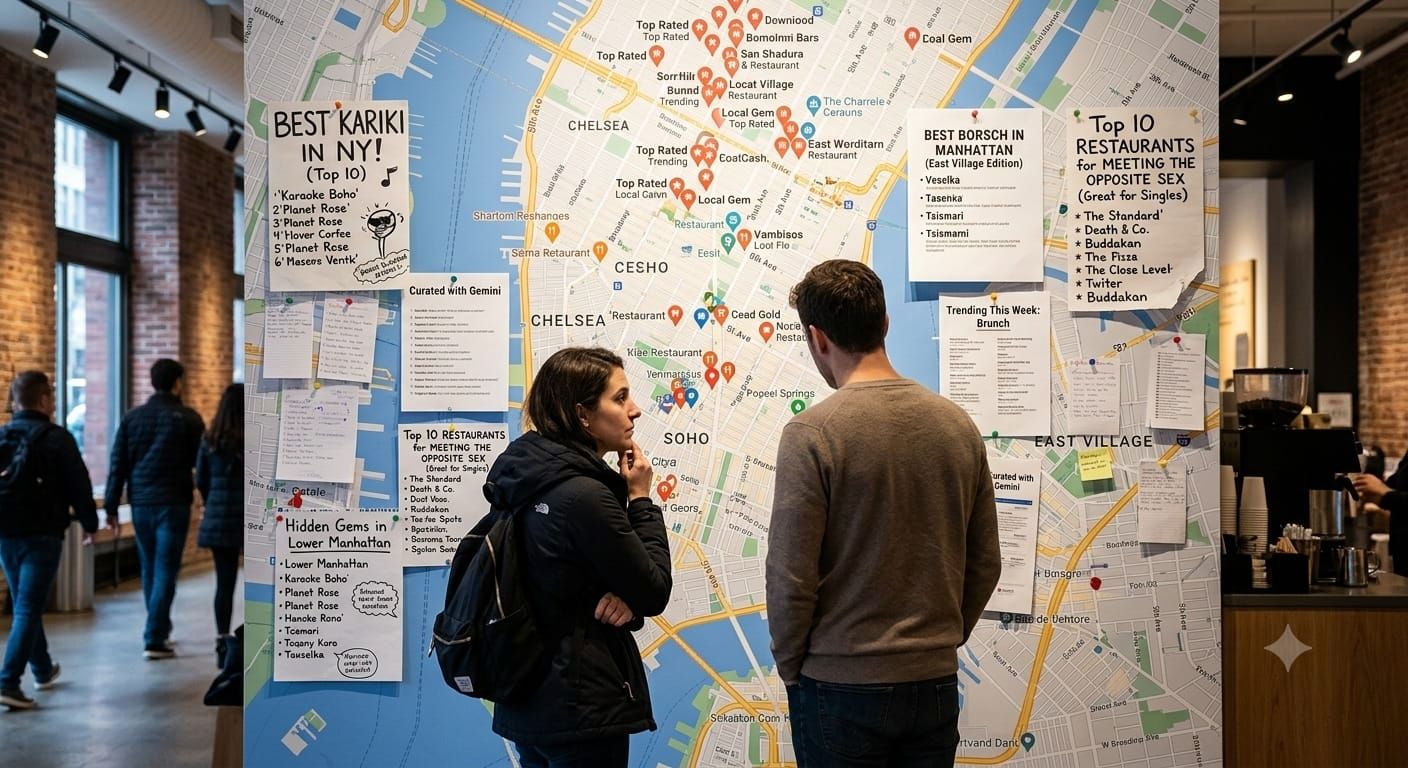
In this episode, local search practitioner Craig Burton joins the team to unpack his discovery of these shifting, algorithmically driven layers within the mobile Google Maps layout. He explains how these updates track real-world user interactions and sentiment patterns rather than static business profiles, providing a critical operational blueprint for marketers who must now transition to an "Evidence Optimization" framework to keep their locations visible.
The Podcast Deets
Segment 1: The Google Maps Discovery Overhaul (00:10 – 16:00)
The team breaks down the structural differences between Google’s primary local ranking layers: Top Lists (historic standbys), Local Gems (emerging year-over-year favorites), and Trending (highly immediate weekly behavioral spikes). They demonstrate how these are augmented by dynamic "Curated with Gemini" query filters that vertically stack faceted recommendations directly on mobile viewports.
Segment 2: Decoding "Evidence Optimization" (16:01 – 33:24)
This section explores the algorithmic inputs that populate these visibility frameworks. The conversation details how Google is shifting past static Google Business Profiles to analyze comprehensive digital evidence—such as natural language sentiment frequencies in local guide text, external editorial authority validations, brand query velocity, mapped real-world location tracking, and aggregated payment provider datasets.
Segment 3: Tactical Playbooks for Small and Enterprise Brands (33:25 – End)
The participants outline actionable strategies for local practitioners navigating these algorithmic updates. They focus on identifying brand coverage gaps, building hyper-localized digital PR footprints, cultivating authentic user-generated imagery, and managing decentralized profile structures for regional storefront networks.
Key Takeaways
- The Death of Static Tuning: Simply completing a Google Business Profile is no longer sufficient; visibility requires active external confirmation across multiple web platforms.
- Three Layers of Algorithmic Curation: Real-time visibility on Maps is stratified into long-term mainstays, annual local gems, and high-frequency weekly trending spikes.
- The Rise of Gemini Facets: Traditional horizontal menus are giving way to AI-sorted vertical carousels that guide users through conversational subcategories.
- Unstructured Signals Drive Ranks: Frequency of specific sentiment keywords (e.g., "atmosphere"), high-level local guide photos, and offline transaction records are critical local ranking inputs.
👇 Watch by topic:
• 00:00 - Introduction: Proliferation of Lists on Google Maps
• 01:51 - Special Guest Craig Burton & Local SEO in Southeast Asia
• 02:40 - The Tyre Plus Case Study: Instant Corporate Branding Permissions on Maps
• 05:11 - Discovering the Google Maps List Hack & Dynamic Patterns
• 07:15 - Live Screen Share Demo: Breaking Down Top Lists, Local Gems, and Trending Spots
• 09:48 - Curated Publisher Networks vs. Organic Local Guide Curation
• 11:22 - The "Curated with Gemini" Faceted Search Overhaul
• 14:17 - UX Design Concerns: The Infinite Scroll & Product Defect Litigation
• 15:38 - Live Testing the Depth of the Gemini "Rabbit Hole"
• 15:59 - Passive Location Discovery & Real-Time Event Integration
• 17:05 - Monetization & Embedded Sponsored Ads in Curation Lists
• 19:27 - Algorithmic Testing: How Google Runs Hundreds of Daily SERP Experiments
• 20:38 - Review Sentiment Analysis: The Power of Specific Keyword Association
• 21:51 - Why Traditional Home Services Categories Are Excluded From Current Lists
• 24:01 - Influencer Curation Partnerships: The Google Dua Lipa Promotion
• 25:59 - Ask Maps vs. Traditional Local SERPs: The Probabilistic Challenge for SEOs
• 29:19 - Decoding Ranking Factors: Review Velocity, Footfall, and Aggregated Payment Data
• 31:36 - The Shift from Search intent to Automated Curation Systems
• 32:56 - Unpacking "Evidence Optimization": Managing Signals Across the Web
• 34:05 - Execution Strategy: Conducting Audits and Identifying Messaging Gaps
• 36:26 - Expanded Best Practices: Digital PR, Review Diversification, and Brand Velocity
• 38:31 - The Franchise Penalty: Why Multi-Location Brands Struggle on Curation Maps
• 41:35 - Future Horizons: Expansion into Hospitality, Hotels, and Real-World Digital Twins
• 42:54 - Maps as Google's Free Data Asset vs. The Complexity of the Interface
• 45:07 - The New Gemini Business Manager Architecture & Closing Remarks
Related Links
 Craig Burton
 Michael B. Snow
 Andrew Duchi
 Mike Blumenthal
Interested in sponsoring this podcast or our newsletters please reach out to mblumenthal@nearmedia.co
Full Transcript -->
Near Memo Episode 261: The Google Maps Lists Disruption
Here is the consolidated, publication-ready transcript. Spoken stutters, conversational filler, and repetitive sentence fragments have been polished out while preserving the exact technical insights, terminology, and natural tone of the speakers.
Near Memo Episode 261: The Google Maps Lists Disruption
Greg: Hey everybody, here we are again, episode 261 of the Near Memo. Today we are joined by Craig Burton from the Greater Bangkok metropolitan area in Thailand, and of course, the effervescent Mike Blumenthal, as always, is here with me. We are here today in our ongoing quest to discover how to deal with all the changes that Google is implementing.
Craig Burton: Yeah.
Greg: And they seem to just keep coming and coming, which is exciting and also kind of exhausting in a certain way. Today we're going to be talking about lists. Craig discovered a bunch of new lists, or rather the intensification of a list strategy that Google has been implementing around Maps, and we are going to be unpacking that today. It's pretty interesting, and it points to a number of things that Google is trying to do with Maps. We'll talk through that and what the implications are for marketers. So welcome, Craig. That was kind of a lengthy introduction, but welcome. How are you doing this evening from Bangkok, Thailand?
Craig Burton: Hello. Yeah, very good. Thank you. Very honored to be here. Everything's good. It's the opposite time of day for us, isn't it? You're in the morning, and I'm heading to bed.
Greg: And Mike is somewhere in between.
Mike B: I mean, it's still ten-thirty here, but it's still early morning from my point of view.
Craig Burton: All right.
Greg: So Craig, just give us a little bit of context about what you do and what your focus is, and then we can jump into the conversation.
Craig Burton: Okay. Well, as you mentioned, I live in Thailand, but I'm originally from the UK. If you can tell by my accent, I've been here for about 20 years. I've got a sales and marketing background, but I fully transferred over into digital marketing about 15 years ago with a focus on local SEO. I've been through various agencies and run different agencies, but the highlight of my career was serving as the head of the digital platform for Michelin in Southeast Asia, where we really pushed and did well with local SEO for the Tyre Plus brand. At the moment now—
Mike B: Could I interrupt real quickly? Do you mind telling the story about the permissions you were given as a local SEO in that context? I think our listeners would find it fascinating.
Craig Burton: Okay, yeah. One of the major things that we did when originally setting up for Tyre Plus is that a lot of the businesses are very old legacy, mom-and-pop type businesses. Their business profiles were on Maps historically from way back when Google used to add them automatically. A lot of them had these really old, long names, and one of the first things that we wanted to do was clean up the naming convention. We had lots of trouble trying to speak to the dealers directly because a lot of them didn't speak English. Then, one of our contacts in France got Google to give me a personal email address that I could do anything on Maps with. I could literally edit anybody's.
Mike B: So you were authorized to change the names to the corporate branding that you wanted for these independent businesses? So Joe's Trading Company became Joe's Michelin Tire store or Michelin Tire?
Craig Burton: Yeah, overnight. Every store became "Tyre Plus" followed by the location. Michelin themselves are not a tire seller; they're a manufacturer. They do all their selling through networks, the main one being Tyre Plus.
Mike B: I see. So it used the Michelin branding, and you were individually allowed to go in and change all these names—
Craig Burton: To all these locations that had never spoken to me and had no idea who I was. They just woke up with an optimized page.
Greg: How did they react to that? You just did that without informing them, I assume.
Craig Burton: No, this didn't happen overnight. It was after many, many months of trying and failing to get through directly. We would have key account managers go see the dealers and try to explain it to them, but it was just taking too long. A lot of the dealers came on board and were very happy about it. Some of the dealers, not so much, because they wanted their mom-and-pop shop name that they'd had for 50 years, you know?
But I've got the evidence: over the whole network in Malaysia, they saw a 45% visibility increase across the network in one month just by changing their name. It turned individual locations into an authority overnight. All these individual places instantly became the same entity.
Mike B: Thank you for that story.
Greg: So let's talk about why we're here today. You wrote a blog post that Darren Shaw commented on on LinkedIn. There was a discussion about it, I saw it that way, and I thought it was very interesting and that we should talk about it in more detail. Tell us about your discovery and what lists you were unearthing here as a broad matter, and then we'll show a demo of what those look like.
Craig Burton: Okay. Well, it stemmed from my envy of not having Ask Maps yet. I tried to recreate it using a Google demo, and when I started seeing the locations, I randomly found the hack that Mike is going to show us where you could generate or have these lists appear. I think most people didn't realize that the key is you have to save them, because a lot of them appear and disappear. Some appear at certain times of day; some are very random. But when you start collecting them, you start seeing patterns. It was an initial surprise to me because I'd never seen them and didn't know what they were. When I was messaging people, I was getting the same response back—nobody knew what they were.
Greg: What kinds of queries were you using to generate them, just out of curiosity?
Craig Burton: I was testing backwards. When I found the lists, I couldn't understand why certain restaurants were on there. Some made no normal sense under what we would say was an optimized profile, or they didn't have a great website or whatever. But the key was that it was mainly down to user-generated content (UGC) review quality and how recent the reviews were, plus a lot of other things that we're probably going to go into a little bit later on. I saw the list first and then wanted to reverse-engineer why it was showing them.
Greg: Okay. Mike is going to take us through a demo that's going to produce a number of these lists.
Mike B: As Craig pointed out, you scroll to the area you're interested in—in this case, Lower Manhattan. Below it, Google typically shows trending results. They show different types of results, but the top category is "Trending on Maps". Do you want to talk about that, Craig?
Craig Burton: Yeah, I'll give you the official definitions for the main three types of lists from GoogleCraig Burton: Yeah, I'll give you the official definitions for the main three types of lists from Google. First, you have the Top List, which features area mainstays with the most all-time interest in the Maps community—best for a spot that's tried and trueTop List. Next are Local Gems, which are emerging favorites in the Maps community from the past year, best for dining like a localLocal Gems. Then you have Trending, which highlights places gaining attention in the Maps community this week, best for discovering the latest hotspotTrending.
The other three categories are based on my own definitions: publisher lists, brand and editorial lists, and individual creator listsThe other three categories are based on my own definitions: publisher lists, brand and editorial lists, and individual creator lists.
Greg: So you were just reading Google's official statements for those first three.
Craig Burton: Yes, the first three are Google's. The publisher, brand, and individual lists are my definitions.
Mike B: Just a little bit of history: Google has always rewarded popular places on Maps. In fact, there was a marketing effort back in 2009 where they'd send out a little sticker if your business was searched frequently. So this is a long-standing concept. They are now surfacing them visually, a trend that really started in late 2024. I believe the "Trending" lists are driven by review quantities during a very recent period. For the "Top List" mainstays, it's calculated over a longer window, combining reviews with driving directions, repeat interactions, and baseline foot traffic.
Greg: Well, they have all that visitation data. The busyness graph is entirely based on Android foot traffic.
Mike B: Right, and what they can pull from iPhone users via non-consensual tracking. Do you want to show the curated lists here? These come from either well-known publishing resources like The New York Times, or from Local Guides who are specialists in reviewing certain types of food and create their own listsThe New York Times. For example, this one is from a Local Guide who has a top New York pizza list. But then we go to the "25 Best Restaurants in New York," which is a curated list from The Infatuation, an online restaurant review platformThe Infatuation.
Then there's the "Lower Manhattan Local Gems," which looks like a public curated list with 15 results. As Craig pointed out, what shows up can feel sort of random. In this specific layout, the long, detailed description written by the business owner actually shows up. But Google always shows you the citations indicating which curated list the business is mentioned on.
Craig Burton: Nine times out of ten, you'll find a quite strong citation from a reputable source that does regular restaurant reviews.
Greg: So Craig, you identified six types of lists, but then there are also Gemini-curated lists. Mike, are you able to generate that?
Mike B: Yeah, I believe I can get there if I clear this search. Google doesn't do a great job of surfacing it easily. If I search for "dinner Manhattan", we get a couple of sponsored results, and then several well-known restaurants like Gramercy Tavern.
Craig Burton: And look at what you're seeing here—it's user reviews being quoted in the snippet, not publisher citations.
Mike B: Right, these are reviews being quoted. Interestingly, some of these locations don't even have that many reviews; Gramercy Tavern has over 4,900, whereas The Landing only has 279. But as you scroll down past another ad, you come to the "Curated with Gemini" lists. These are essentially faceted views of a fairly high-level query. For "dinners," it breaks it down into subcategories like dinners with rooftop views, Broadway bites, Greenwich Village eats, Lower East Side dining, Upper West Side dining, and Brooklyn's Best. It's a number of faceted subcategory lists.
Greg: These are sort of quasi-"People Also Ask" or "People Also Search For" kinds of lists.
Mike B: Yes. They look very similar to the AI-organized categories we saw in organic search in late 2024. When you typed "cocktails in Manhattan," it would generate carousels organized horizontally. Here, they're organized vertically, which is much more phone-facing. But the technology looks very similar.
Greg: Click on "Brooklyn's Best" and let's see what that page looks like. Are we going to get an AI-organized page?
Mike B: No, you're getting a standard result layout: two ads and then a number of listings. But then as you scroll down, you get yet another "Curated with Gemini" list layer. Now it's offering brunch in Brooklyn, pizza joints in Brooklyn, waterfront dining, neighborhood bars, and street food.
Greg: It's turtles all the way down. They can do it endlessly, presumably.
Mike B: They can, which is one of the points I made in our green room. While this serves to satisfy typical user queries and faceted searches, it also serves Google by creating an endless array of possible interactions.
Craig Burton: It's the infinite scroll, isn't it?
Mike B: It is the infinite scroll down the rabbit hole simultaneously. Poor Alice; she has an iPhone in her hand as she's falling down—
Greg: It kind of is. The interesting thing about the infinite scroll, just to digress for a moment, is the ongoing litigation strategy in the United States where plaintiffs are trying to hold platforms liable for product design. They've moved from attacking the content—which is granted immunity in the US—to a product defect litigation strategy, similar to what was used against Big Tobacco. They argue there is something inherently addictive or defective about the feature. The infinite scroll was recently flagged in a Los Angeles, California trial as a feature intentionally designed to keep people addicted to their own detriment, and there are federal court cases coming up using the same theory. So the infinite scroll has been legally tagged as a product defect, at least preliminarily, in the US.
Mike B: In Google's defense here, while you were talking, I was experimenting with the app. I found that this specific rabbit hole is actually only three clicks deep. We went from dinners to Brooklyn, to Brooklyn's best, to Brooklyn happy hours, and that was the end of it. So it isn't completely endless.
Greg: Okay, so my point is totally moot!
Craig Burton: No, but there is another list type that pops up depending on the time of day, and that relates to local events happening. If you are mapping out a daily itinerary via Ask Maps, it will add lists for events in the area. You could say, "I want to go have dinner, then go to a park, and then go for a coffee," and it will pull up those different placesYou could say, "I want to go have dinner, then go to a park, and then go for a coffee," and it will pull up those different places. I've seen lists of just local events happening, though I haven't been able to save one yet.
Greg: Maps has historically been a search-based interface where you put in a query, got a result, and made a decision based on that. These lists seem to be much more about passive discovery. Why do you think Google is doing that? Is it because it's genuinely helpful, or is there something else going on?
Craig Burton: From a user's point of view, I think they are genuinely helpful. I've personally discovered some really great restaurants in my area that I would never have heard of otherwise. But to speculate on the ulterior motive, at the end of the day, Google is going to monetize it. I've already seen curated lists with embedded sponsored results, so even these layouts are getting hijacked for ad inventory.
Greg: So it's more ad inventory, in one sense. I'm not entirely cynical about Google; I do think some of the folks internally are genuinely trying to create a better user experience or leverage AI productively. But there is always a companion, largely unacknowledged motivation around monetization. This simply creates more opportunities to show ads and drive clicks.
The curious thing to me is that I am a big fan of lists because they expedite decision-making. In a way, that's what people are trying to achieve with AI and Ask Maps: give me a short, relevant list of choices so I can decide quickly without scrolling or executing endless searches. So there is a lot of value there. However, some lists are much more prominent than others. The "Local Vibe" carousel Mike showed has highly visible cards as you scroll up, but other elements are buried ten levels deep. Why do you think some of these formats are easily discovered while others remain hidden?
Craig Burton: That's a difficult one, and at the moment, it's mostly speculation. I'm not going to pretend we've cracked any hidden codes. In the few weeks since I wrote that initial blog post, so much has happened in local search and it's moving so quickly that it's hard to tell what the final direction is.
Years ago, there used to be quotes about how many hundreds of experiments Google runs in search results per day globally. People always fixate on the massive core algorithm updates, but Google is constantly testing variations every day. I think they are trying to be helpful to the end user, but it also carries whiffs of the old Google+ strategy of trying to be more social. They've made these lists much easier to share compared to the old My Maps feature. It's too early to say what the definitive endpoint is, but from a user perspective, it's a good feature.
Greg: Let's talk about where the data comes from behind the scenes to build these lists. Some are dynamic, and some are static. Mike, feel free to weigh in on this as well.
Mike B: Sure. I think we need to break the lists out by category. Craig, speak to the "Trending" lists first and how you think those are generated.
Craig Burton: The "Trending" lists are probably the easiest example to explain. They always seem to rely on review commentary specifically mentioning the "atmosphere". Every single time, you will see very good reviews where the word "atmosphere" appears repeatedly. The reviews aren't necessarily from elite-level users, but the Local Guides are usually a couple of levels up and known for consistent reviews. So my jumping-to-conclusion factor is that specific sentiment keywords are a heavy trigger.
Greg: And to clarify, we are talking exclusively about restaurants here.
Craig Burton: It's all food and beverage restaurants at the moment. These all fall under what I classify as the "foodie drop".
Greg: That's an important distinction. These lists are not currently extending into home services or more utilitarian business categories.
Mike B: Right, you aren't seeing a "Top 25 Most Crooked Roofers in Houston" list.
Greg: You know, Yahoo is doing some interesting things with AI lists in local search, and they actually do extend it to home services. Similarly, Yelp has algorithmically generated "Top 10" lists for virtually every category they operate, and those have started appearing in various AI contexts like ChatGPT. If you need a plumber, getting a quick, vetted list of the five best plumbers in your area is incredibly useful. But right now, Google seems to be limiting this to restaurants and probably hotels.
Craig Burton: Hospitality and accommodation would be the next logical step.
Mike B: To summarize on "Trending," from my point of view, it's a short-term view of highly active locations getting sudden spikes in foot traffic or review velocity, with the reviews expressing very specific sentiments. The "Top List" mainstays use a similar calculation but over a much longer haul—steady brand searches, steady driving directions, and positive reviews over the course of a year or moreThe "Top List" mainstays use a similar calculation but over a much longer haul—steady brand searches, steady driving directions, and positive reviews over the course of a year or more. Craig, do you want to speak to some of the other variations, like the influencer lists?
Craig Burton: Yes, one of the prominent examples we discussed in the green room was a list curated by a major celebrity influencer. Google actually published a co-branded blog post promoting her specific travel listsGoogle actually published a co-branded blog post promoting her specific travel lists.
Greg: You're talking about Dua Lipa?
Craig Burton: Yes, she's based in the UK and has lists all over the place, including America. It surprised me because she isn't a traditional food blogger, but Google is clearly leveraging her star power to build mass user awareness for the list feature itself. Even so, these lists remain hidden in the standard interface. Some only appear contextually based on the time of day, like "Lunchtime Picks" or "Evening Options," and you can't manually save themSome only appear contextually based on the time of day, like "Lunchtime Picks" or "Evening Options," and you can't manually save them.
Mike B: The "Gemini Gems" are also incredibly buried. In the dinner search I ran, they were hidden 10 or 12 results deep. Because these Gemini-curated lists are essentially AI-informed search results, Google is likely running a quiet user interaction test without highlighting them prominently.
The underlying problem with Maps right now is the utter complexity of the interface. When we were trying to coordinate in the green room, it was difficult to even communicate where certain features were located or how to surface them.
Craig Burton: Exactly. But isn't their ultimate goal to move us away from using a visual interface entirely? They want us to eventually just talk to the system.
Mike B: Who knows what they want, besides advertising revenue.
Greg: In my opinion, the best AI experience Google currently offers is Ask Maps, precisely because it is so simple. You have a massive degree of control; you can type a descriptive, 40-word query, and it responds directly to your specific intent. In contrast, this massive influx of list components makes the standard Maps interface feel incredibly cluttered—it's almost analogous to Microsoft Excel. Most everyday users are only going to utilize the very top layer of functionality because the density of information hidden 16 levels deep is something they will never discover. Google could simplify this dramatically.
Mike B: To demonstrate your point, I just entered an Ask Maps query: "trending restaurants in Manhattan that have been open a short time, show on a number of lists, and are located in Chelsea.""trending restaurants in Manhattan that have been open a short time, show on a number of lists, and are located in Chelsea." The system immediately pinpointed ten highly specific locations across Chelsea, putting it all together in a much cleaner, quicker list without a single adThe system immediately pinpointed ten highly specific locations across Chelsea, putting it all together in a much cleaner, quicker list without a single ad. I agree completely that it's a vastly superior interface.
Craig Burton: But here is the major gap: are those the same restaurants you would see if you ran a traditional organic search? In my testing, they are not, and that is the scary part for local SEOs.
Mike B: Let's check. If I search for a standard "Indian restaurant in Chelsea," the results are completely different. Granted, my Ask Maps query specifically requested newly opened places, but the specific venue featured in the AI answer doesn't even show up under the "Curated with Gemini" section in standard searchGranted, my Ask Maps query specifically requested newly opened places, but the specific venue featured in the AI answer doesn't even show up under the "Curated with Gemini" section in standard search. It's a completely different answer. This demonstrates that Ask Maps is highly probabilistic and personalized, whereas traditional map results are more deterministic.
Greg: Let's get into the tactical side of this. What are the core ranking factors driving these list placements, and what should marketers be doing? Reviews are clearly central, but what else is influencing this?
Craig Burton: Google explicitly states that a massive portion of this is driven by user-generated content—what real people are saying across reviews, posts, and photos. Because of this, I am actively advising clients to focus less on traditional review volume and focus more on getting customers to upload geotagged photos and videos when they visit.
Greg: What about external data material, like editorial content, social media, or blog posts? To what degree are those factoring in?
Craig Burton: We aren't seeing direct inputs from platforms like YouTube, TikTok, or Reddit showing up in these list extractions yet, even though they represent a ton of local talking points.
Greg: Except those external social signals are occasionally starting to surface directly on Google Business Profiles now.
Mike B: They are just starting to integrate that data.
Craig Burton: It's the next logical step for SEO in general. Google is analyzing every consumer touchpoint to compile aggregate evidence on a business location.
Mike B: I would also suggest that brand query velocity plays a massive historic and current role. Real-world busyness metrics, driving direction requests, and even point-of-sale data influence this; I recall reading that Google actively purchases aggregated credit card transaction data to verify actual consumer purchase volume at specific locations.
Greg: They've had credit card data from major providers like MasterCard for a long time. Historically, Google Maps has been a highly transactional utility used for two primary queries: direct brand lookups or generic "category near me" searches. Ask Maps and these curated lists broaden the consumer use cases dramatically.
Tactically, there is a lot of new advice regarding how to manage a Google Business Profile. It's no longer a "set it and forget it" task; it has to be treated as a living, breathing asset. Craig, you've used the term "Evidence Optimization" to describe this shift over traditional optimization"Evidence Optimization". Can you elaborate on that?
Craig Burton: Traditionally, an agency would optimize a business profile, schedule regular posts, and set up a basic review acquisition strategy. But Evidence Optimization introduces an entirely separate layer: managing the digital proof behind the answersbehind. Google is looking far beyond your official profile to gather external validation to answer complex user queries. Marketers must perform audits to uncover structural gaps in their outward digital footprint—not just on their profile, but deep within customer reviews, Q&As, and third-party mentions.
Greg: How exactly do you identify those messaging gaps?
Craig Burton: Start with a rigorous self-audit. If you are a restaurant owner, look at the local lists appearing in your market and evaluate why your competitors are featured instead of you. More often than not, you'll find you are missing specific sentiment keywords in your reviews, your review frequency has dropped, or you lack citations in the local lifestyle publications Google uses as trusted sources. This is going to turn digital PR and localized blog outreach into a major necessity for local businesses. The absolute key is that people have to be talking about your brand consistently across the webThe absolute key is that people have to be talking about your brand consistently across the web.
Greg: There's a major debate right now over whether AI optimization is its own distinct discipline or merely an extension of core SEO. We don't need to rehash that entire argument here, but current recommendations span review diversification, digital PR, and earning authoritative editorial mentions. If an agency executes good local SEO alongside these expanded best practices, does that naturally cover them for these hidden lists, or do they need to build specific tactics targeted directly at lists?
Craig Burton: At ground level, the harsh reality is that the vast majority of local businesses still aren't doing anything with their business profiles.
Greg: Right, a huge percentage of local listings remain completely unclaimed.
Craig Burton: Exactly. So for most businesses, I advise starting with the foundational basics: claim and optimize your profile, fill out every single data field, and proactively ask customers for detailed reviews. But if you are an agency operating at a higher level with a proper budget, your roadmap absolutely must include local digital PR and deliberate outreach to get your clients named in prominent regional lifestyle lists.
Greg: One quick point we neglected to cover is multi-location brands and franchises. In our current restaurant context, major corporate chains are visibly absent from these algorithmic curation lists. What should a multi-location brand think about in this environment?
Craig Burton: Honestly, I wouldn't sweat it too much. I am seeing zero franchise penetration in these specific lists. My advice for multi-location brands remains consistent: you have to look past corporate headquarters and actively educate your individual store managers. Real, high-quality, authentic evidence and content always bubble up directly from the local store level, not from a detached marketing agency or corporate HQ.
Greg: In this framework, nobody expects McDonald's to make its way onto a "Local Gems" list, because people searching for McDonald's perform direct, transactional brand lookups. The entities that will really suffer here are the smaller, mid-market multi-location brands that lack massive household name recognition. A brand like Shake Shack is a place a discriminating burger eater might go, but if they aren't top-of-mind or visible on an automated "Top List," they lose out on discovery because they don't command the raw baseline search volume of a McDonald's.
As we wrap up, let's look at the future. Google has an array of fragmented interfaces: traditional search, Maps, Ask Maps, AI Overviews, and GeminiGoogle has an array of fragmented interfaces: traditional search, Maps, Ask Maps, AI Overviews, and Gemini. What is the future of these lists, and are we going to see them integrated across Google's alternative surfaces?
Craig Burton: The natural trajectory is an expansion into hospitality, hotels, and travel accommodation. They are testing exclusively with restaurants right now, but hospitality is the next logical step.
Greg: Should marketers be treating this as a high priority because it's going to expand into major AI overviews, or is it too early?
Craig Burton: Time will tell, but right now I'd caution against shiny object syndrome. Focus heavily on the basics. There is a lot of buzzwords in the industry right now, but ultimately, it's still SEOThere is a lot of buzzwords in the industry right now, but ultimately, it's still SEO. Framing it differently can be useful to open up new lines of revenue with corporate clients, but fundamentally, the core discipline hasn't changed.
Greg: Most of our audience would probably agree with that sentiment. Mike, any final thoughts?
Mike B: I've always viewed Google Maps as a fascinating, sort of also-ran product to core Google Search. Restaurants generate massive query volume but represents a relatively low-volume ad ecosystem for Google. Consequently, Google treats Maps as a massive data accumulation point rather than a pure income driver. I can only hope that the conversational Ask Maps engine eventually consolidates this absolute clutter of menus, tabs, chiclets, and drop-down carousels into a clean, dynamic discovery environment that is actually easy to useI can only hope that the conversational Ask Maps engine eventually consolidates this absolute clutter of menus, tabs, chiclets, and drop-down carousels into a clean, dynamic discovery environment that is actually easy to use.
Craig Burton: You have to look at how incredibly generous Google has been to Maps users and Local Guides for years. Think about the massive, unfathomable volumes of proprietary training data we hand over to them completely for free every single day in the form of geotagged photos, food reviews, and videos. If they are trying to build an AI digital twin of the real world, the community is building it for them.
Mike B: Absolutely, it's a massive competitive advantage for Google, and local data is critically important. I just want them to service it more cleanly, and Ask Maps is a step in that direction.
Greg: From a pure consumer standpoint, the single best AI product experience Google offers today is Ask Maps. The quality is exceptionally high, and while they can still clean up the UI, it's an instance where AI genuinely makes the underlying product useful. Go ahead, Craig.
Craig Burton: Let's see what happens now that they've introduced Gemini directly into the Business Profile manager app. I haven't received the update yet, but it's going to be significant for business owners and agenciesI haven't received the update yet, but it's going to be significant for business owners and agencies.
Mike B: To be slightly crude, it looks to me like an AI circle jerk. You have Gemini operating as the basic information resource, Gemini divulging the information to consumers, and Gemini writing the updates for the business owners. It's a completely synthetic, circular ecosystem, so we'll see how it plays out.
Craig Burton: We are living in a simulation!
Greg: On that conspiratorial note, we will conclude today's discussion. Craig Burton, thanks so much for joining us. This is an incredibly exciting time to be in local SEO, and everything is changing so fast that it's tough to stay on top of it all. Thanks to everybody for listening. Remember to tell your friends, like, and subscribe. Have a great rest of your week.