
EP 262 - The $300 Billion Review Fraud Problem (And How the FTC is Fighting It)
Former FTC attorney Michael Atleson reveals the high stakes of review fraud, platform accountability under Section 230, and the new wave of product liability lawsuits reshaping AI law.


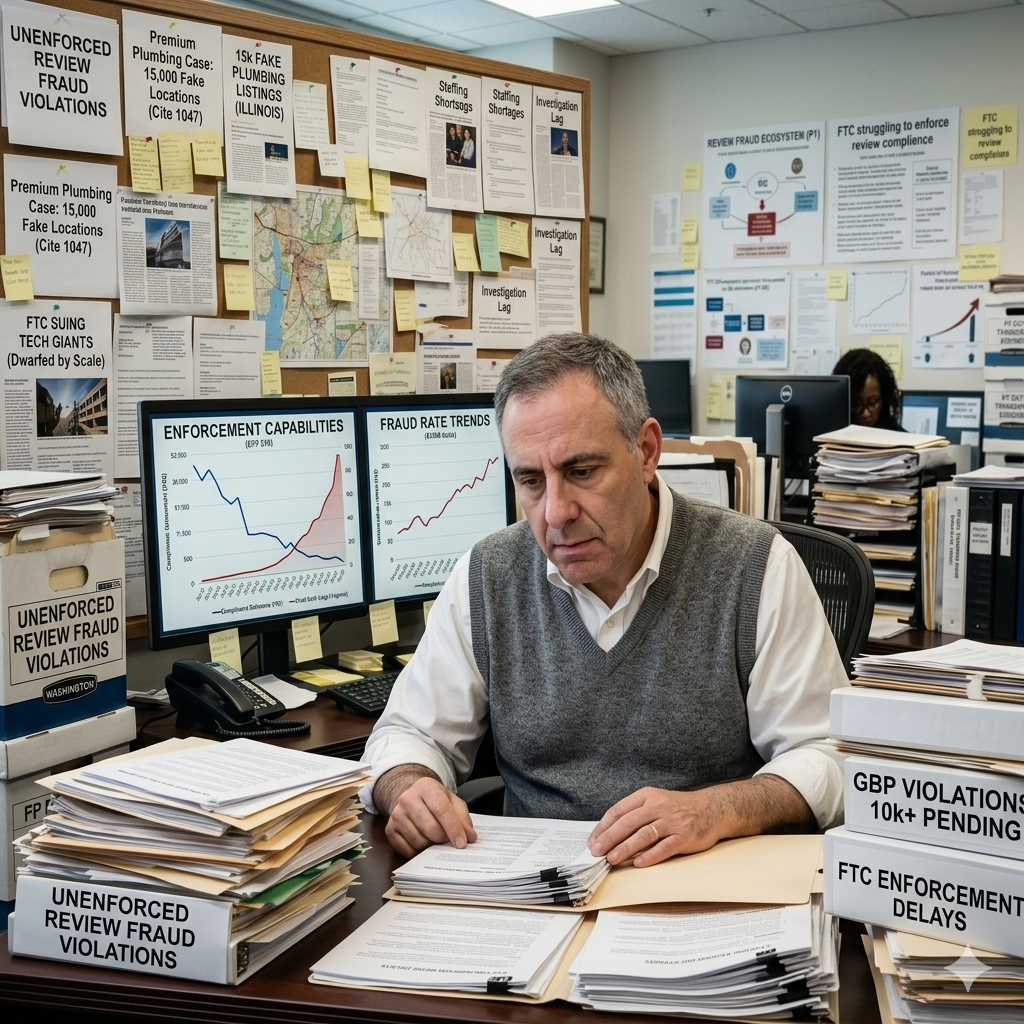
In this deep-dive interview on the NearMemo podcast, hosts Greg Sterling and Mike Blumenthal discuss the growing ecosystem of digital deception with former FTC Senior Attorney Michael Atleson. The conversation explores the systemic flaws of platform moderation, the structural power of the FTC’s Consumer Review Rule to issue civil penalties, and the evolution of tech litigation. From the multi-million dollar Premium Plumbing fake location ring to landmark private and state lawsuits testing product liability theories against generative AI models, Atleson maps out the complex regulatory realities and explains why state-level enforcement is rapidly outpacing federal action.
The Podcast Deets
- Segment 1: The Consumer Review Rule & FTC Enforcement Framework (00:10 – 18:08)
Michael Atleson details his two decades at the FTC, focusing on his work shaping the Consumer Review Rule to close consumer redress loopholes and institute civil penalties. He breaks down how targets are prioritized based on the severity of life impact (such as legal and housing services over restaurants) and explains why Section 230 isolates tech platforms from direct liability despite architectural flaws in their review networks. - Segment 2: The Scale of Review Fraud, Fake Locations, and Economic Harm (18:09 – 34:47)
The conversation expands to international policy, examining Europe's Digital Services Act and the unintended side effects of strict German libel laws that trigger automatic review takedowns. The segment evaluates the massive Premium Plumbing local services scam, the use of metadata analysis to detect fraud, and economic metrics placing the societal impact of review manipulation at $300 billion annually across core industries. - Segment 3: The Intersection of AI, Innovation, and Modern Product Liability (34:48 – 49:12)
Focusing on artificial intelligence, Atleson outlines the regulatory history of the AI review assistant Writer (RYTR)and how its enforcement shifted across administrations. He describes how private litigants and state attorneys general are adapting classic "product liability" and "defective design" common law frameworks to hold generative AI systems accountable for downstream harms, bypassing Section 230 altogether.
Key Takeaways
- Bipartisan Action is Possible: The Consumer Review Rule serves as a modern blueprint for federal rule-making, earning rare unilateral support across consumer protection groups and commercial industries.
- Section 230 Workarounds: Litigators are successfully pivoting away from online content communication lawsuits toward strict "defective design" and "failure to warn" product liability frames to sue platforms and AI providers.
- States Are Leading the Charge: Due to gridlock in Congress, states like California, New York, and Illinois have become the primary legal laboratories for consumer data privacy and AI companion bot guidelines.
👇 Watch by topic:
• 00:00 - Introduction: Former FTC Senior Attorney Michael Atleson Join the Pod
• 04:11 - The Groundbreaking Consumer Review Rule & Civil Penalties
• 07:30 - Inside FTC Investigations: Subpoenas, Warning Letters, and Targets
• 13:54 - Section 230 vs. Platform Responsibility: Why Google Isn't Doing Enough
• 18:51 - Review Fraud in Europe: The Digital Services Act & Germany’s Strict Laws
• 22:57 - Catching the Fraud: Whistleblowers, Metadata, and Fake Locations
• 30:10 - The $300 Billion Consumer Cost & FTC Economic Research
• 34:48 - The RYTR Case: AI Review-Writing Bots and Shifting Bureaucracy
• 39:17 - Circumventing Section 230: Product Liability Theories & Companion Bot Laws
• 45:58 - The Future of AI Law: State Patchworks vs. Federal Gridlock
Related Links
 Mike Blumenthal
 Contributors to Wikimedia projects
 Morgan Mitruka
Interested in sponsoring this podcast or our newsletters please reach out to mblumenthal@nearmedia.co
Full Transcript -->
NearMemo Podcast TranscriptFeaturing Michael Atleson (Former FTC Senior Attorney)
Discussion on Review Fraud, Platform Liability, and AI Regulation
Greg (00:10): Hey everybody, welcome back to the NearMemo with me, Greg Sterling, and Mike Blumenthal as always. And today we have with us Michael Atleson. Welcome, Michael. He was a former senior attorney with the FTC focused on consumer protection. And this is a great and rare opportunity to really get a kind of inside view of how the FTC operates and some of its thinking about questions of review fraud and AI, which is something we'll be we'll be getting in into. So Michael, before we get into this to the meat of the discussion, give a sense of what your what your role was at the FTC, what you did and what it was like to be there. just so for for some context for the audience.
Michael Atleson (00:47): Sure, I'm happy to be with you guys today. I was at the agency for close to twenty years, ending last May, in a variety of management and staff roles across The Bureau of Consumer Protection. And the last six or seven years there, I worked in its division of advertising practices and had two areas of specialty. One was on reviews, endorsements, and influencer marketing. And I was investigating and bringing cases, along with one other attorney, writing the consumer reviews rule and the revised version of the endorsement guides. and then the other the other specialty was artificial intelligence. starting from even before chatbots became a thing that everybody started using. and on AI, I was similarly investigating and bringing cases, writing policy papers and business guidance, and thinking a lot about how AI issues applied in the consumer protection space. When I left last May, I went to work at my current job at the large law firm DLA Piper, where I'm in our AI and data analytics practice, but also still Work on a lot of consumer protection related things, including consumer reviews.
Greg (02:04): Just a real quick question about your current role. What kinds of I mean without getting into anything privileged or confidential or anything, what kinds of things are you doing for for I would imagine large companies and organizations around AI? Just give us a taste of what that involves.
Michael Atleson (02:16): Yeah. Large and small companies, and the work can be both narrowly focused and broad. For example, one thing that we do is work with companies on their overall AI governance to ensure that the way that they are managing internal use of AI tools and systems, as well as any customer service chatbots or or or AI-related products that they are offering to the public are going to meet existing or emerging legal standards. But it could be a more minor topic, like trying to help them draft a policy on some issue like the use of transcription and recording tools that use AI with all their various, you know, privacy and confidentiality issues attended to them, or helping them with other legal issues around the use of AI in human resources and employment. That there's an endless set of issues that tend to cross cut lots of other codes of law.
Greg (03:14): It's it's it's inter it's it's interesting, just not to digress too much, but it's interesting because it kind of creates a horizontal I mean, n normally lawyers are specialized in a in a in a in a particular area, right? Contracts or whatever. I mean, civil litigation is kind of like that, but but but AI cuts across all areas of the organization. That's pretty interesting.
Michael Atleson (03:24): Yeah. Right. It yes. And it's so it's a very interesting place to be in because we are constantly going to our colleagues, and that's the advantage of being in a big law firm, is that there's going to be a colleague somewhere who has the specialty that you need to help with a client's AI related issue that is not within your own wheelhouse.
Greg (03:51): That's great. Well, so we're we're most interested in your time at the FTC and your perspective on on enforcement and the issues that you had to deal with. give it give us a little bit of a sense of like some of the review s related or or broader consumer protection cases, issues that you dealt with that were memorable or significant in one way or another, if you can speak to those.
Michael Atleson (04:11): on reviews, it they're not cases, but the thing that probably took the longest amount of time Sure.
Greg (04:16): I'm you I'm using that loosely, not in a le not in a legal sense, but in the sense of something that you focused on and devoted time and attention to.
Michael Atleson (04:24): I think it was certainly the consumer review rule, which was somewhat groundbreaking because there aren't a lot of jurisdictions in the world that have something like that. and we managed to put together in what is for that sort of federal rulemaking process a r a rather quick time from beginning to end of like two to three years. and we're now seeing as we can talk about later, some enforcement of that rule. And the thing that I think Is one thing I think that's important about that rule is that it had full bipartisan support in the commission and from consumer groups and from industry. Granted, you know, there's always going to be some people who think we went too far, not far enough, but broad support from one administration to the next and an interest in in enforcing it and an agreement that it was attempting to address to the extent the FTC could under its authority. the fake review and fake endorsement problem that has been plaguing the marketplace for years.
Greg (05:27): Well there was a there was a guideline in place which presumably gave you enforcement authority, but you felt there was a need to sort of ratchet up the powers that the FCC could bring to bear on this problem. Is that a fair characterization and what what motivated the change?
Michael Atleson (05:41): Well, yeah, let's un unpack the the the law here a bit. So the FTC on its consumer protection side has a general and broad authority under the FTC Act to stop deceptive or unfair commercial practices. but that authority, which can apply to all kinds of false advertising and fake reviews, among many other things, has its limitations, especially in terms of the kind of relief that the agency can get for consumers. It does not come, generally speaking, with the ability to get civil penalties, and even the ability to get redress for consumers, restitution, has been limited by the courts in recent years and not put back. By Congress. So a rule that spells out what the agency believes is in fact deceptive or unfair in some particular market area, like reviews, is hopefully helpful in terms of setting the rules of the road for businesses, but also provides more enforcement power for the agency because a violation of the rule allows the agency to seek civil penalties and in some Circumstances, consumer relief, monetary relief, and hopefully then provides a greater deterrence in the market for actors within the FTC's jurisdiction, that is within the United States, to avoid review-related misconduct. So that was really the reason for doing it.
Mike B (07:04): So if a business gets a anointed or t a notice from you that they've violated the rule, they have a opportunity in that conversation to provide a remediation plan, I believe. And is that the end of the story? If they do, I mean, how does it go from you advising them that you suspect them of having broken the rule to some sort of redress and or outcome that's, you know, punitive.
Michael Atleson (07:30): do you mean like when when the agency is investigating a company for a potential violation?
Mike B (07:34): Yeah, like in the December case, they sent out ten letters. Three were PI lawyers. I think six were property and one was an accountant. They got letters saying you violated this rule. What goes on next for those companies?
Michael Atleson (07:40): Right. Right. Well, the agency is not obliged to send out warning letters ever.
Mike B (07:54): I see.
Michael Atleson (07:54): so let's put that aside for a second. Most investigations the agency does don't involve a warning letter. They probably would, unless it's a in a case of sort of pure fraud, where the agency doesn't want the bad actors to know we're coming because we want to go into court and get a temporary restraining order and hold on to their assets and records before they, you know, they run off with them. When we're talking about investigations of you know established businesses, what the agency would usually do is send out one or more civil investigative demands, which are pre-litigation subpoenas. They would not be public. And the staff would gather information from them and other sources before deciding internally whether they wanted to bring a case, and then they would talk to the company and its lawyers about whether it would be possible to settle the matter without litigation. There are other instances in which the agency may decide instead to send out a bunch of warning letters. Warning letters go in and out of favor because sometimes. the powers that be in an agency may think that they look like weak. You wouldn't want to send a set of warning letters, for example, to a bunch of people who you think are total fraudsters because they would just laugh at a warning letter and it wouldn't do anything. But in certain circumstances, for example, when you're starting to enforce a rule for the first time, and where the people that you're sending the letters to, you don't know for sure, maybe that they've done something wrong, but on the surface, from looking at a website, you think maybe they have, it's not You know, it's not something that's resulting in people losing their homes or dying. And it's it's it's just not it and it's so it's something that the agency as an effective use of limited resources can do both to send a message to those companies and to send a general message to the marketplace, hey, we've just there's a new law, there's a new rule or a new focus on a particular area, and we're looking, and this is an indication of you know, what companies may do to get noticed in a bad way. So that what happened. Yeah.
Mike B (09:48): So th ten that were noticed, how did you learn about them? I mean, how would they have been learned about that got the notice?
Michael Atleson (09:54): Companies and their potential violations of either the FTC app or rule can come to the staff's attention in a wide variety of ways. someone could see a news article or a social media post, or we could get a referral from another agency or from a congressional office. or We could mine our enormous database of consumer complaints. The I s you know what I still say we sometimes. I can't help but even though I haven't been there for a year. yeah. but the agency gets millions of consumer complaints every year and they are put into a database. And that's why, you know
Mike B (10:20): It's okay. You were there for twenty years, it's a we.
Michael Atleson (10:32): One complaint is not necessarily going to get noticed because the agency just doesn't have the resources to review every single complaint that comes in. But they are mine for a number of reasons, and one of which is to look for trends. And if the agency is trying to focus on a particular area and look for good targets, the complaint database is a good place to look. And my speculation for those 10 companies is that the staff decided that they wanted to let the marketplace know that the rule wasn't just a piece of paper or a web page, and that they were going to enforce it. And they decided to look for certain types of companies in a first tranche of of warnings to send out. And my further speculation is That based on the fact that there are like law firms and property management offices, and I can't remember what else, yes, that they may have been looking for services that that were consequential for people.
Mike B (11:21): One accountant.
Michael Atleson (11:29): So, like not a restaurant where if you go to a restaurant you didn't like it very much, I mean, you know, not that big of a deal. But if you go to if you get a legal service or a mortgage service or rent a rent a an apartment or a home and have an inferior experience because of bad reviews, that matters a lot more to people's lives. And so they may have picked areas to focus on. based on that consideration, which is often a consideration in general when the agency is looking at choosing between cases or choosing areas to focus on.
Greg (12:02): So severity of harm or severity of potential harm in a in a particular context? Or the so s let me ask you
Mike B (12:08): The life impact of it. So in the case of rentals, it's a big impact. You're you know, you're deceiving people about their living conditions or personal injury, you're deceiving people about the quality of of representation they're
Michael Atleson (12:10): Right. Exactly. Right, and their rights and obligations under the law. Yeah.
Greg (12:22): How how big a problem in your experience at the FTC is let's I mean there's a a range of things that might be rolled up under the term fake reviews or review fraud or review manipulation. So I'll just I'll just say fake reviews or review fraud, but there but there's a lot of different things that happen that constitute that. How big a problem is it in the in the United States, in your in your experience? In whatever way you want to quantify it?
Michael Atleson (12:49): Yeah. Well I'm probably biased because I spent so much time working on it, but I tend to think it's a very serious problem, and one that is not abated despite efforts of many people across the ecosystem, including regulators, to to try and mitigate mitigate it. I think it's a microcosm of this larger issue of fraud and deceptive content across like the digital ecosystem, including social media. So I think that a lot of the the the trust and safety and and and other people who are working in some of the review platforms just run across a lot of the same types of issues and and problems that their counterparts do at social media companies and other platforms and it's not it's not easy. But I do think it's it's a serious problem that requires there's there's obviously no easy solution, but it requires the efforts of everyone in that ecosystem to make better. You know, there's not going to be a single law or a set of cases or or or some tech technological solution that is going to fix it.
Mike B (13:54): I mean Google many companies in this space use AI to moderate these reviews. And AI being probabilistic is one only good as it's training, and two, is never going to get it a hundred percent. But in in like in the dominant review platform, Google, it's very difficult to get human moderation when one of these like when fake reviews are left on a business, neg fake negative reviews, or when a competitor is getting them. So The algorithm itself is makes all these mistakes, but then it's very difficult in the case of Yelp or Google or any of these others to actually get somebody to look at the case. I mean, I s what role do you see platforms having in this? I mean, to a large extent, the rule excluded them by necessity, but but what role do you see them playing? And how do you go ahead, Greg. No well, how are you gonna regulate
Greg (14:38): Well j just real quick. Good no, go ahead. I was just I was just I was I was just gonna interject that for people that are unaware of this, which most people probably are not unaware or they are aware, section two hundred thirty of the Communications Decency Act basically prevents anyone from suing a major platform for third party content that's hosted on that platform. So in this case reviews. So third parties write the reviews, Google hosts them, presents them to the audience, and Google has no liability for any of that content.
Mike B (15:11): Although their product by design allows a certain percentage of fake and bad reviews, right? So it's there's this other deeper question. But but anyways, what role do you think platforms have in fighting this problem? And do you think that they've lived up to their obligations broadly across the ecosystem?
Greg (15:19): Wha what what what Google has said yeah, go ahead. Go ahead.
Michael Atleson (15:28): Well, I should say that, you know, section 230 of the Communications Decency Act is the principal reason why the FTC's fake review rule doesn't create obligations for third party platforms that feature reviews, because the rule would have been dead in the water the moment it was promulgated. and my View, my personal view of you know platform obligations here, it's it's really a normative one, right? Like they've created these ecosystems. they didn't exist in nature. They created them, they opened them up and put in the rules that they wanted to put in. And if Whatever they are doing, however much money they are spending, however many re however much resources they say they're throwing at the fake review problem, if it's still there for us to see and for researchers and others to find on the surface without even having to look at metadata, then they're not doing enough. That was always my view at the FTC. Not that I could do that much about it. but y you know, it it was something where we tried to keep some lines of communication open with Platforms that you know cared enough to talk to us. So we, if things did come to our attention, which, like I said, are difficult if consumers are sending things to our our database where millions of other complaints were being housed. But if someone managed to get to one of the attorneys and it was something that we thought was you know a real problem, but nothing that we could do about in terms of law enforcement, we had a way to connect them with someone in-house at one of the platforms. And we did that. And that is, in fact, where I sometimes came across companies that were facing what you were talking about, Mike, when fake negative reviews from a competitor who seemed to have nowhere else to turn, and the platform wasn't paying attention to them. And it's not a problem with an easy solution because those platforms too, even though they have many more people and and and money than a small federal agency does, still the scale that it might take to address every single i concern that comes in from a business like that. Would probably be enormous. And they also have to be worried that it's not a bad business that is attempting to get rid of honest negative reviews by claiming that they're fake and that a c competitor did it. So they'd feel like the need to investigate it. And that takes time and resources. So it's a difficult situation. I was never I always wanted to know, like obviously there lots of lots of evidence of about fake positive reviews.
Greg (17:49): Mm.
Michael Atleson (17:57): But I always wanted to know like, well, what to to what extent are the fake negative reviews a problem? And I hadn't seen any statistics on that. I really have always wanted the FTC to bring a case in that area to make a statement though.
Mike B (18:09): Right. I work in the Google business forums and I specialize in review negative fake negative review takedowns because that's something I can help the business effectuate. But what we see most fake negative reviews are an offended customer gets their husband and their daughter and their sister to leave three or four. We occasionally in Google subsequently to your rule did put in place a form that allowed businesses to report more than ten and Those are a little easier to get down when they're in bulk, but sometimes you know, Google will take down 80% of them and then leave some. And so then it just this constant ongoing struggle to get them to pay attention because even a couple of them affect the business negatively.
Greg (18:51): And An inter an interesting difference between the US and Europe, which we don't need to get into at length, is the the Digital Services Act, which, you know, Europe has no section two hundred thirty, and the DSA is designed to get at fraud and reviews, fake reviews are within the scope of that. There hasn't been any enforcement actions that I'm aware of. I mean they've invoked the DSA in other contexts, but
Mike B (19:15): Well, interestingly though, small businesses have an opportunity to do mediation in Europe, so they can mediate with Google about a negative review. And in Germany, the laws are so strict that lawyers can now get them taken down just by writing a legal letter. So Google has this opposite problem in Germany that you spoke of where right, where businesses are getting any negative review taken down, regardless of its quality. So if you go to Germany, don't trust the reviews. I suppose that's true.
Greg (19:33): It's a it's a libel. It's a libel thing. Yeah.
Mike B (19:43): Probably in the United States as well, but it's a particular problem there.
Greg (19:46): Yeah, I right. I mean l libel law is very strict and so all the there's a whole it's kind of a quasi scam. You get a lawyer involved, you get the review taken down almost automatically. And but everybody knows that. Yeah. Go ahead.
Mike B (19:56): To couple questions about the like you sent the letter, let's say somebody is in the category where you send them a letter, they are asked to provide a remediation plan within five days. Is there and the remediation plan, I assume it says we're gonna try to get these taken down or we're not gonna do this behavior anymore, but is there follow-up on those plans? I mean, if these ten businesses, you know, How do you know that they made an honest effort to get a review taken down at Google? Which and Google doesn't make it obvious or easy to figure out how to do that. So I mean, I they could say they did and maybe they did, but I mean what what happens after they get the letter? Anything?
Michael Atleson (20:34): Right. Well, if you look at different FTC letters, whether on reviews or other topics, and I know they're not always all available and sometimes you just see a template. they are not all the same in that sometimes the agency will send out letters and they won't even call them warning letters and they won't ask the companies who are receiving them to necessarily do anything, although those companies then sometimes may still send something back to the agency and say, Thanks for your letter, we took care of it. other times as you As you note, they will ask the company to take various steps, including getting back to the agency to tell them what they've done to address any concerns that were raised. And it is very important for the agency to follow up on those things because otherwise they become meaningless, those letters. No one will pay attention to them if there's not follow-up, which means that when the agency sends them out. they've got to send them out to companies that they are prepared to sue if they do not address what the concerns are or don't explain to the commission why the commission is wrong and in fact they haven't violated whatever the commission thinks they violated.
Mike B (21:39): In the few cases I followed up on, there was a plastic surgeon in Seattle that was accused of this. Most of the fake reviews stayed up over time, were not taken down. And so I'm just curious, I mean, if if they're able to benefit from the fruits of their illegal behavior after they've been called out by the Attorney General or whomever, it the enforcement then just becomes, you know, just one annoying business cost, right?
Michael Atleson (21:48): Yeah. That that's correct. Now it doesn't mean that The agency or some agency isn't attempting to address issues with that particular company because investigations can take a long time. But another thing the FTC can do is triangulate and talk informally with the platforms at issue, whether it's Google or Amazon or TripAdvisor or whatever, and say, Hey, see these letters. We sent them to these companies about these reviews. Would you please look at them? And if they violate your guidelines, could you please let us know what you do about them? We used to send those kinds of letters all the time, not not or emails even, not in connection with warning letters. but just just when we thought that was something that the platform should do. So it's not like the FTC can't speak to the platforms as well to make sure things are taken down. I don't know why it would not have happened in this me instance you're referring to, but it could be that other things are afoot.
Greg (22:57): I wanna I wanna ask you how did the I mean this is maybe a basic question, but it's it's i interesting. How did you assess what was a fake review or fake testimonial? I mean, how do you know, th this is not always self evident. In some cases it's very egregious, in other cases it's much harder to detect. And by and large, consumers are unable to determine what's real and what's what's fake in their assessment of reviews.
Michael Atleson (23:19): Yeah, it can be difficult sometimes. I think many of the cases that the FTC has brought in the fake review space were cases where a whistleblower or someone else had evidence and provided it to us. In other cases, there may have been sort of obvious outward signs. In other cases, still, it may have been one of these third-party platforms that told us about it and said, Here, here's a nice juice, juicy case for you to do. or it may have been the reverse that we got wind of something that looked like it might be a good case, but we couldn't tell and had to go to the platform and said, like, can you what information can you share with us about this? there are I one other thing to add. I do know that in you know in at least one case we did do some more sort of thorough research at the signals From a set of reviews looking at the kinds of things that I think a number of these third party review fraud services might use. You know, you look at how similar reviews were to each other, where they were coming from, other kinds of issues involving the metadata. Since, you know, as you note, if we just look at text on its face, it's not it's not always clear. Right.
Mike B (24:32): Great.
Greg (24:32): Right, especially with AI tools that now can sound very convincing. before we move on to AI, unless you have other questions, Mike, about this. Okay, let me let me
Michael Atleson (24:36): Yes.
Mike B (24:40): I have a couple, but w in this particular case with the ten, you know, as you know, I told you this privately. I attempted to find out who the ten businesses were. They were not publicized at the time. I subsequently, through a FOIA request, got the name of the ten businesses. And they and the FTC told me that I no longer needed a FOIA because they were now published on the site. I went to the site, tried to find them, and I couldn't, even though I know how to use Google very well and I know how to use site very well. So one And historically, at least under your tenure, the bully pulpit was quite vocal in terms of bringing attention to these problems, naming and shaming, which seems like a critical element of the enforcement thing to create a environment where people are aware and willing to comply. But it doesn't seem to be happening in this case. You have thoughts about it?
Greg (25:15): Na naming and shaming. Naming and shaming.
Michael Atleson (25:30): I was a little bit surprised when you told me earlier, Mike, about how they'd put it online at a URL, but not in a place where anyone would find if they were looking at the website or searching on Google. I will tell you that I think in most cases over the years, maybe not all, but in most, that when the FTC issues warning letters, it doesn't name the companies and that is largely because the warning letters reflect situations in which the FTC has not made any determination that the company in fact did violate the law and it would be, and I agree with this, unfair to tar them with that. However, because it
Mike B (26:02): I see.
Michael Atleson (26:11): Wasn't necessarily a law enforcement investigation, the agency can't protect the identity of those companies if it receives a FOIA request. And what at least used to happen is that if they received a number of FOIA requests such that it kind of became a matter of some public concern, they'd say, okay, fine. And then they would put the information up on the website, but they put it in a place where you could find it, like on you know, it on the side of the page with the press release on the release of those warning letters. For whatever reason, they did not do that here.
Mike B (26:39): Right. Right. Could be lack lack of staff. We don't know. It anything's possible. The other question I had before we got into AI, though, Greg, was just about fake locations, use of fake imagery, and how that relates I mean, that's integrally tied up with fake reviews. Clearly a bigger problem in some industries, locksmiths, moving, siding, roofing than others. But I don't recall seeing many. There's a recent case that the FTC was involved with this.
Michael Atleson (26:53): Yes.
Mike B (27:11): premium plumbing case in Illinois that was referred to the DOJ, where they claim to have fifteen thousand fake locations and committed seventy nine million dollars of consumer fraud is an example of that. But I'm curious your take on that whole thing, which seems more serious than just fake reviews, because these are really fraudulent businesses.
Michael Atleson (27:30): Right. Right. and that is something I certainly noticed and that we we talked about at the FTC that, you know, connection between the fake listings and and and fake reviews. And in fact, you know, if you look at many of the FTC cases that involve reviews, the reviews were the review fraud is often an adjunct to a central allegation that involves something else, like a bogus healthcare product or something like that. but I was really happy to see that case because I'd hoped for for some time that the agency would would bring an action involving fake listings boosted by fake reviews. It was certainly a matter where I remember referring certain things that had come to our attention to attorney general's offices because you know, since they're local services, they are they're often confined within a particular state. And therefore maybe better addressed by local law enforcement. But I was, you know, I was very happy to see that, and it allowed the agency once again, as it is now done a few times this year, to use provisions of the fake review rule which allows the agency to get more relief, especially monetary relief, than it would have if it had just brought a case under under section five of the FTC Act for Deceptive Conduct.
Mike B (28:49): Does the section five prevent things like using fake photographs of your work or, you know, like say a legitimate business, but perhaps might use fake photographs or something to show the quality of their work? Does that fall under that?
Greg (28:49): So
Michael Atleson (29:00): It it it certain yes, it certainly could. in any case where you're looking at whether a company engaged in some kind of false advertising or false or deceptive marketing. You would look at the net impression of the entire ad. So not just the text, but any imagery or anything else, and make a very fact specific judgment that you'd then have to prove in court if there were litigation, that reasonable consumers would be deceived. So there are, in fact, I'm sure FTC cases in which and they might not involve reviews, in in which you know, imagery was at issue. where, for example, let's say a weight loss case where they showed pictures of people who supposedly had used the product and thinned out, but in fact those pictures were fake. Like that would, that's part of the deception. so I can certainly think at least theoretically of instances where if you used a fake picture of your business location to make people think it was local, whereas in fact the company wasn't local at all, or there was something else that is material about that picture that would matter to consumers, then it would, you know, then it would be deceptive under the FTC Act.
Greg (30:10): S my question is, did the FTC ever internally try and quantify this scale of the problem? In other words, you know, th this is a fake reviews, review fraud is costing consumers X amount of money on an annualized basis because it's affecting their decision making. Was there ever any kind of analysis like that that happened internally?
Michael Atleson (30:31): If there I'm not sure I could tell you if if if there there were. but I will tell you that I was certainly interested, as were other people, in any third party surveys and research that were done in that area. I think one of you may have been involved in something like that. Yes.
Greg (30:46): Yeah, yeah. I I was I was directly involved in a in a pro in a project with the transparency company called the the the an economic analysis of consumer harm, the high cost of review fraud. And it was three we only looked at three categories. I did some of the some of the work and then we had a Roberto Cavazos, who was an economist in in Texas at a university, did the did the economic analysis. And the number we came up with first only three categories. I believe it was legal, medical, and and it was home services, legal and medical were the three that we looked at. 73 million reviews. The analysis estimated that review fraud had a had a $300 billion annual consumer economic impact because people were choosing businesses that were defrauding them or mis misrepresenting the quality of their work, which then required remediation or resulted in some sort of harm that had a cost associated with it. It's a very difficult analysis to do, but d does that number sound outrageously high to you? Three hundred billion annually?
Michael Atleson (31:42): Yeah. it sounds very high, but I don't really have anything to compare it to. But we were always interested in those figures. And I just want before I forget, I wanted to add that there was an economist, a great economist who worked at the FTC because the FTC does have a s a Bureau of Economics along with the Bureau of Consumer Protection and Bureau Competition, who was very interested in fake reviews and and did a lot of research himself, not to quantify the problem overall, but he did study that very question of whether.
Greg (31:51): Okay.
Michael Atleson (32:15): fake reviews were associated with inferior products and he found that they were based on the the research and the the data that he had and that study is published somewhere.
Greg (32:23): What what what what was the name of the economist just for my understanding? You can send it to you can send it
Michael Atleson (32:27): Veshwival.
Greg (32:31): it can you say get it get it to me in an email because I'd be very interested in seeing that. All right, let's let's let's pivot, as they say, in the technology industry to to AI for the for the remaining portion of this discussion. talk about talk about the work that you did at the FTC around AI and what kinds of things you were involved with before you left.
Michael Atleson (32:31): I'll get I'll give it to you later. Yeah. Yeah. The first thing that happened is that Congress directed the agency to do a study and a report on the use of artificial intelligence to combat various types of online harms. And they listed many types of harms, some of which were well outside the FTC's jurisdiction, like terrorism and violence. but one of them was you know fraud. And so your your point about using AI to try and catch fake reviews was a germane subject for that report. And I worked on that for about a year and a half and it came out like within months of when Chat GPT came out. So this was pre Generative AI, but by then I was pretty much hooked on the subject. So when generative AI did become a thing, I was more or less in the right place at the right time to start thinking about the extent to which these new text extruding machines and image generators could be used in ways that would fall afoul of the FTC's prohibition on deceptive or unfair conduct. And so a lot of people at the agency kind of saw AI as mostly as a privacy thing. And I tried to make sure both internally and externally that people realized it could also be used for fake advertising and a host of other you know, harmful outputs. And so I wound up writing a series of business blog posts on this topic with different applications of the saying that our our prior chair, Chair Khan, used to make which is there is no AI exception to the laws on the books. And for government blog posts they went a little bit viral. got a lot of attention, not because I was saying anything that other people weren't saying. It was just that it was coming from a federal agency. And then we also started following that up with investigations and lawsuits involving things where companies were overstating the ability of certain types of AI products. and I had other colleagues of course who were working on cases involving other AI-related harms. like those involving facial recognition.
Mike B (34:48): And you also, I think, actually brought a case against an AI company for claiming that it could write reviews, some s a review related AI claim.
Michael Atleson (34:58): Yes, and that is a really fascinating little case because of what happened to it across administrations. So the case is called Writer, R-Y-T-R, which is this yeah. So it offered a number of different services to businesses and individuals if they wanted to use AI for different use cases to write different kinds of things.
Greg (35:09): I remember it. Yep.
Michael Atleson (35:22): And one of the use cases was to write reviews. So and they at marketed this to businesses, not individuals. And you could just put in a few words about what you wanted to write a review about, like a white purse and maybe one or two other little things, and then it would spit out a review. And and yeah, and and it could do
Mike B (35:41): Purchase from Greg.
Michael Atleson (35:46): A whole bunch of reviews very quickly on the same subject with you know variations. And if you you know there was a free version, I think, and then maybe paid a tiers so that you could get a lot of them. It wouldn't post those reviews for you. You would have to copy and paste them into you know on onto the web somehow in accounts that you had set up. So the agency investigated and settled with the company and claimed that offering this service, specifically the review service, was deceptive or unfair, and I won't get into the intricacies of the legal theory there, but because there was really no other legitimate purpose to have that kind of service except for fake reviews. Two of the commissioners who were then in the minority, I think this was in maybe 2024, dissented and said that consumers, individual consumers, could use this service as well to write reviews. And there was no evidence in the complaint that any of the reviews that were created on the site were in fact fake and posted online, thus causing harm. And therefore, it's it was not a good case to bring. It didn't actually violate the act and it harms AI innovation. And then in the new administration, pursuant to some of the White House's pronouncements in the AI Action Plan and Executive Orders, where they told the FTC specifically to look back at its orders relating to AI and see what harmed innovation and do something about them. The agency did. They did something extremely unusual at the FTC, which is they reopened the matter. And they got rid of the order for the very same reasons that I mentioned before. The extraordinarily unusual, I can't even think of another matter during my whole tenure there where that happened. Now the FTC has continued to bring, including this year, cases involving AI washing or companies making claims about AI that are deceptive. But this matter was, of course, especially interesting to me, since it involved my two areas together: AI and reviews.
Greg (37:43): Yeah.
Mike B (37:45): So but given what you know now and all the APIs that somebody could subscribe to and all of the chatbots that can write these at scale, y y it seems like that was the Dutch boy plugging the dam at some level looking back at it. Not I'm not saying at the time it wasn't reasonable, but upon reflection it seems like that was just the
Michael Atleson (37:53): Yeah. Right. Yeah.
Greg (38:06): Well, the the interesting thing the interesting thing to me is that that this company had productized potential fraud in a way that ChatGPT or any of the others had not, but the technology, as Mike is saying, could still be used for the same purpose. And yeah.
Mike B (38:22): But somebody would have to write to the API to get it at scale, that's all. So right. So b
Greg (38:26): Yeah, but but you could s you could do that relatively easy, easily, right? and and and and it's an interesting question about potential harm versus actual harm. You know, if this thing can be used to enable fraud on a massive scale, if this thing can be used to to harm people in various ways, what is that what what is the what is the enforcement posture around that? I mean, for example, in in
Mike B (38:30): Right. Right. That's what I'm saying.
Greg (38:50): In Florida, to bring it back to something Mike said earlier, there's a there's a case, and I don't I don't know enough about the case to give you too much detail here, but it's it's kind of the product de defect theory that's being used. And it's being brought against Sam Altman and OpenAI. And I think it's around child ch child endangerment or tr or potential harm to to minors. But but it's it's it's
Michael Atleson (39:09): Yes.
Mike B (39:09): Misuse of Chat GPT.
Greg (39:17): It's taking this idea of I don't know if there was actual harm in the case, there probably was. It's taking this idea of the of what you could do with this thing and or or maybe what's been done in an isolated case and saying the product is defective because of the all the potential things that one can do with it that are negative or destructive. I mean, that's that's to me very interesting and right at the center of this whole debate about AI innovation and regulation, because in Europe. They have a much stronger AI regulatory framework. I mean, we have nothing here, essentially now, or very little. And and you know, probably somewhere in the middle is better. but but there's always the critics always say, Well, you you you're gonna harm edu you know, but the Chinese and you're gonna harm innovation, right? That always becomes the objection to any sort of attempt to to do regulation. This is a Th this is a very difficult area, I think. I mean, what is your what i I've given you kind of a sloppy question, but what are your thoughts on this?
Michael Atleson (40:12): A few thoughts. There is a set of more than a dozen private lawsuits against multiple AI companies for harm alleged harm from chatbot interactions, including suicide and mental health harms and violence. There are also two cases, the Florida one you mentioned and also one by the Kentucky Attorney General's office against a chatbot company alleging similar types of harm. Pardon me? The Kentucky one?
Mike B (40:37): That was settled. That was s that was recently settled, I think, for twenty six twenty six Kentucky one for twenty six million dollars.
Michael Atleson (40:45): Hmm. So most of the private cases are brought under the very same theories. and you alluded to them, Greg, product liability theories, which for many, many years only were brought involving, you know, products that you could see or hold in your in your hand. and there are various theories that can be used, including like defective design and failure to warn, and they can often be brought on a strict liability basis. And they are now being used both in social media cases and in these chatbot cases. It was also used unusually in the Florida Attorney General's case filed recently because, as I read the complaint, the Florida Attorney General's office can use common law theories. The FTC couldn't, but but the F that the Florida AG's office can common law. Theories that are available to private plaintiffs in Florida. But also both the Florida and the Kentucky Attorney General use their consumer protection laws. And that gets to the the question you were raising, Greg, about like how do you deal with these products that are not intended to cause such harm but have. And
Greg (41:47): Dis disparate intent i intent, disparate impact kind of thing. To use a to use the the Fourteenth Amendment analogy.
Michael Atleson (41:51): Right. Yeah. and it really is a difficult issue. It's one that I struggled with at the agency and in particular I thought not so much about chatbots but about AI image generators and the problem of them at least certain models creating CSAM and non-consensual intimate imagery and other kinds of harmful output that affected real individuals. Again, like although there are certain apps and products out there that are designed for that, many other models have been, you know, designed and marketed just for people to do whatever, nothing Bad, but others have have used them downstream in bad ways because they were able to get around whatever guardrails, if there were any, that were on were on that product. And I was always mad about that because I felt like any image generator company that had designed and you know open sourced this product out into the world. should have known based on history that people were gonna use them a lot for things like revenge porn because that's that was the original meaning of you know that that that's what deep fakes were originally right is and but but I so I was mad about it, but it it was hard to come up with a meaningful theory and meaningful relief under something like the FTC Act or Consumer Protection Law, when you're dealing with a product that was not you know, intended for that result. You could make a claim that it's unfair because the product causes more harm than good. That would be an innovative theory. if you're concerned about its use for, let's say, impersonating people and causing some kind of financial harm. Then you could make a claim that the product was basically a means and instrumentalities of causing harm, and therefore whoever put it into the stream of commerce is liable. But again, that theory is open to
Mike B (43:43): What about in the case of local listings and a product allows thousands and thousands of fake local listings? Could this logic be applied in that context to give a business an avenue to for redress against unfair competition or consumer deception or something? I mean, could the same logic be applied in that context?
Michael Atleson (44:03): Well, I think if you're talking about like a third party platforms liability, you'd still face the section 230 problem. but y you
Mike B (44:12): But in in the recent social media case against Facebook and YouTube, they lost based on defective theory, right?
Michael Atleson (44:16): Yeah.
Greg (44:20): Right. I mean the the product defect thing is a workaround of 230. I mean that the why those cases are being brought because you can't bring a case under 230 or you know, because of the 230 immunity. So people are trying these novel theories as a way to get around that. So there's a whole body of law now being created. there's a whole interesting discussion about these theories of liability and the products and their capabilities and you know, new or should have known. there's a lot of looking away, you know, looking the other way about what's possible with the product because people assume that you know, that's gonna help it take off or whatever. But those are the let's let's sort of put that aside.
Mike B (44:54): you do see these defective product cases as gaining legs and and reach and and as a way of circumventing 230 in the battle against some of this technology.
Michael Atleson (45:05): Absolutely. And also the states are passing more and more laws that are either about AI products or about other things in the digital ecosystem, not just these age assurance laws and and and design safety codes, but also laws specifically that relate to to companion bots. And they at least nine or ten states have these laws now. And they not only require notices to consumers that they are in fact dealing with with bots But they have special protections for children and require various types of protocols and measures to prevent the bots from having certain kinds of output and over-engaging people. And they're very specific about that. And so it seems like state legislatures are some of them are trying not to make what is seen as the mistake of the social media area era of waiting too long to regulate.
Greg (45:58): AI is obviously a massive topic and a massive technology that's impacting virtually every area of our lives now. the the federal government in the last, you know, couple of cycles has been unable because of gridlock or because of other considerations to pass laws around comprehensive laws around privacy and and other kinds of technology regulation. And so, you know, everybody in the technology industry complains we can't have a patchwork of all these different state laws because compliance is impossible, but there's nothing happening at the federal level at all. Do you foresee this being the kind of condition going forward where you're going to get lots of different state laws that sort of directionally correspond but may have nuances and differences and lots of litigation from private parties as an alternative to what should be coherent federal regulation? Is that is that the future in your mind?
Michael Atleson (46:49): Think it's probably the future, but there's been this interesting shift in the last few months in which the administration has been pushing Congress to to have minimally burdensome AI regulations in order to both protect innovation because the administration is all about AI innovation, and also to preempt state laws that it finds to be burdensome or that create a patchwork that is very difficult for companies and their compliance efforts. it's been and and so this this shift from no regulation at all to well how about some minimally burdensome regulations from Congress. in addition to you know
Greg (47:28): For the purpose for the purpose of preemption, ost largely for the purpose of preempting state law regulation in those areas.
Michael Atleson (47:35): yes, but it does have a number of exceptions the the the the white house plans have for other types of state laws that address ai and just within the last few days we've heard that a bipartisan group of legislators is going to present a large package that will probably deal with among other things some of the issues involving like Large frontier models and catastrophic risks and transparency. And it'll be interesting to see how much of that bill reflects what is already in the state laws on that subject in New York and California and now Illinois and whether you know they're creating a lesser standard or basically equivalent to those state standards. Obviously it would be better if there was a federal standard that was it you know that everyone could agree upon and that wasn't impinging on you know states' rights and that was sufficiently protective of you know whatever whatever the you know whatever consumers are are you know are the focus of that law but we'll see what happens because it's obviously my reason for saying that it's probably unlikely that we're gonna have that is just because not because Congress can't pass an AI law it just as you noted is not really passing much of any laws right now. And the idea that that's gonna happen, especially in, you know, an election period, seems doubtful.
Greg (49:00): Mike, any final thoughts or questions? Well, Michael Atlison, thank you very much for your expertise and your time. A lot of fascinating topics that we could go further into and maybe we'll leave that for a follow up interview in the future. And yeah, and everybody, thanks very much for listening. And as always, tell your friends, share, like, and we'll see you next time.
Michael Atleson (49:12): Happy to do it.