
EP 258 - From Keyword Rankings to Brand Reverence: The New Local AI SEO Blueprint with Darren Shaw
Discover how Google’s Ask Maps and AI-driven local features level the playing field for local businesses, shift rankings toward non-deterministic visibility, and turn customer review responses into invaluable data for market research.


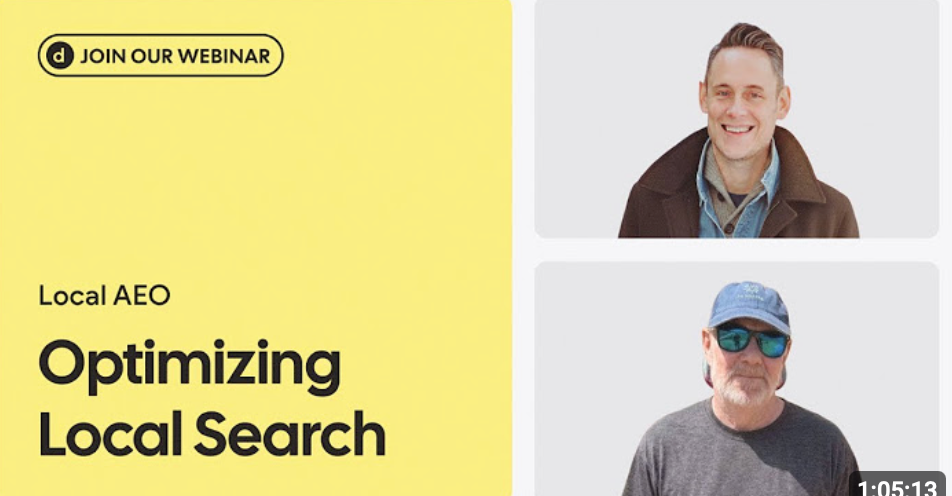
In this Duda webinar, Darren Shaw and Mike Blumenthal explore the paradigm shift occurring in local search as Google increasingly incorporates generative AI into Google Business Profiles and Google Maps. Through new features like "Know Before You Go" and the conversational "Ask Maps," local discovery is transitioning from a deterministic ranking model to a highly personalized, context-aware ecosystem. Blumenthal demonstrates how to leverage Ask Maps for deep competitive analysis to pinpoint market weaknesses and operational gaps. The speakers emphasize that while traditional SEO remains foundational "table stakes," long-term visibility in the AI era requires businesses to cultivate a deeply revered brand through comprehensive website data, widespread consumer sentiment, community engagement, and niche specialization.
The Podcast Deets
. The Integration of Generative AI in Local Graph Signals [06:45]
In this section, the speakers dissect the early layers of AI hitting Google Business Profiles (GBP), including automated business summaries, "Know Before You Go" cached metrics, and conversational Q&A modifications. Blumenthal highlights a critical shift: Google's LLMs look first and foremost at the "local graph" (the entity data within Google Maps, business profiles, and connected websites) before looking out to the wider web. They explain that AI has completely flipped the script on older local SEO advice; details hidden within service descriptions and even text crafted inside review responses are now being actively parsed to determine situational relevance for voice and AI chat prompts.
2. Deep Dive and Live Demonstration of "Ask Maps" [15:50]
Blumenthal screenshares a live demo of "Ask Maps," demonstrating how conversational discovery handles multi-variable, long-tail queries that traditional map searches fail to process. Using complex examples—such as finding a New York City brunch spot equidistant via subway lines for three friends in different neighborhoods, or matching broad geographic solar installations—he showcases how the feature pulls dynamically from localized entity clusters. The segment contrasts traditional deterministic search results with the fluid, non-deterministic nature of AI, highlighting current UI complexities, verbosity issues, and the lack of native share links or tracking metrics.
3. Market Research Tactics and Future Brand Strategy [38:23]
The final core segment pivots from technical mechanics into actionable business strategy, detailing how owners can treat Ask Maps as a powerful, free market research tool. By prompting the AI to compare a business's weaknesses against its primary competitors based on sentiment analysis across reviews, owners can reveal hidden operational or content gaps. To win visibility six to nine months down the line, Blumenthal urges businesses to look beyond individual keyword chasing and aim to become the most "revered" brand in their local market. This involves securing professional accreditations, building relationships with local media for PR, tracking organic sentiment across platforms like Reddit, and narrowing focus to dominate a specific industry niche.
Key Takeaways
- Traditional SEO is Only Table Stakes: Tweak-based optimization and standard local ranking factors are still mandatory to ensure data gets ingested by Retrieval-Augmented Generation (RAG) loops, but they are no longer sufficient to guarantee dominance.
- The Death of Uniform Rankings: Local AI search is fundamentally non-deterministic and highly personalized; results shift dynamically based on historical user data, localized user proximity, explicit conversational variables, and default AI memory tracking.
- GBP Descriptions and Services Matter Anew: While keyword stuffing a business description historically had zero impact on traditional map pack algorithms, comprehensive descriptions and thoroughly completed service fields directly influence whether an LLM flags a business as relevant.
- Leverage Conversational Competitive Audits: Businesses can bypass costly research tools by directly prompting Ask Maps to compare specific competitor names, asking it to explicitly map out customer pain points, structural weaknesses, and localized operational flaws extracted from review data.
- Revered vs. Merely Known: Future-proofing against AI requires an active community footprint—focusing heavily on media relations, localized corporate sponsorships, helpful non-promotional interactions on platforms like Reddit, and intentional niche specialization (e.g., dialing in on "engagement rings" over general jewelry).
👇 Watch by topic:
00:00 - Local SEO/AEO Success in the AI Era
01:56 - Mike's background: family business, internet design, discovering local SEO
03:29 - Google Maps consolidation and the end of yellow pages
04:42 - First blog post, early local SEO community (Bill Slawski, Matt McGee)
06:00 - Collaboration in local SEO vs. the threat of large corporate entities
06:45 - AI features in Google local search: AI-generated business summaries
07:56 - No legal accountability for AI-generated content about businesses
08:21 - Intro to Ask Maps as the main webinar topic
08:52 - "Know Before You Go" feature explained
10:19 - GBP description now matters for AI visibility (not just rankings)
11:49 - Review responses as a relevance signal for AI results
13:51 - Mike's view: reviews, attention, and clever responses as ranking signals
15:50 - Ask Maps demo begins; Google Maps interface overview
18:54 - Traditional maps search vs. Ask Maps: deterministic vs. non-deterministic results
21:55 - Ask Maps example: complex brunch query with subway equidistance
23:57 - Ask Maps limitations: no inventory data, no event data, no agentic sharing
25:56 - Ask Maps as market research: competitive strengths and weaknesses via reviews
33:08 - Current drawbacks: Maps UX complexity, verbosity, no tracking
35:32 - Hallucination risk is low; Ask Maps is grounded in the local graph
38:23 - Strategy: local SEO as table stakes; becoming the most revered local brand
43:09 - Word of mouth, reviews everywhere, professional accreditations, PR, media relations
48:34 - Community involvement, Reddit, social media sentiment as new signals
53:14 - Niching down: be revered for one specific thing (Barbara Oliver engagement rings)
55:00 - Ask Maps is hidden; most clients don't know it exists yet
56:01 - Multi-location businesses and LLM visibility: optimize service descriptions, website as primary database
58:34 - Service area businesses: AI may level the playing field vs. brick-and-mortar
01:01:26 - Where Ask Maps pulls data: top vertical directories, complete listings
01:03:10 - Closing plugs: Whitespark local ranking grids, Near Media user research
Interested in sponsoring this podcast or our newsletters please reach out to mblumenthal@nearmedia.co