
ChatGBP, AI Sidebar, Google Says 99% Use It, Yahoo AI, the Broligarchs


Here Comes ChatGBP: Insights and Agents
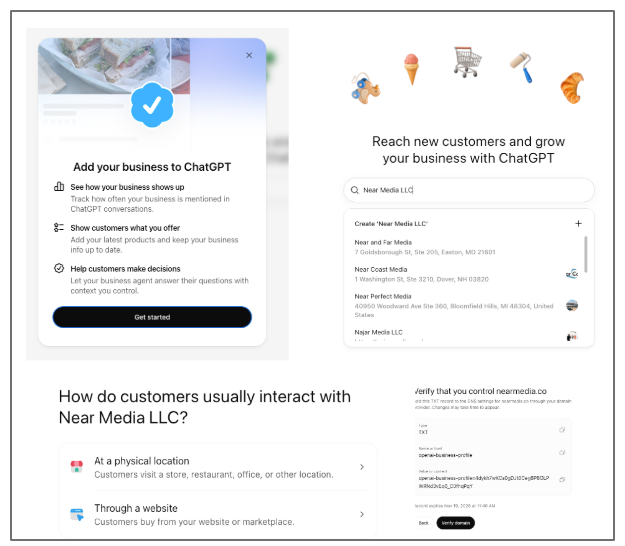
OpenAI recently launched Businesses in ChatGPT, allowing businesses to create a profile that will appear in ChatGPT results. It's conceptually similar to Google Business Profiles – call it "ChatGBP." It's managed through a new Business Hub, a kind of GSC lite. Verified profiles get a familiar blue checkmark and can update business details; product sellers can upload product feeds (Shopify merchants can integrate their catalogs). According to OpenAI, profile claiming does not guarantee ranking or appearance in ChatGPT answers, but I suspect there will be some improved visibility. The process is fairly simple but not friction-free. There are a couple of ways to verify; I used DNS verification. Then there's a secondary identity verification. Once set up, an insights dashboard will show "mentions" and clicks, as well as the most common discovery topics where the business was mentioned or appeared. This is the first data the company is offering outside of ads; however, it's pretty thin. Perhaps most interesting, there's an option to create a branded agent that lets users have a conversation with the business inside ChatGPT results (via chat button on the profile). The agent’s answers come from content the business supplies, including its profile, website and any integrated product data. Agents can also be used in ChatGPT ads. Agents are "currently available to eligible ecommerce and online service businesses, in the US." Profiles are available to both online and traditional local businesses. Should you do it? Probably yes.
Our take:
- The checkmark and chat agent could become differentiators for businesses.
- It's not clear how much adoption there will be. Only a minority of small businesses actively manage Google Business Profiles today.
- Nothing is configured for multi-location businesses. Expect those features to come in 2027. The dashboard is also a clear ads upselling tool.
Google Sidebar Part of AI Makeover
Robby Stein, Google’s VP of Product for Search, announced on Twitter that Google is rolling out a collapsible AI sidebar on its desktop homepage. Signed-in users will be able to quickly find recent AI Mode searches, as on Gemini and other AI chatbots. This change is theoretically about helping users, but it's ultimately about getting more search users to engage with AI Mode. The sidebar appears when a user clicks into AI Mode and then the left rail. People not using AI Mode won’t see it. If you're signed in on AI Mode, you'll see a list of previous prompts, which could (and likely will) include Gemini later. The Google homepage itself also now has a bunch of AI Mode "prompts": an AI Mode button in the search bar and two AI buttons beneath it: "do more with AI Mode" and "create images." The sidebar rollout is global but not everyone will have immediate access. It seems to be another step toward a more AI-centric default experience on Google. Earlier this year Google CEO Sundar Pichai said Google AI Mode has "already surpassed 1 billion monthly active users." On Google's last earnings call, Chief Business Officer Philipp Schindler blamed AI Mode for falling short of Wall Street search revenue expectations. He said, "It's worth noting that the strong growth in AI Mode queries had an impact because of the lower monetization we were seeing in AI Mode." The very next day the company lost $500 billion in market cap.
New on the Google desktop homepage globally: we’re rolling out a collapsible sidebar to easily find & jump back into your recent AI searches.
— Robby Stein (@rmstein) November 19, 2026
People are coming to Search with more questions that aren’t just one and done – and in testing, this sidebar made a big difference for… pic.twitter.com/mKHz295tzK
Source: Twitter
Our take:
- Investors are justifiably nervous about Google's ability to monetize AI results, despite Google's public confidence.
- Many SEOs believe AI Mode will become the default experience next year. I have been skeptical because of its monetization issues. Regardless, the future of the Google SERP will look much more like AI.
- Google's search ad revenue growth will continue to suffer during the transition.
Google: '99% of AI Shoppers Still Use Us'
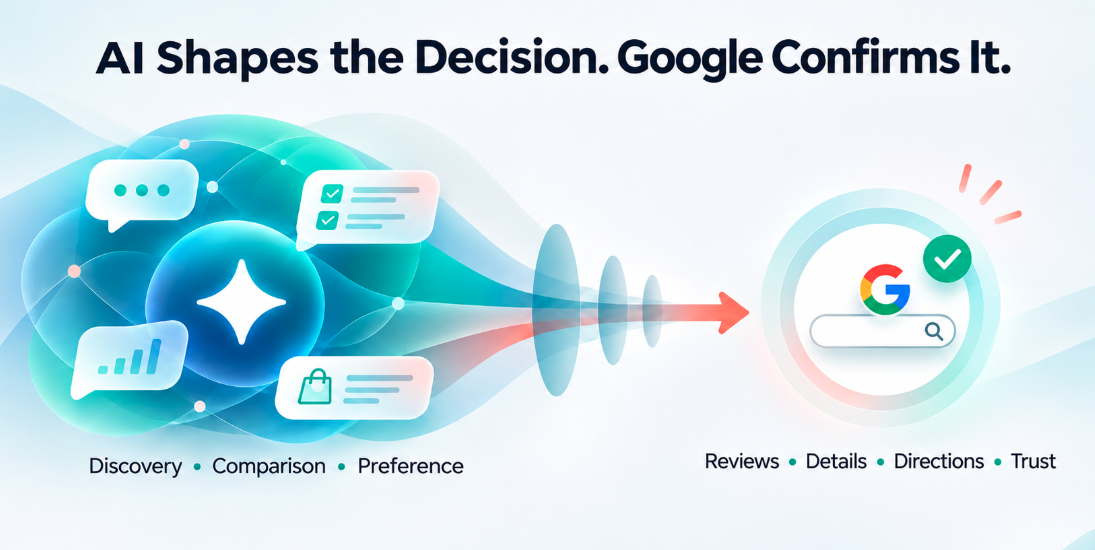
One of Google's recent AI-related presentations includes a slide that says, "99% of those who go to ChatGPT to look into products or services consult with Google Search to help with purchase decisions." The key word here is "help," which I'll come back to. The broader message is: nothing has changed; people may be using ChatGPT but Google is always there – and closer to the purchase than anyone else. This is superficially true. The 99% number strains credulity, however, based on both anecdotal experience and considerable survey data. But the pattern of visiting Google after ChatGPT holds. In local specifically people often don't get enough information from ChatGPT or there are trust issues about data accuracy and reliability. This frequently motivates a Google visit to look at reviews, get directions or confirm business details. (This incomplete trust is partly what's motivated OpenAI to do a deal with Yelp and introduce Business Profiles.) Yet when people make those Google visits, they've frequently decided or are very close to a buying decision, based on their AI research. The Google visit may be more of a formality than in the past. Most of the time Google isn't monetizing those users; ads are unlikely to influence them. There are two big qualifiers to this generalization: local inventory and reviews. In both of these cases, content on Google could well influence the buying decision.
Our take:
- Google remains the leading channel where people begin their research, but that position is being eroded by AI and social media. This is partly why Google is so aggressively pushing AI Mode, to reclaim the top of the funnel.
- Many SEOs want to believe consumer behavior hasn't changed. It has. Consumer journeys are now either more complex or we're just waking up to the full complexity of what has always been.
- Google and GBP management are critical and Google will remain at the center of local. But consumers are increasingly using other tools for discovery.
Yahoo's AI Search Moves
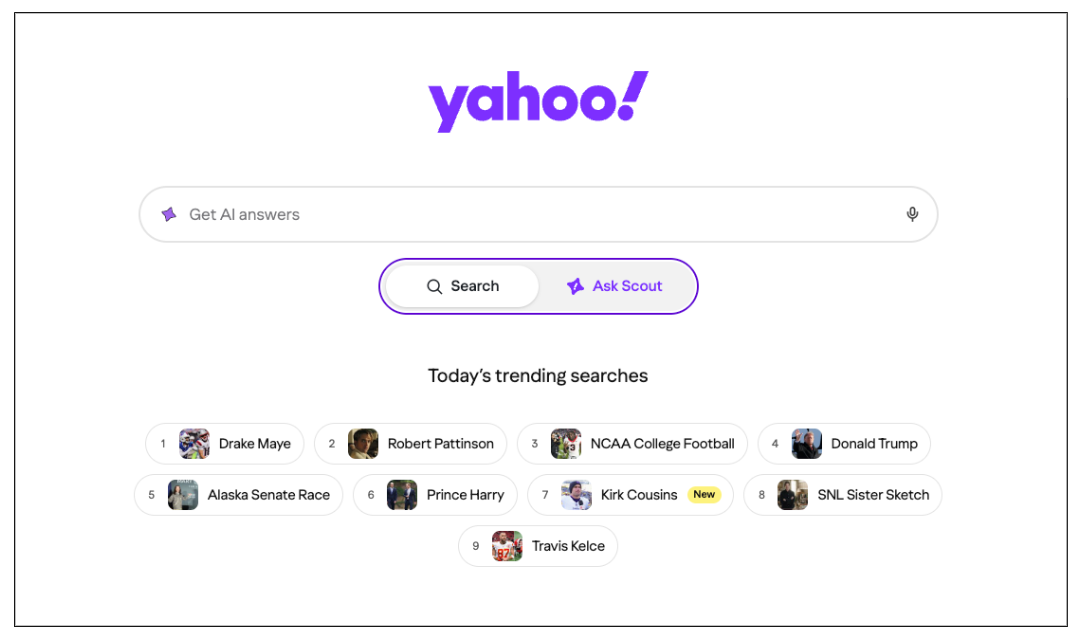
Yahoo's AI search tool Scout launched with an innovative AI-search hybrid interface in January. I liked it and so did many others. It's not clear, however, how much adoption Scout has seen in the interim. Most people's search behavior remains pretty habitual and entrenched (read: Google). Yahoo had 1.4 billion US visits to its homepage in October according to Similarweb, and it has the third largest search engine by market share. Now the company is announcing a newly rebuilt search experience that fully integrates AI ("Pivot Search"). It also shared that Scout was coming out of beta and that AI capabilities were being deployed across Yahoo Finance, Sports, News "and more." There's also a new stand-alone Scout app. As part of the release, Yahoo said Scout had generated "more than 3 billion answers" since Q1. That's a big number but tiny compared with ChatGPT. Last August, OpenAI reported that ChatGPT processed 3 billion messages per day. More recently, OpenAI claimed the subset of prompts that resemble search queries was about 20% of Google's total volume. The new Yahoo SERP looks a lot like Google results with "AI Takeaways" instead of "AI overviews." Microsoft and Yahoo have both largely sought to emulate Google's UI and features for some time, which is obviously calculated and limits their growth potential.
Our take:
- The top entry point for Yahoo search is the Yahoo home page, not search.yahoo (pictured). However, the homepage is badly in need of a redesign.
- These AI upgrades are unlikely to boost Yahoo's market share much. Perhaps it will steal a point from Bing. If so that would still be valuable.
- In 2023, Microsoft CFO Amy Hood said every additional point of search advertising market share was worth $2 billion in annual revenue.
Monsters of the Universe
The opening skit of the previous SNL was a sendup of the Nvidia spy fiasco that included well-deserved mockery of several of the tech oligarchs. Bezos, Satya Nadella, Tim Cook and Sundar Pichai were mercifully spared. The sketch portrayed the others as clueless, chiding them for their naïveté in the face of "honeypot" espionage. While the satirical bit skewered the broligarchs' adolescent narcissism, it left out their darker behavior, which borders on sociopathy in some cases. Much remains to be investigated about the Chinese spying allegations and Nvidia's transfer of advanced chips to China. That extends to a year-long disregard of intelligence warnings by Trump and Commerce Secretary Lutnick. Both of them had financial interests in Nvidia's success. Then there's Elon Musk, with his throttling of Ukraine's satellite access and bromance and regular contacts with Putin. These episodes, which implicate national security and potentially criminal misconduct, go beyond the routine deceptions, regulatory evasion and exploitative behavior of big tech. Many of the tech CEOs transferred millions to Trump’s political operations, inauguration and pet projects, and were rewarded with a series of direct benefits and quid pro quos. In the wake of the midterms, the broligarchs are scrambling to distance themselves from Trump (e.g., here, here, here) fearing investigations. But it's not just the incoming Congress, society at large is increasingly hostile to Silicon Valley.
Source: SNL
Our take:
- The "rules are for others" mentality is out of control. These CEOs and their companies have too much power with almost no accountability (see Huang's reinstatement).
- Their arrogance and tone-deafness ("most jobs will be eliminated," "humanity may be destroyed") have helped turn the public against AI and bring about a market crisis.
- Once admired as "innovators" and "visionaries," the major tech CEOs put aside their integrity to secure more revenue. They're now villains.
Latest Podcasts
- Near Memo ep. 283: ChatGPT's New Business Profiles, Google's Silent Review Bans & the War on Scrapers
- Near Memo ep. 282: Small Businesses Think Google Doesn't Matter. Their Customers Disagree.
- Near Memo ep. 281: Siri Going Agentic, Apps Face the Agent Dilemma, and Big Tech Falls From Grace
LOCAL SEARCH & SEO
- How to stop unauthorized edits to your Google Business Profile.
- Ask Maps is a great product that almost nobody is probably using.
- Google AI Mode integrates Home Services booking.
- Messenger now available as a chat option in GBP.
- Case study: spam fighting can be effective as a local SEO tool.
- Google's "preferred sources" may help with local AI visibility.
GENERAL, SEO & AI OPTIMIZATION
- Ranking content types that earn the most backlinks.
- AI is expanding the shortlist in B2B SaaS/software buying.
- The way prompts are framed impacts how ChatGPT presents brands.
- More facts on your homepage means more AI visibility.
- AIOs now appear for 83% of branded searches (here, here).
- Top brand position in ChatGPT is relatively stable.
ARTIFICIAL INTELLIGENCE
- Google rebrands its agent "Spark" as "Task(s)."
- Apple working on its own AI agent to rival Muse, Dots, etc.
- Airbnb to launch an "AI travel agent" in 2027.
- Google AIOs reduced organic clicks for French websites after launch.
- A glimpse at Google AI's "thought process" for a B2B vendor query.
SOCIAL, ADS & COMMERCE
- For half of product shoppers, AI is more influential than search.
- Product data, reviews key drivers of AI shopping visibility on Google.
- AI most trusted for shopping comparisons but not for purchases.
- Instant Checkout failed for OpenAI, will ChatGPT Wallet succeed?
- Bing putting sponsored links in its version of AI Overviews.
- ChatGPT ads significantly underperform Google paid search.
- Google's search ad revenue challenges are impacting Apple.
LAW, POLICY & PRIVACY
- Google goes after SerpApi scraping again – and loses again.
- EU Digital Fairness Act could dramatically impact tech business models.
- xAI/Grok sued (again) over creation of child sexual abuse imagery.
OVERFLOW
- Web is losing traffic even as the audience grows, with no clear explanation.
- Ad revenues won't be able to cover ChatGPT's costs for free users.

How can we improve? Email us with suggestions and comments.