
Scout: Yahoo's New AI 'Answer Engine' (First Look)

Yahoo has been through a lot in the past 32 years. It dominated the internet for much of its early life, until being unseated by Google as the most visited US online destination in 2000.
In 2008, Yahoo turned down a $45 billion ($68 billion today) buyout offer from Microsoft, only to turn around and outsource its search business to Redmond the next year. After that, Yahoo endured a slow decline culminating in an acquisition by Verizon for $4.5 billion in 2017.
But Verizon didn't really know what to do with Yahoo – it had also acquired AOL – and wound up selling both to private equity firm Apollo Global Management for $5 billion in 2021. Apollo then brought in search and digital media veteran Jim Lanzone to run the company. Lanzone was CEO of CBS Digital and then Tinder and, much earlier, was behind Ask 3D, an innovative search user experience that influenced Google.
Since Lanzone took over at Yahoo, the company has been making regular investments, acquisitions and hiring talent, largely under the tech-media radar. The company is profitable and likely headed for an IPO. It's a relatively rare private equity success story.
A year ago, I asked Lanzone on social media whether Yahoo was going to do anything with AI and search. He gave me the impression they weren't. But that was a head fake.
Enter Yahoo Scout
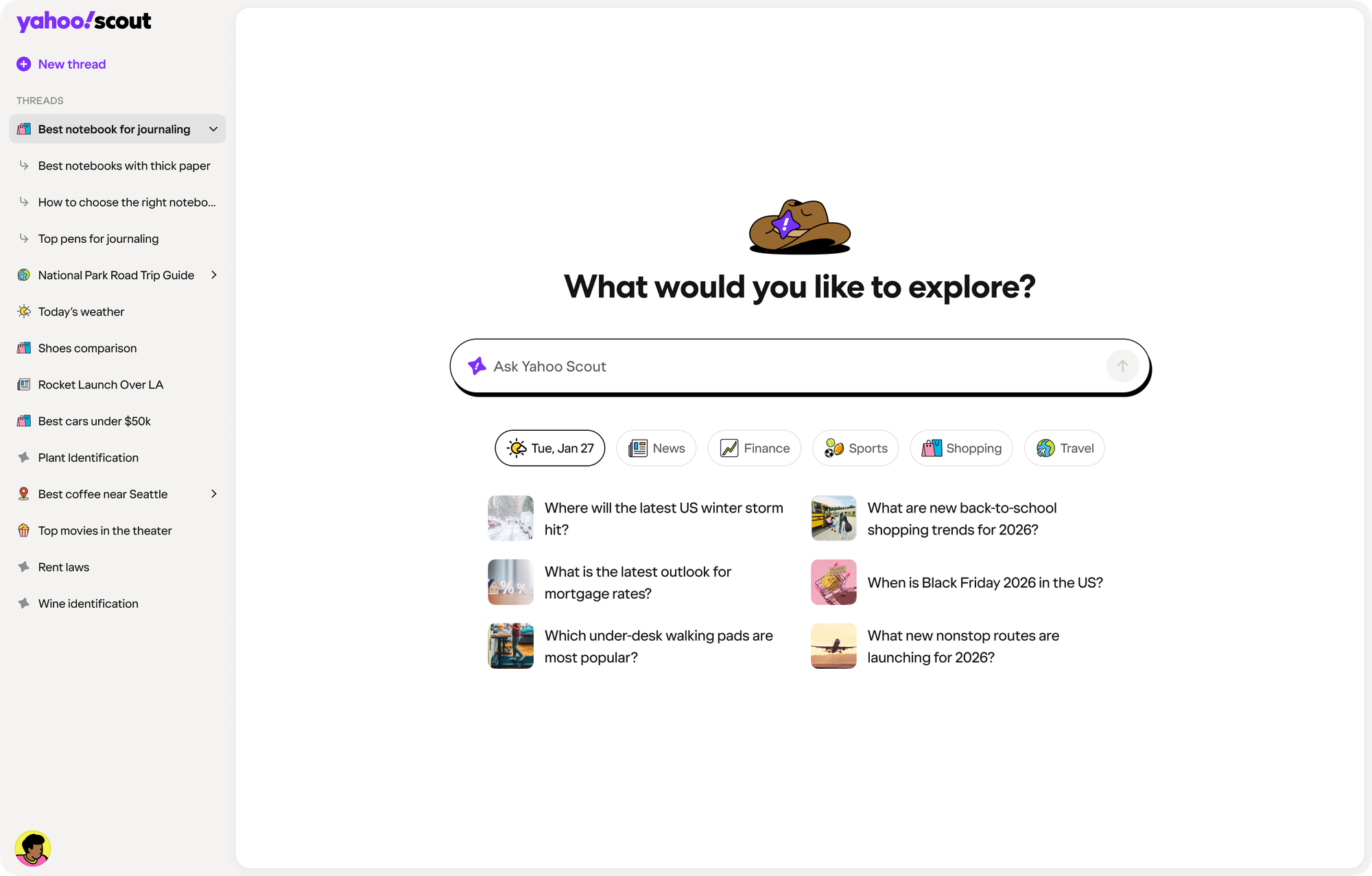
Last week I got a chance to reconnect with Lanzone and his team at Yahoo for a sneak preview of a new AI-powered "answer engine" the company is rolling out today: Yahoo Scout. It's a stand-alone site, but its features and capabilities are being integrated across Yahoo, including into search.
Built on what the company is calling the Yahoo Scout Intelligence Platform, the AI capabilities will be deployed in Yahoo Mail, News, Weather, Shopping, Finance, Sports and other areas of the site (desktop and mobile). In Mobile, Scout is directly available within the Yahoo Search app, which will let you toggle back and forth, as Google did initially with Gemini.
Scout will offer different capabilities in each of these vertical content areas. As one example, in Finance, Yahoo says Scout will "provide one-click access to real-time insights spanning company news, analyst ratings, financials, and earnings calls. Key signals are synthesized into clear analysis with headlines that refresh every 10 minutes and stock movements explained as they happen, helping investors make faster and smarter decisions."
Yahoo also appears to be adding an AI summary to search results, not unlike Google's AI Overviews.

Anthropic + Bing API
Yahoo is using Anthropic as its foundational LLM and Bing’s grounding API to supplement it. Scout also taps into Yahoo's extensive knowledge graph, "spanning more than 1 billion entities, and 18 trillion consumer events that occur annually across Yahoo."
Yahoo says Scout will be immediately available to the company's 250 million US desktop and mobile users. It was developed by an internal team led by Eric Feng, Senior Vice President and General Manager of Yahoo Research Group. Among other things, Feng was the founding CTO of Hulu.
Better AI-Search Hybrid
Lanzone told me he didn't necessarily see Scout as Yahoo's entry into general market AI-Search competition, but rather as a tool to improve Yahoo search and the user experience across the Yahoo suite of verticals. But Scout could well have broader market appeal.
Google is struggling to figure out how to integrate AI into its SERP, with many people speculating AI Mode is the future. Then there's Google's Web Guide, which is an AI-Search hybrid. But what Yahoo has done with Scout may be much closer to a true blending of AI and search.
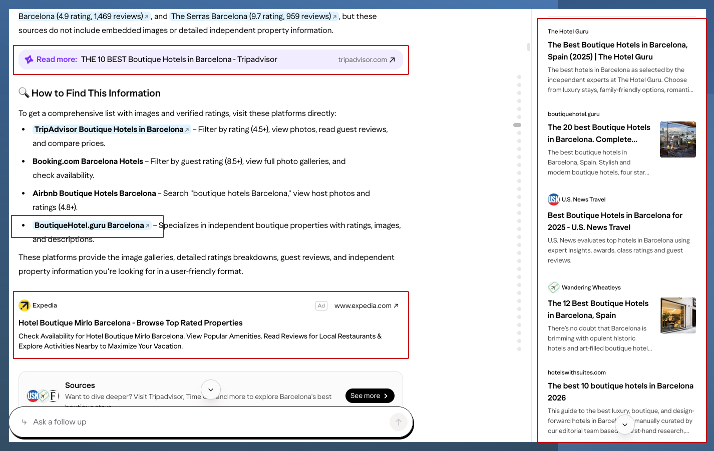
Rather than duplicate the ChatGPT or Gemini LLM search experience, Scout feels more like a genuine hybrid of AI and traditional search. It operates like an LLM but with elements that feel more traditionally like search (e.g., prominent links). Scout features a conversational UI but it blends visual elements and predictable structure that relieves some of the LLM fatigue from looking at dense text, outlines and lists.
Scout is also less likely to be a zero-click experience. That's because it doesn't answer every question. It answers many questions but frequently refers users to websites, which can be previewed by hovering over the link.
A search I did for independent hotels in Barcelona Spain (above) yielded multiple links and branded site references. It's not clear why all the site mentions aren't links. But the Yahoo approach (blue highlighting) is superior to the tiny source "buttons" on, for example, ChatGPT – or the customary source box in the right panel, which this also has.

Yeah, but What about Local?
Without trying to verify the accuracy of any of the business listings or reviews data, I thought Scout did a decent job with Local results. It appears to be drawing upon many of the same directories and editorial sources used by Gemini and ChatGPT, which vary widely by category. There's also a relationship with Yelp, though Yelp's presence was inconsistent.
Overall, the experience is pretty good, but there's considerable room for improvement – as there certainly is in ChatGPT.

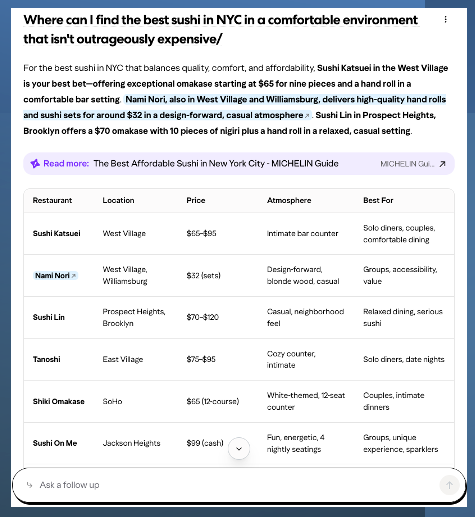
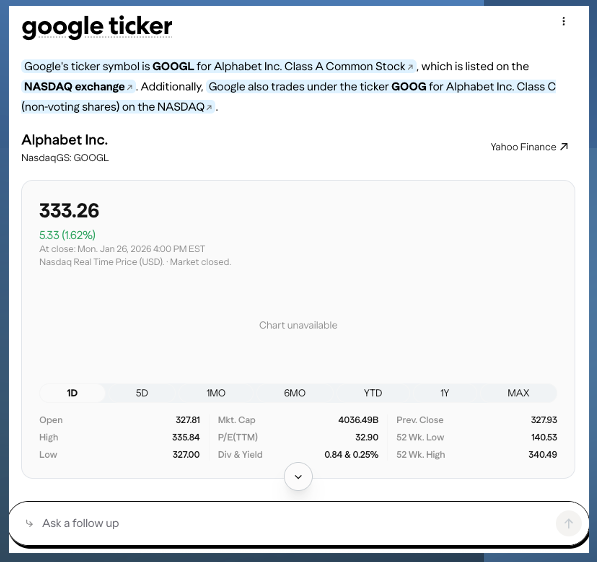
Many of the Scout results have a consistent format, and Local seems to follow that pattern. There's usually a short narrative at the top, often with multiple links, some sort of table or comparison grid and then bulleted lists discussing features or individual listings/products. Often there are vertically or context-specific elements in the SERP, such as a map for Local or a ticker graphic for a stock lookup (below).
Ads Will Follow – Fast
There are a lot of search advertisers on Yahoo and they're definitely going to get their chance to appear in Scout answers. However, in numerous searches and prompts, I only saw a one ad in Travel (i.e., Expedia, see above). Undoubtedly there will be many more as Scout rolls out and evolves.
There will be lots of advertising opportunities. But, hopefully, Yahoo will be restrained.

Competitive Outlook
The Yahoo team has done a nice job with Scout at launch, bringing together the familiar and predictable structure of a SERP with AI's interactivity, depth and flexibility. The company says that in the near future Yahoo Scout "will become more personalized [and] add new capabilities focused on deeper experiences within key verticals."
Scout is unlikely to grab market share from Gemini or ChatGPT. At a minimum, however, it will probably generate more engagement and search frequency from the millions of people who use Yahoo. That, in turn, will deliver more search revenue. If it does that, it will be deemed a success.
One of Scout's virtues is that it's fast, and typically faster than Gemini. The page structure is also consistent and predictable, which many people may prefer to the variability of LLM outputs.
I haven't used or thought about using Yahoo search for years. But after exploring Scout for only a couple of hours, I'm inclined to add it to my AI search repertoire.
Take your own spin and give us your reactions and comments ...