
Got Moats?, Google AI Training Probe, Agencies Are 'OK,' SMBs Are Social


Where's the Moat?
The way many SEOs and investors are now talking, you'd think that Google had locked up the "AI race." That perception has only emerged since Gemini 3's recent rollout. But there are several indications Google has gained ground on OpenAI. One data point is that OpenAI downloads have recently slowed. (OpenAI has also become nervous about Google's gains.) There's also Sensor Tower data showing that last month Gemini grew its monthly active users 30%, compared with ChatGPT's 5%. On the other hand, The Information reported that ChatGPT has nearly 900 million users, up from 800 million in October. Much of Gemini's recent adoption is tied to the viral popularity of its Nano Banana image creation tool, part of Gemini 2.5. Another consideration is that Google has a full AI tech stack, with its own chips, so it doesn't need to rely on Nvidia to the same extent that rivals do. And, as we've said before, Google can fund AI development out of the "irrationally high" rents it collects from advertisers. This leads to the perception that Google's financial position vis-à-vis AI is much stronger than its rivals, which is probably true. Feeling some pressure, ChatGPT just hired Slack CEO Denise Dresser as CRO to accelerate monetization. And while ChatGPT still "owns" the AI brand and remains the market share leader – including among younger users – the adage that "the competition is just a click away" seems more applicable to AI than search.
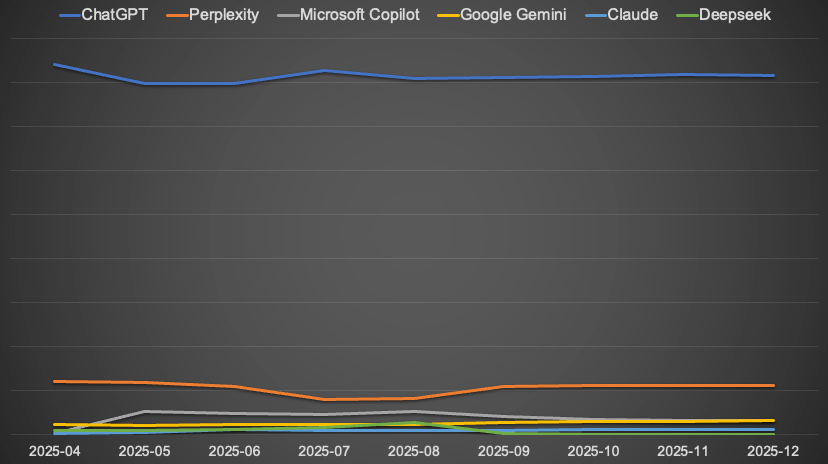
Our take:
- Google's massive distribution channels (i.e., search, Chrome, Workspace) are huge advantages, together with its ad-revenues
- If Google delivers a "good enough" AI experience, it will claw back some usage from ChatGPT, especially in local where it has better data.
- Google is speeding up AI feature rollouts and pushing more people into AI Mode. But the need to drive ad clicks will block radical SERP change, for now.