
EP 250 - AI, Photos, Reviews & Intent Pages: What Actually Drives Multi-Location SEO Now (Part 2)
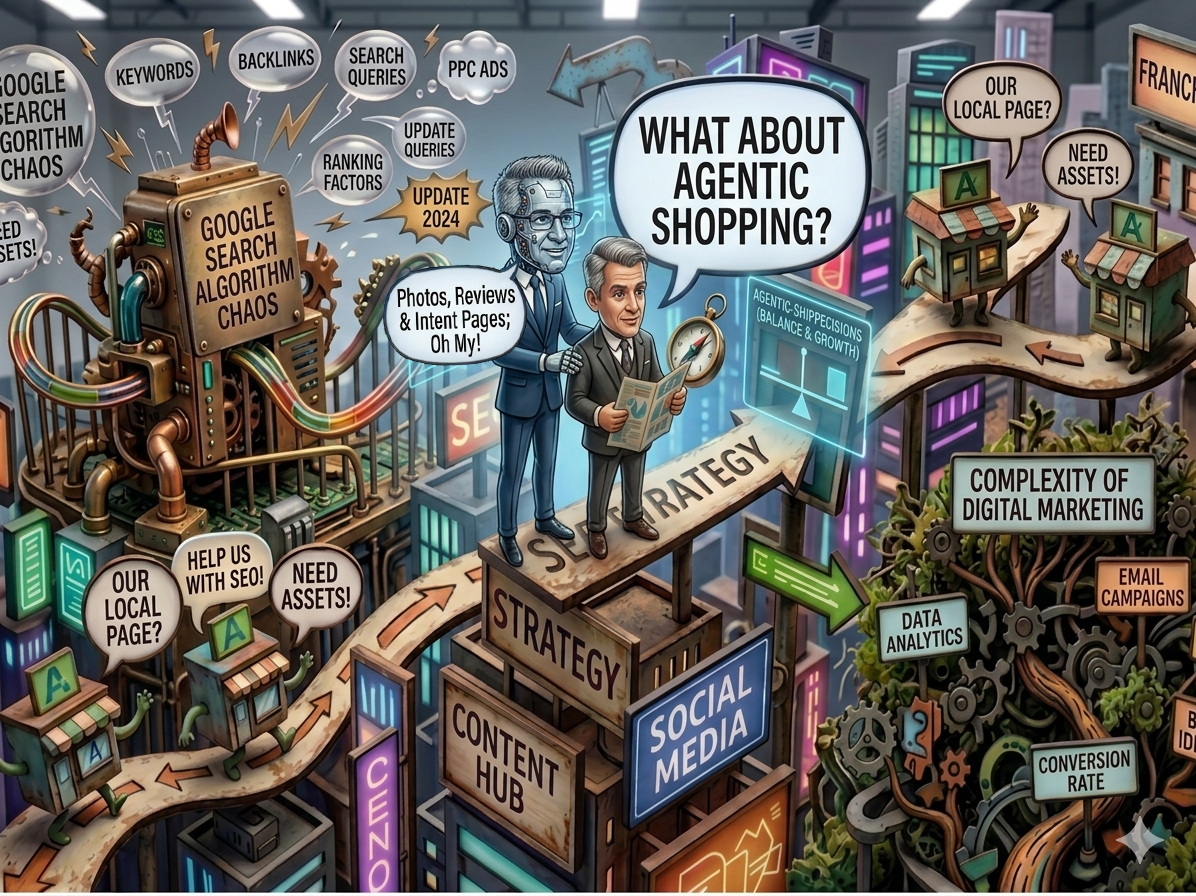
AI search isn’t driving traffic—but it is reshaping visibility. Learn why intent pages, review signals, and brand awareness matter more than ever for multi-location SEO, and what actually works now.


Interested in sponsoring this podcast or our newsletters please reach out to mblumenthal@nearmedia.co
The Podcast Deets
1. AI Hype vs Reality (00:00–04:44)
The conversation opens with growing executive concern about AI and “agentic commerce.” However, real-world data shows AI contributes less than 1% of traffic and revenue for most brands. The takeaway: don’t panic—but pay attention.
2. What Actually Drives Visibility (04:44–13:10)
The discussion shifts to what’s working now. Intent pages—originally built for SEO—are now powering visibility in AI tools. The shift from keywords to intent, combined with insights from reviews & photos, is shaping the next generation of content strategy.
3. The Future of Local Search (13:10–End)
AI isn’t replacing Google—it’s changing behavior. Websites are becoming data sources, brand awareness is driving clicks, and review diversification across platforms like Yelp and TripAdvisor is becoming essential. The future rewards foundational SEO, not shortcuts.
Key Takeaways
- AI traffic is currently negligible (<1%) for most brands
- “Agentic commerce” is overhyped (for now)
- Intent pages are a major competitive advantage in AI search
- Reviews are not just reputation—they are content + ranking signals
- Brand awareness is increasingly critical in a zero-click world
- Websites are evolving into data sources for AI systems
- Review diversification (Yelp, TripAdvisor, etc.) matters more than ever
- Long-term SEO (“the garden”) beats short-term tactics
👇 Watch by topic:
00:00 Intro – AI and multi-location marketing
00:18 Are clients worried about AI visibility?
01:10 The “agentic commerce” panic
02:05 What actually matters for AI SEO
03:05 AI traffic reality ( less than 1%)
04:44 AI vs Google behavior by category
05:46 Ask Maps and discovery changes
07:42 Intent pages driving AI visibility
10:04 From keywords → intent
11:53 Using reviews as content strategy
13:10 Zero-click search and attribution
14:00 Measuring AI → offline conversions
15:07 Are websites becoming data sources?
16:05 Brand awareness and marketing shift
18:49 Long-term SEO strategy (“the garden”)
21:45 AI hype vs Google dominance
23:26 Review diversification strategy
25:06 Yelp, TripAdvisor, and local authority
26:14 The future of local search (3–5 years)
27:43 Final takeaways
Related Links

Sign up for our new Legal Marketing Newsletter. Once a month, no fluff, just good ideas.
Full Transcript of the Near Memo EP 250 -->
Greg Sterling (00:18) But Let's talk about where we are in the market right now with some of the AI stuff. So about like, Hey, we're not in this AI search or we're not in, you know, we did this ChatGPT search or whatever Gemini search and we don't show up for our phrases or our keywords. Are you hearing a lot of that kind of feedback from your clients? What is their level of attention to AI search, AI mode, AI overviews, et cetera?
Steve Wiideman (00:27) Mm-hmm. It's much broader than that right now. It's not as granular as we're not appearing in search. It's more about what are we doing about AI? This came down from the CEO of one of the brands that we work with and it went to the digital marketing manager who then gave it to our contact. And so this big email thread comes through with all the history and the CEO wants to know, how are we addressing agentic commerce? What are we going to do about it? And I'm like, that's so interesting that they jump straight to agentic and never even ask. Yeah, probably. Oh my God. So we get to see what.
Greg Sterling (01:12) Somebody read an article is what it amounts to and then, you know.
Mike Blumenthal (01:17) Yeah, at the firm my daughter works for, which is not in the food industry. Her boss says, you know, have you learned Claw? What is that one? The agentic manager? What's that? The OpenClawHave you learned OpenClawWe've got to implement it. And I've been feeding my daughter articles about the danger of this sort of stuff so early. And it's just funny. This is what a CEO focuses on, right? Is that.
Steve Wiideman (01:25) OpenClaw.
Greg Sterling (01:26) MCP or whatever. OpenClaw. Yeah.
Steve Wiideman (01:31) You
Greg Sterling (01:36) Yeah.
Mike Blumenthal (01:41) They managed to pick out the part that's both the least functional and the most hazardous to your health.
Steve Wiideman (01:46) Yep. So what's our response? We always jump back with, well, let's start, let's go back a little bit, right? Let's take a step back and then let's make sure that we're looking at things a little bit more strategically. And your first part of this question before we get into Agentic is what are we doing in general about artificial intelligence and LLMs, right? And then, and that's where we communicate. Well, we're working with the tech teams to make sure these bots can access our website. We're making sure... You know, are our contents retrievable and that they have no issues finding and being able to cite us as a potential answer. We're working with off-page teams to help increase, you know, the frequency of these semantic triples that are important to us in all of our citations everywhere so that when someone's saying, find me a restaurant that does X, all across the web, all these citation sources says, this restaurant offers X, right? Fundamentally, we're measuring that too, right? We're making sure that we're actually tracking in what it's doing. So the good news, CEO, the good news, key stakeholder, is when you look at the data, which I'm sure we'll get into, there's not a lot of traffic or revenue coming from it. Literally less than 1 % for these restaurant chains anyway. Less than 1 % of the traffic and revenue is coming from clicks from ChatGPT, Perplexity, Claude, or any other LLM. Agentic will be the next thing. It's coming down the pipeline. It's not even something you can really do yet as a restaurant chain. But yes, at some point in the near future, somebody is going to go to ChatGPT and they're going to say, help me place an online order for restaurant. Help me to place a takeout order. Help me to book a reservation for such and such place. And they're going to want to do it through either a third party like an OpenTable or a delivery service provider. For the delivery portion and they might want to do it for themselves, you know, for takeout and for, you know, other things that somebody would want to make a purchase for. So yeah, the days of the website might be going away a little bit as these, you know, LLMs are trying to do what YouTube does and keep users on their website as opposed to navigating off of it. So it's definitely an interesting transition, but I don't see agentic happening for these chains. You know, for several years, I think we're going to be paying attention to it and watching and those early adopters who are in there goofing around with things, who are making mistakes, we're going to learn from them so that we don't have to repeat them and we'll go in strategically and when there's actual documentation that helps brands to do a little bit more, we're going to do it, but we're not going to do it with a sense of urgency knowing what we already know that the traffic and, you know, the ROI from it just isn't there. So there's definitely no means to panic right now. This is like Hitchhiker's Guide to the Galaxy. Where's the book? Don't panic. But pay attention, right? Watch, listen, don't spend a lot of money on super expensive AI prompts, optimization tools just yet, but pay attention.
Greg Sterling (04:44) Well, as Mike suggested, think in our pre-show discussion, the behavior is different by category. And I think that that pertains to AI. I mean, I think in a restaurant context where brands queries are a very high percentage of the searches, people already have a brand in mind and they're less inclined to do that in ChatGPT or Gemini or something like that. It's much... It's much lower in the funnel. They want to know driving directions or are they open or whatever it is. And that's a Google search. Think if you're looking for product discovery, well, if you're looking for product discovery, if you're trying to learn about something, then that's much more in the domain of AI, which can lead you down to specific recommendations. But if you're looking for a, I don't know, a Buffalo
Steve Wiideman (05:16) 100%. Doctor.
Greg Sterling (05:34) Wild Wings or something like that. You're not going to go to AI and say, unless you're already in there and say, hey, where's the nearest one or whatever, you're just going to go to Google because that's the comfortable, familiar behavior.
Steve Wiideman (05:45) 100%.
Mike Blumenthal (05:46) Although one has to ask now that Ask Maps is in Google Maps, is there much high level discovery that's gonna go on because Ask Maps frees the user to ask questions they never could ask before in terms of geography or style or combination of when do they open, are they good date place, do they have excellent food, do they have five stars?
Greg Sterling (05:50) Yes.
Mike Blumenthal (06:10) and find me a place that's within 25 miles of this location, those kind of complicated queries that users haven't been able to ask before about a restaurant can now be asked, can be very personalized and it's exactly, yeah, exactly.
Steve Wiideman (06:20) or personalized, yeah, like a place I haven't been to before, right? Or haven't been to lately.
Greg Sterling (06:26) Or, yeah, and it's, I think it's gonna happen. I mean, I Mike is exactly right. I was getting coffee with somebody the other day. I had to find a place that was kind of convenient for both of us that had certain characteristics, know, coffee, a coffee. Well, no, no, no, that's your, no, no.
Mike Blumenthal (06:38) You stole my example. No, one that's halfway between us. That was what I was talking about two weeks ago. OK.
Greg Sterling (06:46) Yeah, but I wasn't looking for halfway between. I was looking for some place that was convenient to the freeway because this other person was coming, a place where we could talk, a place that had decent food, that had a comfortable atmosphere inside. Wasn't just a, you know, kind of some of these places are pretty raw. Yeah. And anyway, so it gave me, I did that on Ask Maps and it gave me a bunch of choices and I made a choice from
Mike Blumenthal (06:53) I see.
Steve Wiideman (06:55) Mm-hmm.
Mike Blumenthal (07:02)
Greg Sterling (07:14) from the choices that were there. And it worked out. And it was a good experience. And I think there will be a lot of people using it. I mean, right now, it's pretty kludgy because you've got this dual interface with the button there and then the normal search bar. But Google will find a way to integrate it more elegantly. And I think a lot of people will use it. And it may kind of swallow the traditional experience, other than for something like directions or.
Steve Wiideman (07:19) That was interesting.
Greg Sterling (07:41) You know, some very simple thing. Right. Right. Right.
Mike Blumenthal (07:41) or brand queries.
Steve Wiideman (07:42) Which are brand driven searches anyway, right? So yeah, think what's been helping us, and we didn't expect this to happen. And Greg, you and I have talked about this before about the intent pages and landing pages that we were creating on these sites. We were doing it for web search back in 2019. And the collateral benefit of doing that is these intent pages, these sub pages underneath each location page that are highly focused around a page for takeout, a page for delivery, a page for restaurant specials, a page for restaurant jobs, maybe even specific menu items like pancakes near me, waffles near me. These intent pages are now being cited as the citations when we look at a ChatGPT search. And that wasn't what we built them for. We built them for web search. But it turns out because they're kind of a source of truth being on the brand site and being so specific to an intent, that our brands that are utilizing them are seeing significant improvements in visibility and zero-click visibility in these AI models. It's really kind of exciting.
Greg Sterling (08:47) But what about search, though? Also improve visibility in search or no? Yeah.
Steve Wiideman (08:51) of course. Yeah, that was that was the original intent. And the more we we make it unique, the more we add in, I mentioned 60 fields went down to like 30 or 40 that the client will actually use. Huge difference because because like you mentioned, some of those fields are distance from freeway. Some of them are distance from the nearest park and we'll list like three parks. Distance from the nearest body of water, evergreen things that don't need to be changed every couple of months because the neighboring business, you know, gets new ownership or something. It's it's ⁓ evergreen, helpful, useful content that isn't just here's the weather in the city, unique, hyperlocal. We're talking about "our restaurant is a block away from such and such field" or "such and such stadium". So those queries that are, I need to find a restaurant that's, what's near? Yeah, exactly. So that's where I found, at least from a groundwork standpoint, those intent pages make such a big difference and so few brands are even using them.
Greg Sterling (09:34) near this thing. Yep.
Steve Wiideman (09:46) So it's been great. So now our clients have had five to six years of CTR history and we've got some really good rankings that are going be hard to unroot. So anyone who's out there trying to create new stuff, is, know, do it now because it's going to take a few years for some of them to get the maturity to rank as well as you'd like them to.
Greg Sterling (10:04) I can't remember who, somebody on LinkedIn published this and it might've been Claudia Tomina, but I don't remember who it was. Somebody else could have been talking about sort of moving from keywords to intense, right? Sort of in your thinking about content creation. Know, what's that?
Steve Wiideman (10:20) Things not strings. Yeah. Things not strings, as Google has been telling us for a decade.
Greg Sterling (10:25) Right, yeah, yeah. So people have been focused around keywords, which is a proxy for intent, to shifting to intent and building content around that. And I assume that that would be your recommendation for this sort of new, brave new world of AI.
Steve Wiideman (10:39) Right. And we keep trying to remind our clients to stop being so obsessed with the idea of keywords. If we think about a keyword itself, really, Google defined that in its Google Ads platform, combining several different search terms and misspells and singulars and plurals into what they call a keyword. And we get so obsessed over Google's keywords, even though they're made up, they're not the actual searches that people are making. Pay more attention. To your search console, to real searches that are happening so that that can help inspire and be the catalyst to growing your content online. Searches are way more important than keywords. I think internal search and learning from your internal search is probably one of the missing links that a lot of brands don't pay attention to. Whenever we ask, like, hey, what are people searching for on your website? You have a chat feature on there. Can I see ⁓ an export of what people are asking in the chat? At data points that are real humans typing in real things, not some made-up keyword that Google created to sell ad clicks. So I think there's where one of the biggest opportunities might stem from is really understanding what people are actually searching and testing your content strategy around what you're learning from your searches.
Greg Sterling (11:53) And you talked about reviews, the role that reviews play in that process as well earlier.
Steve Wiideman (11:57) I love that. So if you're using AI, we use AI for every research we do now. If you're using AI and you can you can dump your your reviews into, you know, a spreadsheet and throw it up into a perplexity computer. And if you've been playing with that, I love that tool, perplexity computer does some really smart things. And so you can upload all of your reviews and say, help me to to craft ideas for titles and meta descriptions and and content. Based on what customers are saying about us and help me draft an email to my client based on the negative things that people are saying about us so that they can be aware of it and address it. And a lot of the platforms that are out there from Uberall and Yext and BirdEye and these platforms do a lot of that automation for you now on their own. So if you already use one of those data management platforms, talk to them first and say, Is there something I can do with reviews to understand sentiment and to classify and categorize all the things that people are saying so that I can use them in my content strategy and my citation building as well as in our overall content plan? I think there's a huge missed opportunity that most brands just don't pay attention to.
Greg Sterling (13:10) So you talked about zero click search. There's a lot of people who believe Rand Fishkin is the champion of that whole kind of arena, but a lot of people are talking about it. And this is one of the problems or challenges with AI. Mean, you talked about how there's so little referral traffic. My own theory, and this is category dependent, is that... Know, the behavior is just different. People aren't clicking through. So they're not seeing the influence of AI on the conversion or on their Google searches because they're not getting the clicks. You know, it's like I'm going to AI to learn about something, to discover something. Then I go back to Google and I do the bottom of the funnel search. And so that looks like a Google search. Doesn't.
Steve Wiideman (13:37) Mm-hmm. So I went to Korean barbecue place Greg the other day and I got there and there was a tablet where you go to sign in and before you sign in there's a couple little options to say where did you find us? I'm a previous customer, I found you from ChatGPT, I found you from Google, you just hit a button. I was like that's the simplest easiest thing to do and you don't measure the volume, you're measuring the trend. Where are people finding us and where over time are we seeing the most trend there? Where are we not getting clicks? We're not really getting a lot of clicks from people finding us on social media. We probably need to look at what we're doing in social media to make sure that customers are still finding us in social. Let's do a little bit of research and figure out what's missing. I think that's the easiest way to better understand offline. With Skechers, we just use a simple promo code. It didn't always work because they had buy one get one that would compete with it but if someone went into the store and they use that promo code that was exclusive to the local landing page we can understand trend and how many users were actually going into the store after finding the code on the local page so if you can if you can do some online to offline attribution with QR codes and promos and and track the actual search to an in-store visit fantastic but it's been over a decade since BJ's pizza was doing that and You know, no other brand seemed to be doing online to offline still after all these years. Yeah. It's like, isn't everybody doing it? It's
Greg Sterling (15:07) It's just kind of crazy. It's crazy. But what I wanted to ask is about the strategy going forward. And Mike suggested this with the Ask Maps question. Does your website, do your landing pages simply become data sources for AI now, whether it's Google AI or ChatGPT or perplexity or Claude or whomever? That really all, know, less and less about humans visiting your site and more and more about the data that then gets processed by the AI tool.
Mike Blumenthal (15:37) as if Google Local hasn't always been about data, about using your website as data to deliver a result in Google. I mean, you know.
Greg Sterling (15:44) Well, that's true, but it's getting more so. It's getting more so, I think, in certain categories in particular. And restaurants is one of those. Don't need to go. The only reason I would go to a restaurant website is because the Google version of the menu is inadequate versus the restaurant's own menu. I don't trust that as much. But you can get all the information you need from Google, and you don't ever need to go to the restaurant's website.
Steve Wiideman (16:05) which is still not an excuse to not create great content because if they are still using the website as a data source, even if a customer isn't going to actually visit your website, even if your impressions are up and your clicks are down, still continue creating really helpful content because it's going to get crawled and used and hopefully help with your visibility as AI becomes more prominent. It's interesting. And was Danny Sullivan who was talking about it a couple years ago about the importance of brand and people were spinning it into, it's not fair that big brands get more clicks or more visibility. And the reality is it's not what he was saying. He was saying it's important for people to know who you are. And the behavioral differences that are happening is that people aren't just going to Google, performing a non-brand search, clicking a result and being done. You need to be top of mind. So now marketers need to start doing more proactive marketing so that we're top of mind so when they are performing searches they recognize us and say yeah I saw one of their ads a week ago or I clicked on an ad a couple weeks ago for this brand and I wanted to check them out and I never got chance to go in there so we we can't just rely on on inbound being you know what is the catalyst to our organic success it we really need to think more about the the the other types of marketing that we've neglected to make sure we're top of mind for people who are performing searches and that every single time will result in more brand search and it'll result in higher click-through rates for non-brand because we're doing more proactive work in marketing and in paid social and in UGC. So I think that's where we need to shift our mindset around, not just being myopic on a Google SERP, but instead making sure that our brands are doing other types of marketing that support you know, our efforts in inorganic.
Greg Sterling (17:56) Well, we've seen that in our research when somebody is familiar with a particular brand, they're, you know, in these legal categories that we're tracking, you know, there's a lot of sameness, there's a lot of noise and a lot of similar, similarly well-reviewed businesses, similar looking lawyers. And when people have some awareness of the firm or the individual from another channel or another medium that really plays into their behavior, we can see them. Say I recognize them, I've seen their TV commercials, I've heard their ads, and that ultimately turns into a consideration or a click. So it's very clear that that's going on. Let me just back to this sort of zero-click scenario in your statement about you still need to create great content. If I were a multi-location client who was saying to you, well, we're not seeing any clicks, do websites really matter, blah, blah.
Steve Wiideman (18:29) Absolutely. Right?
Greg Sterling (18:49) What would be your sort of disciplined approach to content, given what you know about where the world is going? What would you tell them about the content that needs to be created and how you would go about doing that?
Steve Wiideman (19:02) I would go back to the phrase groundwork, right? I would say what we're doing right now is planning a garden, right? That's with the right amount of water and sunlight over the next several years is going to help drive the visibility we're going to need when the ecosystem continues to evolve. We're getting ahead of things. And while you're not feeling like this is driving anything right now, based on what we've seen in the work we've already done with location and intent pages, and we weren't wrong there, this is going to set us up for success in the future. So we just make it clear instead of expectations, don't expect to see immediate return on investment from this work. This is SEO, this is the marathon, this is a long run. In a couple years from now, here's what could happen. If it doesn't happen, we still have great content. If it does happen, then we're going to flank all of our competitors who won't invest in the resources to make these things come to life. That's the least the first part of getting the buy-in. The second part sometimes is just kind of creating some estimates, you know, looking at the data and saying, hey, based on how people are currently searching, you know, using whatever metrics we can from Search Console, here's where we think we can go. Here's our average position for a certain query or a longer tail phrase and across all of our locations based on what our click-through rate is, based on what our average order value is, based on what our conversion rate looks like. If we are able to increase visibility like we do in traditional search, this is what we could forecast in a year to two years from now. So a lot of it is going to stem from putting forecasts together to help quantify what the ROI could look like in two to five years.
Greg Sterling (20:43) Do you get a lot of pushback on that from the executives that you're, no, but the long-term, really what I'm talking about is the long-term view that you're taking, which I think is strategically correct, but people want immediate results. They want quarter over quarter growth. So do you get, you, yeah.
Steve Wiideman (20:47) Not when you have data. Data seems to always be my... Yeah, we've been pretty fortunate. Honestly, we haven't had too much kickback because a lot of these brands have trusted us since like 2016. They've been with us forever and we've never steered them wrong. But there's always going to be occasions where we get pushback. We've had pushback on things like native reviews for the entire tour of working together. It's like, boy, if we could get those star snippets, wow. But in terms of trying to get buy-in for AI when messages are coming down from the CEO, it's actually becoming less challenging now, especially when the, you know, again, the big shiny thing freaks out the leadership team. Suddenly, there's more of an interest and as long as we can communicate effectively with our point of contact, you know, there's a higher chance that our suggestion will get approved.
Mike Blumenthal (21:45) One of the things I see in my consulting practice is the freakout was caused by ChatGPT and that still has a high presence of mind. But the reality of how capitalism works means that the extreme likelihood is that Google is going to dominate all aspects of this and ChatGPT is going to be bringing up the rear. Do your CEOs recognize that sort of reality of monopoly and
Steve Wiideman (22:04) I keep hearing that.
Mike Blumenthal (22:09) the moat that Google is currently constructing and reinforcing on a daily basis.
Steve Wiideman (22:15) Yeah, depending on your category, like Greg said, but yeah, I think there's definitely a lot of uncertainty. There's a lot of FOMO, I think, happening around AI. The message for, at least for our category of clients that we work with, everything's fine. In fact, in many cases, we remind our clients that people are looking for fresh content. Fresh content requires the LLMs to search the web. When they search the web, they're searching Bing and Google, and we've been optimizing for that for years. So there's no need to panic when it comes to local search as it relates to LLMs, other than just making sure that the bots on the LLMs aren't being blocked from crawling, which IT and security teams can be a bit of a jerk with sometimes. And making sure that we're not being myopic on Google business reviews that we're telling our customers to share feedback everywhere online. And if you want to throw up some logos like TripAdvisor and Yelp and other sites that aren't just Google Maps, that could remind them that they don't have to go to Google and leave a review. They can leave a review somewhere else that might actually help our AI visibility.
Greg Sterling (23:26) Where do you stand on, sort of as we're coming to the end here, a couple of last questions, where do you stand on review diversification across multiple sites, right? So people have focused for a long time, you know, with some justification on Google pretty exclusively. And now, you know, there's a broader range of sites that are playing both on Google itself and on ChatGPT and elsewhere. What do you tell clients about where they need to get reviews beyond Google?
Steve Wiideman (23:52) Sure, well, I always try to be data driven. So if there's research that's been conducted or if you want to do your own research to see what citation sources are coming up the most prominently for your locations, I would start with that citation research and say, hey, we did some research and it turns out that the recommendations that these AI platforms are giving out stem from these publishers. Again, Yelp, TripAdvisor, whatever they happen to be. So by giving them that data, that helps get buy-in, think, to convince them to not just focus on Google Business Profiles, but to also look at other websites that people are talking about. Sometimes it's Reddit, not a big Reddit fan, but sometimes Reddit might be part of that. So just making sure that at the counter when people are coming to the location or to the store, there's a nice little reminder or flyer or poster that reminds them of the places that they can leave. Feedback, I think that's a good start. The other is just showing them screenshots where you can, like here's an example where our competitor is beating us and the citation source is TripAdvisor. So maybe we should be paying a little more attention to TripAdvisor because we want to beat that competitor in terms of what we're coming up for in the search results.
Mike Blumenthal (25:06) I would just add that historically, if you go back and you read the first Google local ranking algorithm, they make it quite clear that third party reviews matter when the page that they are on has some prominence. And both TripAdvisor and Yelp highlight the most popular pages in a local market, giving those pages prominence. And so this behavior
Steve Wiideman (25:13) ⁓ Mm-hmm. Yeah.
Mike Blumenthal (25:31) which people think is somehow new to AI has been around forever. And the trick, it's particularly easy in the restaurant because it's clear it's Yelp and TripAdvisor, right? And those are pages, unlike AVO that sends all of their page strength to their category pages, not to the local business pages, but with both Yelp and TripAdvisor. If you can become a top 10 in something, 10 best hamburgers, 10 best pancakes, whatever,
Steve Wiideman (25:55) Mm-hmm.
Mike Blumenthal (25:59) the benefit is gonna be universal across local search and AI. And this has always been the case. It's just now there's an additional surface that makes it obvious to people. Just sort of think it's myopic to think this is new,
Steve Wiideman (26:13) Right.
Greg Sterling (26:14) So three years from now, Steve, what do you think local? What's going to be different? What's going to be the same in local?
Steve Wiideman (26:22) What's going to be different is the platforms that we use to manage our local will be smarter and better. And you'll want to choose the right one to see the best results. If you're a multi-location brand anyway, I would say what's going to be different is that I imagine your typical Google web search, you know, is going to be less prominent and we're going to be doing a lot more conversational searches like Joaquin Phoenix in the movie Her. I think you can see a lot more wearables and our job is still the same. It's still to make sure our data is accurate and consistent. It's still to make sure our location pages and intent pages are as detailed and as helpful as they possibly can be, even if they're just used as a data source. It's going to be to make sure we're as prominent across the web as we possibly can be with the right, I use the term semantic triples, everywhere within those citations. And mentions. Then lastly, it's going to be to continue to pay attention to reputation and to not be so, I'll use the word of the hour, myopic on just Google Maps. So think about where the reviews are going to matter across the web and to make sure that those reviews where they can be can be influenced with the right narrative and potentially the right semantic triples so that we continue to show up for all the ways that AI and traditional search engines are going to be. Displaying this.
Greg Sterling (27:43) I think I have the impulse to ask more questions, but we could go on and on. But I think that's a good place to leave us. A lot of great advice. Know, what I heard overall was like a lot of hard work, a lot of foundational work, no simple...
Steve Wiideman (27:49) Awesome.
Mike Blumenthal (27:58) a lot of repeating your instructions.
Steve Wiideman (28:02) No techniques or tricks or hacks.
Greg Sterling (28:04) Right. No magic bullets, no simple, you know, fast track approaches, just a lot of hard work and effort over time.
Steve Wiideman (28:15) Yep, patience, lots of patience.
Greg Sterling (28:16) Okay, all right, well thanks very much Steve Wiideman for being with us and giving us your advice and perspective on all these issues and we will definitely have you back in the future. Yeah, and thanks everybody for listening and we'll see you next time.
Steve Wiideman (28:19) Thanks, guys. Appreciate you guys. Thank you so much.
Steve Wiideman (28:19) Thanks, guys. Appreciate you guys. Thank you so much.Greg Sterling (28:16) Okay, all right, well thanks very much Steve Wiideman for being with us and giving us your advice and perspective on all these issues and we will definitely have you back in the future. Yeah, and thanks everybody for listening and we'll see you next time.Steve Wiideman (28:15) Yep, patience, lots of patience.Greg Sterling (28:04) Right. No magic bullets, no simple, you know, fast track approaches, just a lot of hard work and effort over time.Steve Wiideman (28:02) No techniques or tricks or hacks.Mike Blumenthal (27:58) a lot of repeating your instructions.Steve Wiideman (27:49) Awesome.Greg Sterling (27:43) I think I have the impulse to ask more questions, but we could go on and on. But I think that's a good place to leave us. A lot of great advice. Know, what I heard overall was like a lot of hard work, a lot of foundational work, no simple...Steve Wiideman (26:22) What's going to be different is the platforms that we use to manage our local will be smarter and better. And you'll want to choose the right one to see the best results. If you're a multi-location brand anyway, I would say what's going to be different is that I imagine your typical Google web search, you know, is going to be less prominent and we're going to be doing a lot more conversational searches like Joaquin Phoenix in the movie Her. I think you can see a lot more wearables and our job is still the same. It's still to make sure our data is accurate and consistent. It's still to make sure our location pages and intent pages are as detailed and as helpful as they possibly can be, even if they're just used as a data source. It's going to be to make sure we're as prominent across the web as we possibly can be with the right, I use the term semantic triples, everywhere within those citations. And mentions. Then lastly, it's going to be to continue to pay attention to reputation and to not be so, I'll use the word of the hour, myopic on just Google Maps. So think about where the reviews are going to matter across the web and to make sure that those reviews where they can be can be influenced with the right narrative and potentially the right semantic triples so that we continue to show up for all the ways that AI and traditional search engines are going to be. Displaying this.Greg Sterling (26:14) So three years from now, Steve, what do you think local? What's going to be different? What's going to be the same in local?Steve Wiideman (26:13) Right.Mike Blumenthal (25:59) the benefit is gonna be universal across local search and AI. And this has always been the case. It's just now there's an additional surface that makes it obvious to people. Just sort of think it's myopic to think this is new,Steve Wiideman (25:55) Mm-hmm.Mike Blumenthal (25:31) which people think is somehow new to AI has been around forever. And the trick, it's particularly easy in the restaurant because it's clear it's Yelp and TripAdvisor, right? And those are pages, unlike AVO that sends all of their page strength to their category pages, not to the local business pages, but with both Yelp and TripAdvisor. If you can become a top 10 in something, 10 best hamburgers, 10 best pancakes, whatever,Steve Wiideman (25:13) ⁓ Mm-hmm. Yeah.Mike Blumenthal (25:06) I would just add that historically, if you go back and you read the first Google local ranking algorithm, they make it quite clear that third party reviews matter when the page that they are on has some prominence. And both TripAdvisor and Yelp highlight the most popular pages in a local market, giving those pages prominence. And so this behaviorSteve Wiideman (23:52) Sure, well, I always try to be data driven. So if there's research that's been conducted or if you want to do your own research to see what citation sources are coming up the most prominently for your locations, I would start with that citation research and say, hey, we did some research and it turns out that the recommendations that these AI platforms are giving out stem from these publishers. Again, Yelp, TripAdvisor, whatever they happen to be. So by giving them that data, that helps get buy-in, think, to convince them to not just focus on Google Business Profiles, but to also look at other websites that people are talking about. Sometimes it's Reddit, not a big Reddit fan, but sometimes Reddit might be part of that. So just making sure that at the counter when people are coming to the location or to the store, there's a nice little reminder or flyer or poster that reminds them of the places that they can leave. Feedback, I think that's a good start. The other is just showing them screenshots where you can, like here's an example where our competitor is beating us and the citation source is TripAdvisor. So maybe we should be paying a little more attention to TripAdvisor because we want to beat that competitor in terms of what we're coming up for in the search results.Greg Sterling (23:26) Where do you stand on, sort of as we're coming to the end here, a couple of last questions, where do you stand on review diversification across multiple sites, right? So people have focused for a long time, you know, with some justification on Google pretty exclusively. And now, you know, there's a broader range of sites that are playing both on Google itself and on ChatGPT and elsewhere. What do you tell clients about where they need to get reviews beyond Google?Steve Wiideman (22:15) Yeah, depending on your category, like Greg said, but yeah, I think there's definitely a lot of uncertainty. There's a lot of FOMO, I think, happening around AI. The message for, at least for our category of clients that we work with, everything's fine. In fact, in many cases, we remind our clients that people are looking for fresh content. Fresh content requires the LLMs to search the web. When they search the web, they're searching Bing and Google, and we've been optimizing for that for years. So there's no need to panic when it comes to local search as it relates to LLMs, other than just making sure that the bots on the LLMs aren't being blocked from crawling, which IT and security teams can be a bit of a jerk with sometimes. And making sure that we're not being myopic on Google business reviews that we're telling our customers to share feedback everywhere online. And if you want to throw up some logos like TripAdvisor and Yelp and other sites that aren't just Google Maps, that could remind them that they don't have to go to Google and leave a review. They can leave a review somewhere else that might actually help our AI visibility.Mike Blumenthal (22:09) the moat that Google is currently constructing and reinforcing on a daily basis.Steve Wiideman (22:04) I keep hearing that.Mike Blumenthal (21:45) One of the things I see in my consulting practice is the freakout was caused by ChatGPT and that still has a high presence of mind. But the reality of how capitalism works means that the extreme likelihood is that Google is going to dominate all aspects of this and ChatGPT is going to be bringing up the rear. Do your CEOs recognize that sort of reality of monopoly andSteve Wiideman (20:47) Not when you have data. Data seems to always be my... Yeah, we've been pretty fortunate. Honestly, we haven't had too much kickback because a lot of these brands have trusted us since like 2016. They've been with us forever and we've never steered them wrong. But there's always going to be occasions where we get pushback. We've had pushback on things like native reviews for the entire tour of working together. It's like, boy, if we could get those star snippets, wow. But in terms of trying to get buy-in for AI when messages are coming down from the CEO, it's actually becoming less challenging now, especially when the, you know, again, the big shiny thing freaks out the leadership team. Suddenly, there's more of an interest and as long as we can communicate effectively with our point of contact, you know, there's a higher chance that our suggestion will get approved.Greg Sterling (20:43) Do you get a lot of pushback on that from the executives that you're, no, but the long-term, really what I'm talking about is the long-term view that you're taking, which I think is strategically correct, but people want immediate results. They want quarter over quarter growth. So do you get, you, yeah.Steve Wiideman (19:02) I would go back to the phrase groundwork, right? I would say what we're doing right now is planning a garden, right? That's with the right amount of water and sunlight over the next several years is going to help drive the visibility we're going to need when the ecosystem continues to evolve. We're getting ahead of things. And while you're not feeling like this is driving anything right now, based on what we've seen in the work we've already done with location and intent pages, and we weren't wrong there, this is going to set us up for success in the future. So we just make it clear instead of expectations, don't expect to see immediate return on investment from this work. This is SEO, this is the marathon, this is a long run. In a couple years from now, here's what could happen. If it doesn't happen, we still have great content. If it does happen, then we're going to flank all of our competitors who won't invest in the resources to make these things come to life. That's the least the first part of getting the buy-in. The second part sometimes is just kind of creating some estimates, you know, looking at the data and saying, hey, based on how people are currently searching, you know, using whatever metrics we can from Search Console, here's where we think we can go. Here's our average position for a certain query or a longer tail phrase and across all of our locations based on what our click-through rate is, based on what our average order value is, based on what our conversion rate looks like. If we are able to increase visibility like we do in traditional search, this is what we could forecast in a year to two years from now. So a lot of it is going to stem from putting forecasts together to help quantify what the ROI could look like in two to five years.Greg Sterling (18:49) What would be your sort of disciplined approach to content, given what you know about where the world is going? What would you tell them about the content that needs to be created and how you would go about doing that?Steve Wiideman (18:29) Absolutely. Right?Greg Sterling (17:56) Well, we've seen that in our research when somebody is familiar with a particular brand, they're, you know, in these legal categories that we're tracking, you know, there's a lot of sameness, there's a lot of noise and a lot of similar, similarly well-reviewed businesses, similar looking lawyers. And when people have some awareness of the firm or the individual from another channel or another medium that really plays into their behavior, we can see them. Say I recognize them, I've seen their TV commercials, I've heard their ads, and that ultimately turns into a consideration or a click. So it's very clear that that's going on. Let me just back to this sort of zero-click scenario in your statement about you still need to create great content. If I were a multi-location client who was saying to you, well, we're not seeing any clicks, do websites really matter, blah, blah.Steve Wiideman (16:05) which is still not an excuse to not create great content because if they are still using the website as a data source, even if a customer isn't going to actually visit your website, even if your impressions are up and your clicks are down, still continue creating really helpful content because it's going to get crawled and used and hopefully help with your visibility as AI becomes more prominent. It's interesting. And was Danny Sullivan who was talking about it a couple years ago about the importance of brand and people were spinning it into, it's not fair that big brands get more clicks or more visibility. And the reality is it's not what he was saying. He was saying it's important for people to know who you are. And the behavioral differences that are happening is that people aren't just going to Google, performing a non-brand search, clicking a result and being done. You need to be top of mind. So now marketers need to start doing more proactive marketing so that we're top of mind so when they are performing searches they recognize us and say yeah I saw one of their ads a week ago or I clicked on an ad a couple weeks ago for this brand and I wanted to check them out and I never got chance to go in there so we we can't just rely on on inbound being you know what is the catalyst to our organic success it we really need to think more about the the the other types of marketing that we've neglected to make sure we're top of mind for people who are performing searches and that every single time will result in more brand search and it'll result in higher click-through rates for non-brand because we're doing more proactive work in marketing and in paid social and in UGC. So I think that's where we need to shift our mindset around, not just being myopic on a Google SERP, but instead making sure that our brands are doing other types of marketing that support you know, our efforts in inorganic.Greg Sterling (15:44) Well, that's true, but it's getting more so. It's getting more so, I think, in certain categories in particular. And restaurants is one of those. Don't need to go. The only reason I would go to a restaurant website is because the Google version of the menu is inadequate versus the restaurant's own menu. I don't trust that as much. But you can get all the information you need from Google, and you don't ever need to go to the restaurant's website.Mike Blumenthal (15:37) as if Google Local hasn't always been about data, about using your website as data to deliver a result in Google. I mean, you know.Greg Sterling (15:07) It's just kind of crazy. It's crazy. But what I wanted to ask is about the strategy going forward. And Mike suggested this with the Ask Maps question. Does your website, do your landing pages simply become data sources for AI now, whether it's Google AI or ChatGPT or perplexity or Claude or whomever? That really all, know, less and less about humans visiting your site and more and more about the data that then gets processed by the AI tool.Steve Wiideman (13:37) Mm-hmm. So I went to Korean barbecue place Greg the other day and I got there and there was a tablet where you go to sign in and before you sign in there's a couple little options to say where did you find us? I'm a previous customer, I found you from ChatGPT, I found you from Google, you just hit a button. I was like that's the simplest easiest thing to do and you don't measure the volume, you're measuring the trend. Where are people finding us and where over time are we seeing the most trend there? Where are we not getting clicks? We're not really getting a lot of clicks from people finding us on social media. We probably need to look at what we're doing in social media to make sure that customers are still finding us in social. Let's do a little bit of research and figure out what's missing. I think that's the easiest way to better understand offline. With Skechers, we just use a simple promo code. It didn't always work because they had buy one get one that would compete with it but if someone went into the store and they use that promo code that was exclusive to the local landing page we can understand trend and how many users were actually going into the store after finding the code on the local page so if you can if you can do some online to offline attribution with QR codes and promos and and track the actual search to an in-store visit fantastic but it's been over a decade since BJ's pizza was doing that and You know, no other brand seemed to be doing online to offline still after all these years. Yeah. It's like, isn't everybody doing it? It'sGreg Sterling (13:10) So you talked about zero click search. There's a lot of people who believe Rand Fishkin is the champion of that whole kind of arena, but a lot of people are talking about it. And this is one of the problems or challenges with AI. Mean, you talked about how there's so little referral traffic. My own theory, and this is category dependent, is that... Know, the behavior is just different. People aren't clicking through. So they're not seeing the influence of AI on the conversion or on their Google searches because they're not getting the clicks. You know, it's like I'm going to AI to learn about something, to discover something. Then I go back to Google and I do the bottom of the funnel search. And so that looks like a Google search. Doesn't.Steve Wiideman (11:57) I love that. So if you're using AI, we use AI for every research we do now. If you're using AI and you can you can dump your your reviews into, you know, a spreadsheet and throw it up into a perplexity computer. And if you've been playing with that, I love that tool, perplexity computer does some really smart things. And so you can upload all of your reviews and say, help me to to craft ideas for titles and meta descriptions and and content. Based on what customers are saying about us and help me draft an email to my client based on the negative things that people are saying about us so that they can be aware of it and address it. And a lot of the platforms that are out there from Uberall and Yext and BirdEye and these platforms do a lot of that automation for you now on their own. So if you already use one of those data management platforms, talk to them first and say, Is there something I can do with reviews to understand sentiment and to classify and categorize all the things that people are saying so that I can use them in my content strategy and my citation building as well as in our overall content plan? I think there's a huge missed opportunity that most brands just don't pay attention to.Greg Sterling (11:53) And you talked about reviews, the role that reviews play in that process as well earlier.Steve Wiideman (10:39) Right. And we keep trying to remind our clients to stop being so obsessed with the idea of keywords. If we think about a keyword itself, really, Google defined that in its Google Ads platform, combining several different search terms and misspells and singulars and plurals into what they call a keyword. And we get so obsessed over Google's keywords, even though they're made up, they're not the actual searches that people are making. Pay more attention. To your search console, to real searches that are happening so that that can help inspire and be the catalyst to growing your content online. Searches are way more important than keywords. I think internal search and learning from your internal search is probably one of the missing links that a lot of brands don't pay attention to. Whenever we ask, like, hey, what are people searching for on your website? You have a chat feature on there. Can I see ⁓ an export of what people are asking in the chat? At data points that are real humans typing in real things, not some made-up keyword that Google created to sell ad clicks. So I think there's where one of the biggest opportunities might stem from is really understanding what people are actually searching and testing your content strategy around what you're learning from your searches.Greg Sterling (10:25) Right, yeah, yeah. So people have been focused around keywords, which is a proxy for intent, to shifting to intent and building content around that. And I assume that that would be your recommendation for this sort of new, brave new world of AI.Steve Wiideman (10:20) Things not strings. Yeah. Things not strings, as Google has been telling us for a decade.Greg Sterling (10:04) I can't remember who, somebody on LinkedIn published this and it might've been Claudia Tomina, but I don't remember who it was. Somebody else could have been talking about sort of moving from keywords to intense, right? Sort of in your thinking about content creation. Know, what's that?Steve Wiideman (09:46) So it's been great. So now our clients have had five to six years of CTR history and we've got some really good rankings that are going be hard to unroot. So anyone who's out there trying to create new stuff, is, know, do it now because it's going to take a few years for some of them to get the maturity to rank as well as you'd like them to.Greg Sterling (09:34) near this thing. Yep.Steve Wiideman (08:51) of course. Yeah, that was that was the original intent. And the more we we make it unique, the more we add in, I mentioned 60 fields went down to like 30 or 40 that the client will actually use. Huge difference because because like you mentioned, some of those fields are distance from freeway. Some of them are distance from the nearest park and we'll list like three parks. Distance from the nearest body of water, evergreen things that don't need to be changed every couple of months because the neighboring business, you know, gets new ownership or something. It's it's ⁓ evergreen, helpful, useful content that isn't just here's the weather in the city, unique, hyperlocal. We're talking about "our restaurant is a block away from such and such field" or "such and such stadium". So those queries that are, I need to find a restaurant that's, what's near? Yeah, exactly. So that's where I found, at least from a groundwork standpoint, those intent pages make such a big difference and so few brands are even using them.Greg Sterling (08:47) But what about search, though? Also improve visibility in search or no? Yeah.Steve Wiideman (07:42) Which are brand driven searches anyway, right? So yeah, think what's been helping us, and we didn't expect this to happen. And Greg, you and I have talked about this before about the intent pages and landing pages that we were creating on these sites. We were doing it for web search back in 2019. And the collateral benefit of doing that is these intent pages, these sub pages underneath each location page that are highly focused around a page for takeout, a page for delivery, a page for restaurant specials, a page for restaurant jobs, maybe even specific menu items like pancakes near me, waffles near me. These intent pages are now being cited as the citations when we look at a ChatGPT search. And that wasn't what we built them for. We built them for web search. But it turns out because they're kind of a source of truth being on the brand site and being so specific to an intent, that our brands that are utilizing them are seeing significant improvements in visibility and zero-click visibility in these AI models. It's really kind of exciting.Mike Blumenthal (07:41) or brand queries.Greg Sterling (07:41) You know, some very simple thing. Right. Right. Right.Steve Wiideman (07:19) That was interesting.Greg Sterling (07:14) from the choices that were there. And it worked out. And it was a good experience. And I think there will be a lot of people using it. I mean, right now, it's pretty kludgy because you've got this dual interface with the button there and then the normal search bar. But Google will find a way to integrate it more elegantly. And I think a lot of people will use it. And it may kind of swallow the traditional experience, other than for something like directions or.Mike Blumenthal (07:02)Steve Wiideman (06:55) Mm-hmm.Mike Blumenthal (06:53) I see.Greg Sterling (06:46) Yeah, but I wasn't looking for halfway between. I was looking for some place that was convenient to the freeway because this other person was coming, a place where we could talk, a place that had decent food, that had a comfortable atmosphere inside. Wasn't just a, you know, kind of some of these places are pretty raw. Yeah. And anyway, so it gave me, I did that on Ask Maps and it gave me a bunch of choices and I made a choice fromMike Blumenthal (06:38) You stole my example. No, one that's halfway between us. That was what I was talking about two weeks ago. OK.Greg Sterling (06:26) Or, yeah, and it's, I think it's gonna happen. I mean, I Mike is exactly right. I was getting coffee with somebody the other day. I had to find a place that was kind of convenient for both of us that had certain characteristics, know, coffee, a coffee. Well, no, no, no, that's your, no, no.Steve Wiideman (06:20) or personalized, yeah, like a place I haven't been to before, right? Or haven't been to lately.Mike Blumenthal (06:10) and find me a place that's within 25 miles of this location, those kind of complicated queries that users haven't been able to ask before about a restaurant can now be asked, can be very personalized and it's exactly, yeah, exactly.Greg Sterling (05:50) Yes.Mike Blumenthal (05:46) Although one has to ask now that Ask Maps is in Google Maps, is there much high level discovery that's gonna go on because Ask Maps frees the user to ask questions they never could ask before in terms of geography or style or combination of when do they open, are they good date place, do they have excellent food, do they have five stars?Steve Wiideman (05:45) 100%.Greg Sterling (05:34) Wild Wings or something like that. You're not going to go to AI and say, unless you're already in there and say, hey, where's the nearest one or whatever, you're just going to go to Google because that's the comfortable, familiar behavior.Steve Wiideman (05:16) 100%. Doctor.Greg Sterling (04:44) Well, as Mike suggested, think in our pre-show discussion, the behavior is different by category. And I think that that pertains to AI. I mean, I think in a restaurant context where brands queries are a very high percentage of the searches, people already have a brand in mind and they're less inclined to do that in ChatGPT or Gemini or something like that. It's much... It's much lower in the funnel. They want to know driving directions or are they open or whatever it is. And that's a Google search. Think if you're looking for product discovery, well, if you're looking for product discovery, if you're trying to learn about something, then that's much more in the domain of AI, which can lead you down to specific recommendations. But if you're looking for a, I don't know, a BuffaloSteve Wiideman (01:46) Yep. So what's our response? We always jump back with, well, let's start, let's go back a little bit, right? Let's take a step back and then let's make sure that we're looking at things a little bit more strategically. And your first part of this question before we get into Agentic is what are we doing in general about artificial intelligence and LLMs, right? And then, and that's where we communicate. Well, we're working with the tech teams to make sure these bots can access our website. We're making sure... You know, are our contents retrievable and that they have no issues finding and being able to cite us as a potential answer. We're working with off-page teams to help increase, you know, the frequency of these semantic triples that are important to us in all of our citations everywhere so that when someone's saying, find me a restaurant that does X, all across the web, all these citation sources says, this restaurant offers X, right? Fundamentally, we're measuring that too, right? We're making sure that we're actually tracking in what it's doing. So the good news, CEO, the good news, key stakeholder, is when you look at the data, which I'm sure we'll get into, there's not a lot of traffic or revenue coming from it. Literally less than 1 % for these restaurant chains anyway. Less than 1 % of the traffic and revenue is coming from clicks from ChatGPT, Perplexity, Claude, or any other LLM. Agentic will be the next thing. It's coming down the pipeline. It's not even something you can really do yet as a restaurant chain. But yes, at some point in the near future, somebody is going to go to ChatGPT and they're going to say, help me place an online order for restaurant. Help me to place a takeout order. Help me to book a reservation for such and such place. And they're going to want to do it through either a third party like an OpenTable or a delivery service provider. For the delivery portion and they might want to do it for themselves, you know, for takeout and for, you know, other things that somebody would want to make a purchase for. So yeah, the days of the website might be going away a little bit as these, you know, LLMs are trying to do what YouTube does and keep users on their website as opposed to navigating off of it. So it's definitely an interesting transition, but I don't see agentic happening for these chains. You know, for several years, I think we're going to be paying attention to it and watching and those early adopters who are in there goofing around with things, who are making mistakes, we're going to learn from them so that we don't have to repeat them and we'll go in strategically and when there's actual documentation that helps brands to do a little bit more, we're going to do it, but we're not going to do it with a sense of urgency knowing what we already know that the traffic and, you know, the ROI from it just isn't there. So there's definitely no means to panic right now. This is like Hitchhiker's Guide to the Galaxy. Where's the book? Don't panic. But pay attention, right? Watch, listen, don't spend a lot of money on super expensive AI prompts, optimization tools just yet, but pay attention.Mike Blumenthal (01:41) They managed to pick out the part that's both the least functional and the most hazardous to your health.Greg Sterling (01:36) Yeah.Steve Wiideman (01:31) YouGreg Sterling (01:26) MCP or whatever. OpenClaw. Yeah.Steve Wiideman (01:25) OpenClaw.Mike Blumenthal (01:17) Yeah, at the firm my daughter works for, which is not in the food industry. Her boss says, you know, have you learned Claw? What is that one? The agentic manager? What's that? The OpenClawHave you learned OpenClawWe've got to implement it. And I've been feeding my daughter articles about the danger of this sort of stuff so early. And it's just funny. This is what a CEO focuses on, right? Is that.Greg Sterling (01:12) Somebody read an article is what it amounts to and then, you know.Steve Wiideman (00:27) Mm-hmm. It's much broader than that right now. It's not as granular as we're not appearing in search. It's more about what are we doing about AI? This came down from the CEO of one of the brands that we work with and it went to the digital marketing manager who then gave it to our contact. And so this big email thread comes through with all the history and the CEO wants to know, how are we addressing agentic commerce? What are we going to do about it? And I'm like, that's so interesting that they jump straight to agentic and never even ask. Yeah, probably. Oh my God. So we get to see what.Greg Sterling (00:18) But Let's talk about where we are in the market right now with some of the AI stuff. So about like, Hey, we're not in this AI search or we're not in, you know, we did this ChatGPT search or whatever Gemini search and we don't show up for our phrases or our keywords. Are you hearing a lot of that kind of feedback from your clients? What is their level of attention to AI search, AI mode, AI overviews, et cetera?