
EP 252 - Google Reviews Crackdown, Meta vs Google, and the AI Search Shift (What Marketers Are Missing)
Google’s new review rules are triggering removals, Meta may surpass Google in ad share, and AI is quietly reshaping search behavior. Here’s what marketers need to understand now.


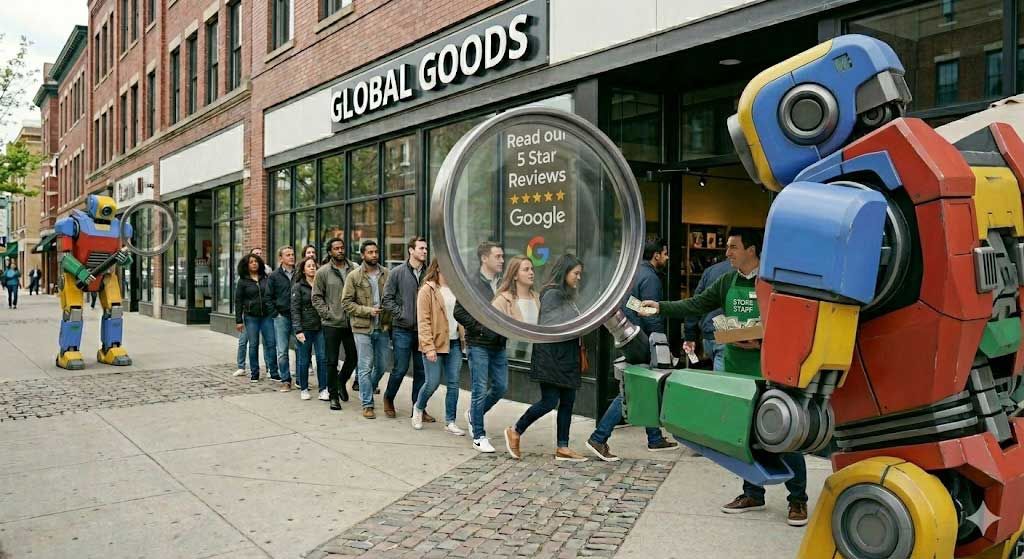
This episode explores three major shifts: Google’s tightening review enforcement and what signals drive removals, Meta’s potential rise past Google in digital ad share despite ethical concerns, and the growing but under-measured impact of AI on search behavior. Together, these trends reveal a rapidly evolving landscape where traditional SEO, attribution, and customer journeys are being fundamentally redefined.
The Podcast Deets
1. Google Review Crackdown (00:00–14:50)
Google’s updated policies targeting incentivized reviews, especially those tied to employee names and unusual volume patterns at a store location. Enforcement appears algorithmic, combining multiple signals. Businesses must rethink review generation strategies and normalize volume.
2. Meta vs Google + Ad Market Shifts (14:50–23:15)
Meta is projected to surpass Google in ad share, even amid legal and ethical controversies. Rising costs and declining ROI clarity are pushing marketers to diversify channels, highlighting growing the conflict of marketers dealing with Facebook despite their unethical behavior.
3. AI Search & the Future of Discovery (23:15–End)
AI tools like ChatGPT and Ask Maps are reshaping search behavior in ways analytics don’t capture. Google’s infrastructure advantage positions it strongly, while OpenAI may pivot enterprise. The future of local search will be conversational and intent-driven and is likely driven by Google.
Key Takeaways
- Google's newest review enforcement to prevent in-store pressure is multi-signal
- Review volume spikes + named employees = risk factors
- Meta’s dominance persists despite serious ethical issues
- Ad ROI is becoming harder to measure and justify
- AI is already changing behavior—but analytics lag reality
- Google has structural advantages in consumer AI
- Ask Maps signals a shift to conversational local search
- GBP content must evolve to answer complex, intent-rich queries
Related Links
 Mike Blumenthal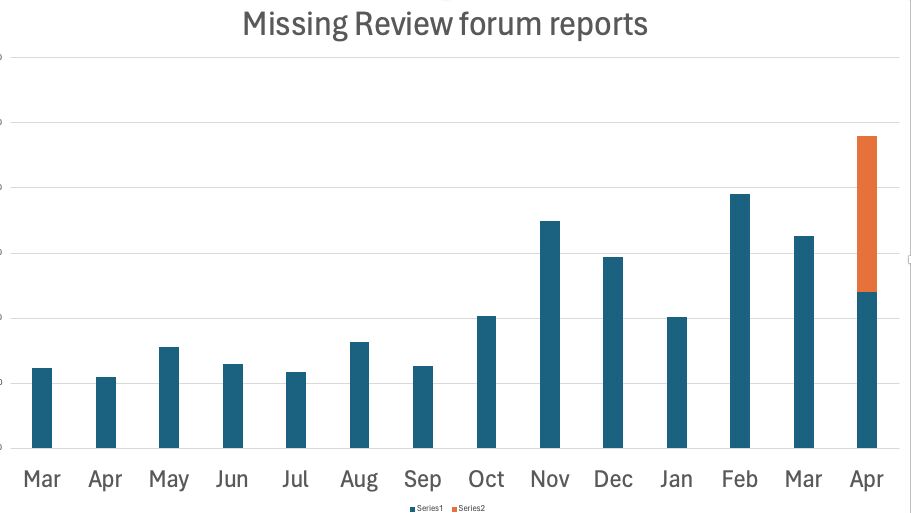
 Mark Ritson
 Douglas Clark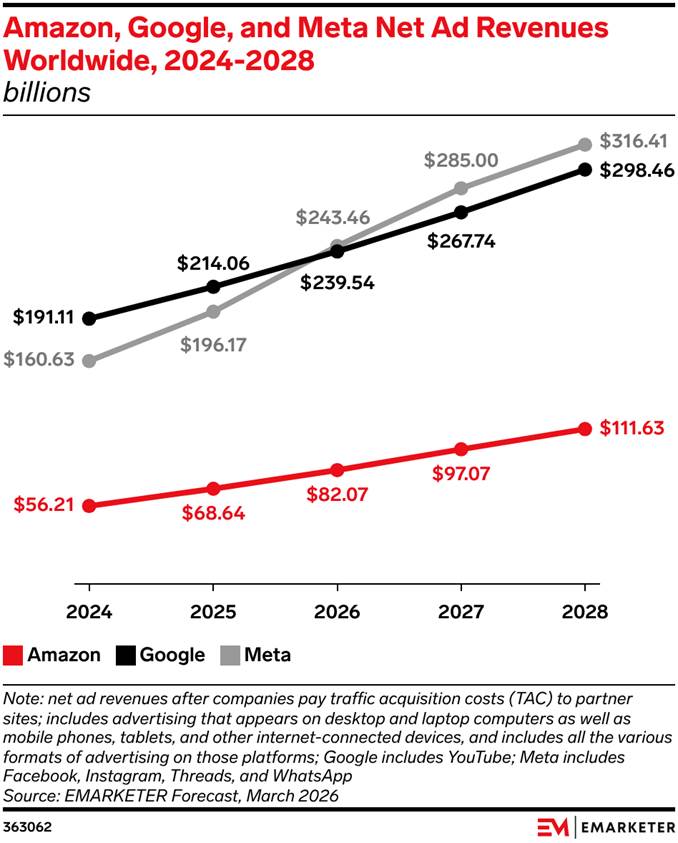
 Apr. 16, 2026
👇 Watch by topic:
00:00 Intro & Episode Overview
01:00 Google Review Policy Updates
04:30 Review Removal Signals & Missing Reviews
08:00 Point-of-Sale Reviews & Incentives
12:55 Ethical Review Strategies
14:50 Meta vs Google Ad Market Shift
18:00 Rising Costs & ROI Challenges
20:30 Meta Legal Issues & Ethics Debate
23:15 Section 230 & Product Liability Theory
26:50 AI Search Behavior Is Changing
28:15 Ask Maps & New Discovery Patterns
31:00 Who Wins AI? Google vs OpenAI vs Meta
34:00 Future of Search & Monetization
Interested in sponsoring this podcast or our newsletters please reach out to mblumenthal@nearmedia.co
Full Transcript of the Near Memo EP 252 – >
Episode 252: Near Memo Transcript
Greg Sterling: Hey everybody, welcome back to the near memo coming off a great episode last week with Cyrus Shepard where I was not present.
Mike Blumenthal: and a great green room session. We could have recorded a whole podcast in the green room.
Greg Sterling: I'm This is Episode 252, remarkably. And it's me and Mike today. And we're going to be talking about some updated review guidelines and a range of issues tied to reviews, like the signals Google's relying on to remove reviews, our point of sale reviews being penalized. We're going to talk about the eMarketer projection that Meta is going to surpass Google as the largest internet ad platform and some associated issues there. And then we're going to have a kind of broader discussion about AI and where we are. And Mike and I have some different opinions about who's going to win and what's really going on with consumer behavior. So let's jump into the reviews. show us the, show, yeah. Yep.
Mike Blumenthal: Sure. Well, before I show you the chart, just want to put this into context. So Google updated their review practices and policies several weeks ago. I think it was first noticed by Amy Toman on LinkedIn where they, a week or so ago, they noticed, they note that merchants, it's prohibited for merchants requests that staff solicit a certain number of reviews and it's prohibited that merchants requests that staff solicit reviews that include specific content, including content that identifies a staff member. Those are two relatively new things. And then one that's sort of old, but is not widely that I think Claudia Tomina talked about, but content exhibiting unusual volumes or patterns of review contributions that are indicative of efforts to manipulate a places rating. And then the final little snippet in that is that Google does allow merchants to solicit or encourage the posting of content that represents a genuine experience without offering, of course, incentives or gating. or they shouldn't attempt to influence the rating of or the contents of the review. So it's OK to ask, but you shouldn't be you should. You don't want to be exhibiting unusual volume. And you if you're you don't want be including, asking for specific content. the context is sort of new as well. so what I, you know, I'm a product expert, I...
Greg Sterling: Can I just say to people like us that sort of live in this world and are very fixated on all the nuances of these little changes, this may add some clarity to what's going on, but to an ordinary business that isn't going to really be aware that maybe these even exist or understand the distinctions between what was existed before and what exists now. They sound like they're talking out of both sides of their mouth in a certain way. You can solicit, but you can't do this and that and the other. You can ask for reviews at the point of sale, but you can't do this and blah, blah, blah, blah,
Mike Blumenthal: So a lot of my clients, not a lot, but for me a lot, reached out this week and wanted to know because they use name and review as they incentivize salespeople and people on the front lines. And the metric they use is if the name is in the review, they incentivize that employee. So instead of incentivizing review, they incentivize. Right. They reward it. And so several people reached out to me and asked me if I thought this was a real rule and if Google is going to enforce it algorithmically. And the reality is that it's a fairly trivial, given the state of AI, it's fairly trivial to enforce it algorithmically. I think though you have to view it in the context of volume and other things. Sometimes a review is going to have a user's name. It's going to be a salesperson's name. It's going to be a totally legitimate review. Other times, if they're getting 10x the volume of reviews, And there's a bunch of names in it. I think the combined signal is going to lead to a series of large takedowns. Now, one of the sort of early indicators I use of an update to the filter is posts in the Google forum around missing reviews. I think you can see this that in April so far, we've almost had as many reports as we had in March. You can see over the last year, a general increase in review, missing review reports. But this April, there's a particularly large uptick in the first two weeks. So the red line is my projection for the rest of the month that it looks like there are reviews being taken down. Now, I don't know that these posts are about reviews with names in them. It just appears that Google is generally tightening them. I think it could be around a combination of volume and other signals like names combined. And so I think that businesses, one, need to look carefully at how they incentivize employees to ask for reviews. I think they should perhaps use some metric other than the name in the review to reward them. In other words, tie the user to the account. best you can, sales rep to the business account as best you can, or the person's account as best you can. And I think you need to be really careful about special events where volumes go beyond average. think if you can sort of mitigate those three things without freaking out about it, I think you're going to be fine long haul. was just as a reference, I went to a restaurant a month ago and the waiter said to me, gee, and he was a very nice waiter had a great conversation with him. he said that if I mentioned his name in a review, he would get free lunch. So he was incentivized to ask me for review and he got free food. So I put his name in the review. went back to check and all of their reviews are still there. Now that doesn't tell us much other than having gone back and looked at excessive volume. It could be they haven't gone back and looked at excessive volumes of names or it be that Google's gonna find those acceptable given their normal volume. Don't know yet. So I think you need to not freak out. I think you need to keep close track of all of your reviews so that if there are missing reviews, there's a form at Google support, or if you fill it in, you can tell them how many reviews are missing. But if you need to provide them with usernames to have any chance of getting those reviews back, because Google says, if you don't tell us who's missing, we can't tell you why they're missing. So then it can help you. So keep track of them. So sort of. Even out your review volumes, don't get crazy. I think find a different mechanism to reward employees for getting reviews to measure rather than name. And I think you'll be okay.
Greg Sterling: I mean, Google, it seems to me, is trying to shut down the system of internal incentives where employees are rewarded for soliciting reviews. I think that's a rational and effective tool that businesses have been using to get reviews. And I think Google is trying to shut it down without explicitly saying you cannot incentivize employees because they can't police that itself. They can police review volume. You know, another thing that's relevant is and they can police names, but they can't police incentives, direct incentives. Yes, right. So I think what we have to do, which you just said, is we have to look at combinations of factors. Google has multiple signals that it's looking at to determine whether reviews are unduly influenced or improper. And one of those is volume, clearly, and another one is names, as you just mentioned. Claudia had earlier talked about seeing restaurants penalized where she sort of through the inference that the point of sale solicitation of a review was something that Google was cracking down on. And that is something.
Mike Blumenthal: Wasn't just restaurants. was, I think it was a cannabis store or something where they got it. And they had a contest at point of sale. It was retail.
Greg Sterling: OK, retail, retail, sure. OK, retail. So Google can see, at least in the case of Android and maybe in the case of the iPhone, they can see where the user is. And if the user's location is physically at the point of sale, the business premise, and that's where the review is coming from, I was operating under the assumption that they were drawing an inference that that was improper. What Google itself says, and I've had two people from Google say a version of this to me, is they're really concerned about influence and pressure, which they cannot see and they cannot discern from the behavior. What they can do is they can say these signals together, point of sale, solicitation, excessive volume, et cetera, et cetera, looking at all these factors, they can say this is likely a review that was improperly gained through incentives or pressure or what have you. And it raises the question, which we don't need to get into at length, what is pressure? There's a continuum. Is somebody persistently asking you to review them, like a waiter who says, this happened to me in Mexico, which I wrote about, waiter in this Indian restaurant, Señor Nón in Mexico, which is a very good restaurant, by the way, put the QR code in the little check where the check goes. There it was. And he pointed to it. He said, essentially, leave us a review. And then he did it a couple other times before we left. He wasn't pressuring us per se, but that might be seen as pressure, which is something that Google has no capacity to observe. how, other than a user saying,
Mike Blumenthal: And they're trying to thread this very thin line between solicit and too much solicit. Too much rights. You can solicit this much, but not that much. It's a very thin line. So that is the confusion. And I think that you as a business need to assess your business model. One, are you a location-based business? Two, do you have events where you might have this higher volume of reviews? And three, are you using employee names to track?
Greg Sterling: Solicitation and pressure. Right, exactly. That's right. That's the confusion. That's the crazy thing is, yeah.
Mike Blumenthal: Now, a service area business is going to have a different issue because there's no location data, right? And so one presumes that the volume and the name, you know, whatever the metrics are, have to be higher to make up for the location information, right?
Greg Sterling: There's no location. are going to be more heavily weighted. Right. Right. And so many service area businesses will do that. They'll finish the job, and then they will solicit a review on site. I've had that experience a number of times.
Mike Blumenthal: Right. Exactly. But I think if they switch the metric they use to reward, particularly in service area businesses, this shouldn't be hard. The electrician knows that he went to House, Blumenthal House, Blumenthal left to review. That should be plenty of metric to incentivize to pay the electrician. I don't think that I need to have the electrician's name in my review. for them to know that I did business with them.
Greg Sterling: Well, that's key thing for service area businesses. It doesn't work as well for traditional storefronts, obviously.
Mike Blumenthal: Right, but my sense is, and this is a gamble that the business is have taken, I'm not gonna be responsible if I'm wrong, is that if you can keep two of the three sort of modulated, then you're gonna be okay. In other words, if you don't have massive increase in volume at your location, but you do have some with names, I think you're gonna probably still be okay if the volume stays at whatever it was. Hard to know. mean, Google could go sweep through and look at all your reviews at some point as they sort of wind through their system. Because what they do is they go through old reviews in waves. New reviews get the new metrics, the new filters. Old reviews, the filter gets applied to slowly as they work their way around the world. So we don't know yet what's going to happen. But my sense is that if you have to deal with it differently, if it's a service business or a location-based business, I think if you're having an event, don't tie it with review solicitation at the event. Keep your volume fairly steady and pretty, and I think you'll be okay. But if I'm wrong, let me know.
Greg Sterling: Right. Right. Well, I mean, if you have a bunch of people, this is not unethical. you have a bunch of people show up, grand opening for the restaurant or the store or whatever, a bunch of people show up, they give you their emails or you have their emails, and then subsequent to their visit, you send an email out with the link, which Google provides, and you say, hey, thanks for coming in. If you enjoyed our stuff, feel free to leave us a review here. That's completely ethical, but it may result in excessive volume. It could result. Why? Why wouldn't it?
Mike Blumenthal: Totally ethical and probably wouldn't result in excessive volume, right? And because the response rate to email is lower, you're gonna get a 10 % response rate as opposed to a 60 % response rate. So the overall volume is gonna be less.
Greg Sterling: Yeah, maybe, maybe, maybe statistically that you'll be protected. anyway, all right, let's move on to our sort of, yes, yes.
Mike Blumenthal: I think one other point for business people to keep in mind is that, and I see this all the time, that reviews cause a great deal of angst in business owners because they feel it's an unfair system. They're being singled out. They're doing the best they can. They take it very personally. And the reality is over time, you will lose reviews. If you're well organized, you can dispute that. If you're not, you just need to move on and get more reviews.
Greg Sterling: Well, they take it very personally. They take it very personally, yep.
Mike Blumenthal: You and you can't let this drive your emotional state. It's like, I see it all the time.
Greg Sterling: Well, this is... Right, this is a very important point. It's a process. It's not something that they should be attached to or fixated on. You just have a process in place that produces reviews over time and let go of your attachment to particular reviews. It's a Buddhist take on review solicitation. There you go. All right, OK.
Mike Blumenthal: Exactly. Here you go. Or don't take you can't control the things that you can't control.
Greg Sterling: OK, so let's talk about Google and Meta. So eMarketer came out this week, I think, or maybe late last week, and said, Meta is going to surpass Google as the world's largest digital advertising company. And that would mean that they were now at 27 % of global ad spend, and Google was going to be at just below that at 26.4 % of global ad spend. And this is a projection. So it may or may not have, you know, it's informed by all kinds of data and, know, they've certainly been wrong before. But the point is that Google is potentially losing its position as the number one ad platform, which is on one level quite significant on another level, not really, because Google continues to grow its own revenue. And to that point, the IAB put out a report, 2025 full year advertising report as they do every year. which is interesting. And what it shows is that in 2024, search grew 16 % year over year, which is almost, that's Google basically. And then in 2025, only 11%. So there was a 5 % or 5 point rather, not 5%, 5 point deceleration. And the report also talks about the diversific
Mike Blumenthal: Is that in total searches or users searching or a revenue?
Greg Sterling: No, this is revenue, revenue only, revenue only. And what is also in the report, I mean, there's a lot of stuff in there. It's interesting, worth reading. what's also in there is this idea that people, and they've been doing this for a while, but there's more diversification going on, video, social media, other channels beyond search. That's always been true that people have used other channels and it's always been true that people have moved money into those channels to bolster their position. But it does seem like now there is some, some migration away from, from Google, which is still going to take a huge amount of ad revenue. But, you know, I think marketers, SEOs are, and, digital marketers generally are frustrated by you know, the sort of decline in clicks we've talked a lot. Rand Fishkin has talked a lot about zero click search and AI is contributing to that. So we're, we're in an interesting time. you know, and we've had a number of calls with, people who are small businesses and digital marketers. And there's a lot of confusion that is reflected in those calls. and in surveys that I've done, people are confused about what's working. You know, there's genuine confusion about how to put all the attribution, what's working. That's always been the feature of internet marketing, but it seems like it's much more true today as a general matter. But then...
Mike Blumenthal: Part of the problem too is that Google has been raising prices. So the ROI, which used to be obvious and high is no longer an obvious use case, right? As they've jacked the prices. And even as users have become, our research have become more acclimatized and more willing to use ads, it's not clear that the value is there. I some of these LSA ads per click are
Greg Sterling: Depending on the category, right. Right, and Google is essentially forcing people by pushing organic. You've got LSAs, you've got the AI overview, and you've got the organic stuff. By pushing that further and further down the page, it compels people to advertise to get visibility and clicks. So it's just interesting to see that we're at this point in the market. We've got AI. We've got Meta sort of. gaining, we've got Google still very profitable growing because they're jamming more and more ads everywhere, but maybe losing its dominant position. then advertisers frustrated marketers, not just advertisers frustrated by attribution challenges, ROI challenges, increasing cost. Yes, right. then you add AI into the mix and there's a lot of...
Mike Blumenthal: some of journey challenges.
Greg Sterling: confusion about the role that that's playing. But let's talk real quickly before we get into AI about something you posted on LinkedIn this morning, an Adweek article illustrating Meta is an ethically challenged, I mean, all these companies are ethically challenged to varying degrees, but Meta is a supremely ethically challenged company. We don't need to do the litany of bad behavior. Most recently, there were two trials that they were found liable in. One was a New Mexico trial that involved child safety. And the other one was a trial in state court in Los Angeles that employed the sort of big tobacco product theory of liability. And they were found liable by the jury for creating an addictive and defective product. There are some federal cases coming up that employ that same product defects or addiction, addictive product theory. And we'll see how those goes, but what they see how those go, but what they represent is a kind of sea change in the attitude of the public toward these companies, right? I mean, for years and years and years, they were able to hide behind section 230 immunity and avoid any kind of accountability responsibility for the shit that happened on their platforms. And there has been an attitudinal shift among the public toward these companies, which has enabled now these legal theories that would have been perceived as inapplicable or outrageous like product defect. to succeed because the public thinks these are companies that are up to no good. So you found the headline. What was the headline?
Mike Blumenthal: So the headline from Adweek was, Meta has made child exploitation a cost of doing business. The subhead was, for today's chief marketing officers, Meta has always been both under legal scrutiny and the best performing buy in their marketing plan. the, just highlight, and this isn't the first sort of super egregious conviction on the part of Facebook, right? There was a privacy scandal in 2017 where they were involved in hijacking elections. And there was the fact that they make 10 % of their profit from scams that they know are taking place and they look the other way because it's such a profitable thing. And yet, and so they have always been an ethically challenged company. Right, and you can see this in marketers own behavior, right?
Greg Sterling: they've had all the privacy stuff. Right. It doesn't seem to matter. Doesn't matter. Doesn't matter.
Mike Blumenthal: Every marketer I know left Twitter in moral outrage, but most of them went, many of them went to Threads where they get better exposure. Now, I don't know if you're going to have moral outrage. seems to me Facebook deserves as much moral outrage, if not more than Elon Musk and Twitter. mean, they're both, both their CEOs and the companies have checkered pasts, but of them, which does the greater damage? It's not Twitter, it's Facebook in terms of society damage.
Greg Sterling: Yeah, yeah, yeah. Well, this to me, I mean, we can argue about the willpower of individuals or the kind of hypocrisy, but this to me illustrates the position of these monopolies, right? You are compelled to use them. If you're a digital marketer, if you're a company, you are compelled to use these platforms. mean, Google is a monopoly also. Facebook is a monopoly.
Mike Blumenthal: with some ethical challenges, historical and current that are really questionable as well.
Greg Sterling: Google is better than Facebook, not, I mean, not tons and tons in my mind.
Mike Blumenthal: They're not as pure as the driven snow.
Greg Sterling: Well, yes, this is a larger philosophical debate about guardrails and self-regulation versus.
Mike Blumenthal: It is the nature of how large, most companies work, but large companies particularly.
Greg Sterling: They will push to the limit of the law and beyond it sometimes to make as much revenue as they can.
Mike Blumenthal: and calculate that the losses due to the violation of the law are sustainable or at cost to a business.
Greg Sterling: are costs of doing business. That's how they've Europe, which has tried to regulate privacy and other things. They have seen violating those rules as simply a cost of doing business, which caused Europe to pass the digital DMA and the DSA, the Digital Markets Act and the Digital Services Act to increase the penalties to the point where they couldn't simply be a cost of doing business.
Mike Blumenthal: An interesting question sort of related to this, but not totally, but it's about Google. And one of the things that's happened in the last couple of weeks is the success of a novel legal theory that these products are defective in design and thus, and that extends to YouTube. it allows the plaintiffs to avoid the question of 230 protection that Google, Facebook, and all these other companies have long had. What I'm wondering is,
Greg Sterling: And that extends to YouTube. That extends to YouTube.
Mike Blumenthal: If one views Google Maps as a defectively designed product because it's so easy to hijack a business, to hijack a phone number, to create fake businesses and to post fake reviews. If you use this argument that this isn't just protected 230 speech, but is really a defective product, would Google have lose that case and what would be the result?
Greg Sterling: Well, I'm not sure what you described in the Maps case is the same as what was being litigated and what will be litigated in the Meta and YouTube case.
Mike Blumenthal: Well, the impacts are different, but Google has a product that allows a consumer to change business information that often leads to scams and to the loss of the part of business and deception of the consumer.
Greg Sterling: Right. Right. Will the product defect theory extend to this kind of use case that you're describing? Well, think it may be litigated. mean, Google has, this backs onto the question for 230 purposes, is Google a publisher? Publishers are not immune. Platforms are immune, but not publishers. And Google is in a very gray area. Content moderation does not make you a publisher.
Mike Blumenthal: Yes, that's the question I am asking.
Greg Sterling: But Google's all the Google AI stuff, what it's doing in Maps, arguably makes it a publisher. And so 230 should not apply, right? They are publishing new content that is not created by a third party in AI overviews.
Mike Blumenthal: Yeah, there's a lot of novel ways to go after Google. be interesting to see if anybody does.
Greg Sterling: Well, but I mean, a lot of the problems, and we can move on to the AI discussion, a lot of the problems that have come out of the fraud, the disinformation, the misinformation that is going on, chiefly on social media, but also on Google to a lesser degree, YouTube in particular, would be solved if 230 didn't exist because they would be compelled to do responsible moderation. And they don't, in fact, they're not doing any moderation. mean, what happened on Facebook was all the conservatives said, oh, you're censoring conservative positions, which was not true. And then they stopped doing moderation. When Trump got elected, they stopped doing moderation. And now they're doing reverse moderation, which is censoring some of some and you know certain kinds of political positions that are seen as contrary to their interests.
Mike Blumenthal: Well, I think though that the most recent cases point out a direction that doesn't require getting rid of section 230. It requires a more technical view of these products and viewing the impact of design decisions on user behavior and user right and on fraud and crime. And I think, you know, we'll see. And AI is going to raise that question too. So as they say, we live in interesting times.
Greg Sterling: on user engagement and retention, yep. Yeah, Okay, so just to wrap up a kind of a quick discussion about AI, know, obviously tons and tons and tons of stuff always going on. You know, David Mihm has said.
Mike Blumenthal: Not the least of which is AI for Maps.
Greg Sterling: Right. Well, that's a huge topic. think I am very bullish in a certain way about Ask Maps. Some people don't like it. I think it is the future of Google Maps. And yes, we will talk about it, the future of the user experience and what marketers need to do to prepare. Because I think the way you have to approach content on Google Business Profile, and maybe more generally,
Mike Blumenthal: We were talking about having a panel on just this topic.
Greg Sterling: It's very different in an Ask Maps scenario versus a straightforward Google Maps scenario where you're saying, best brunch near me, or is this particular place open, or what are the directions to this place? But when you start using very complex queries that have multiple criteria in them and you're asking all kinds of questions about the business, the AI is cultivating new behaviors for search. you know, the experience of these conversational queries is being imported back into Google. And that will change the way in which you have to meet the moment as a marketer by providing content that answers those questions. And I think your, your, your GBP starts to look very different than just a catalog of facts about your business, you know, over time. But, but anyway, so just real quickly, you know, when I was in, in, in, Mexico a couple of weeks ago,
Mike Blumenthal: Great.
Greg Sterling: I use ChatGPT a ton, I use Ask Maps a ton, where it was available, it wasn't always available to me. And I used regular Google only in cases where I was looking for a brand and I was looking for walking directions to the place. And the combination of Ask Maps and ChatGPT were just enormously helpful. And it causes me to reflect on my own changing behavior. And then I subsequently had, I wrote about this on LinkedIn and in the newsletter, I subsequently had some car related shopping things. I got back and it's like, suddenly I have to do a bunch of stuff on this one car. And what I did is I just used AI. I used, what? I thought you were laughing at me, not coughing. Yeah, I do too. I have terrible allergies.
Mike Blumenthal: No, have a seasonal cough.
Greg Sterling: I used AI, these were product and service search questions to identify the problem and then to find businesses. And then I used Google to validate as we've discussed a bunch. And these are isolated anecdotal examples, but I think search behavior is really changing, especially product search, but also local search. And it's not being reflected in the referral data. It's not being reflected in the analytics. And I think that a lot of SEOs don't think that it's changing because they say, hey, look at this. And it's mostly desktop clickstream data also that's being used in this discussion. The percentage of volume that is being, referral volume or traffic is just de minimis. And this AI thing is being really overhyped. And I think That's an overly simplistic and incorrect answer. And I think what's happening is there's a lot more complexity now in how people are engaging with Google, how people are using AI in tandem with Google, even Google's properties. And it's just not being captured in the analytics. It's just not being seen by marketers. And so they're not correctly understanding how, and I'm speaking in generalities, and this is different from category to category, how user behavior is changing. I mean, we can see it in our research.
Mike Blumenthal: But also I think your definition of AI needs to be explicit.
Greg Sterling: I'm including Google. I include Google in that.
Mike Blumenthal: But it needs to be explicit. It's chatbot AIs, which means largely it's Google OpenAI, ChatGPT, and to some lesser extent, Claude /Perplexity, right? And the reality is, from where I sit, is that there's really two markets for AI right now. One is the corporate market, the enterprise market, which Claude's going after very aggressively.
Greg Sterling: Mm-hmm. Enterprise. Yep. That's all operational stuff and internal stuff and all of that. Yep.
Mike Blumenthal: Bright coding and management and finance. And then there's chat, which is very consumer driven, which initially ChatGPT went after. But as you start reading about ChatGPT's problems, overextended, they're going after enterprise, Right his house being bombed or whatever. But what you see is that consumer driven chat is very expensive.
Greg Sterling: Sam Altman. Molotov cocktail.
Mike Blumenthal: for people like ChatGPT So it's one of the reasons they're pulling back is their model that they developed, is hard to make a living on $20 a month with very expensive inference costs. There are only two companies that I think are likely to be frontier AI and consumer focused in the end. One is Google, which has a great ability to lower the cost of inference and understands fast delivery speeds and how to cache answers so they don't have to continually have the expenditure. They run their own chips, et cetera. mean...
Greg Sterling: Well, right, Google is the only company that owns the entire tech stack for AI. That's a very significant thing.
Mike Blumenthal: Right, and that speaks to a consumer fulfillment. And the other is Facebook, I think, has the opportunity with their recent changes in their AI stuff to deliver consumer base. But I see ChatGPT as not being a force, nor do I see Claude currently configured or, you know, or even, I don't see how they get profitable enough to be consumer facing AI tools.
Greg Sterling: What co- Well, Claude is not emphasizing consumer. I mean, you can use Claude as a consumer tool and it'll search the web. Claude is not emphasizing that. They're clearly betting on the enterprise and all these B2B facing tools. And I think that they have...
Mike Blumenthal: And I think what we're seeing with OpenAI is that is there transitioning to that also because the high cost of inference.
Greg Sterling: But they're not abandoning the consumer market. What they have abandoned is their grandiose instant checkout, we're gonna take a piece of all these e-commerce transactions. They've abandoned that because they either thought that that was too difficult or consumers weren't biting. know, ChatGPT is...
Mike Blumenthal: I think those abandonments are a foreshadowing of ChatGPT cutting back on consumer focus, which changes this discussion. So this went from defining what AI is. So right now it's Google and ChatGPT and to a lesser extent, Claude, and then how that affects the customer journey. And so from my point of view, given those economics, the customer journey, which is currently more mixed, but Google's goal and
Greg Sterling: Well, it's some, it's.
Mike Blumenthal: Amazon's goal and everybody else's Facebook's goal is to consolidate using what they have, which is huge cashflow to dominate the consumer interface on that AI so that they then can simplify the customer journey to benefit them.
Greg Sterling: Well, so they can then not lose engagement in revenue is what it ultimately amounts to. I mean, everybody, everybody, you know, there are a lot of people out there saying, oh, it's going to be, you know, Q1 2027, Google's going to flip the switch and it's going to be AI mode and that's going to be the SERP. And I just don't believe that partly because Google has so many interfaces running around that they're testing, but also they're just not going to monetize AI mode.
Mike Blumenthal: Exactly. Right.
Greg Sterling: to the same degree that they monetize the current SERP It's just not, unless what they do is they give us a dedicated ad block and then AI mode down below or some, it's gonna be a hybrid in some way because they can't, they can't.
Mike Blumenthal: But I think we are seeing foreshadowing of this in Ask Maps. They created a separate user interface for Ask Maps with its own unique button. But there's no reason that their system can't get intelligent enough to understand the difference between a near me query and an AI query in a single user interface where they then present the results. and, and, and.
Greg Sterling: Set a separate button. Right. 100%.
Mike Blumenthal: present them profitably in the case of maps with the ability to continue on to make the reservation or whatever it is is the appropriate call for an appointment, whatever.
Greg Sterling: 100%. Right, I mean, and that's what they should do. They should integrate those things because it's just really awkward. This is a feature, this is a function of it being new. One of the interesting things to consider, and not everybody is as enthusiastic about Ask Maps. I mean, I was never using Google Maps outside of work just to test things. I had abandoned it. I used Apple Maps and I used Google Search for local searches where I need a category search. But Ask Maps has prompted me to use Maps again because it's more flexible and it's more interesting. And I wonder if Google does what you describe, which is the complete integration of conversational UI into, you know, this with this local graph behind it and all the other stuff with maps and navigation, whether that would that would kind of siphon off traffic from Google itself. right, which is where most of the local search happens. whether, I mean, on a desktop, people are going to go to Google. They're not going to go to maps.google.com and then do a search. But on a mobile device, they might abandon Google and go just to Maps for local search. I could foresee that because it's a better experience. And it's going to be less aggressively monetized than the regular SERP.
Mike Blumenthal: Yeah, I think it'll depend on the environment. mean, in an iPhone right now, it's very app-based. It's very split up. Like there's the Google app, there's Safari, there's Apple maps, Google maps. It's very fragmented. And so it's a bigger problem than an Android where they control the whole stack there. I mean, it's conceivable to me that there's going to be a search bar on Android that makes a decision whether to go to search or maps or where it's going to get the best answer. Right. Right.
Greg Sterling: Yeah, just on the homepage, right? Right. That's very true, very true. Different experience. The antitrust court, the search and paid search antitrust trial that found Google liable and found Google to be a monopoly. And then the remedies portion of the trial, which kind of chickened out. One of the primary concerns was that Google was going to leverage its search monopoly to dominate the AI. you know, kind of world by, tying things together by, by just taking that search traffic and, and exposing people to AI. And that's precisely what they're doing. That's their playbook. And the court should have acted more aggressively to prevent that from happening because I do believe like you, that Google will eventually be able to capture, a, a substantial, a sort of plurality of search or of AI usage. or the outright majority of AI usage by using search and by using Android and by using all these distribution channels that it has. And a lot of people...
Mike Blumenthal: and for enterprise by integrating it into their office applications, right? Absolutely.
Greg Sterling: Claude and all of that. Yep. Well, Microsoft has been trying to do a version of that strategy and it's completely failed.
Mike Blumenthal: Thanks.
Greg Sterling: But Google's in a different position. All right. As always, more to talk about. But thank you very much for listening. All the things that people say, tell your friends, click and subscribe, blah, blah, blah, blah. Thanks again. And we will be back with more guests in the future and the dedicated session on Ask Maps and what marketers should be thinking about doing in response to that. So have a great rest of the week, and we'll see you next time.