
EP 246 - Inside the LSA Agency Model (Former Google Insider Explains)
How are agencies turning Google Local Service Ads into a scalable service? In this Near Memo panel, experts from Leadwise HQ, Reputation Arm, Sterling Sky and Google’s product expert community discuss LSA strategy, pricing, lead quality and fraud.


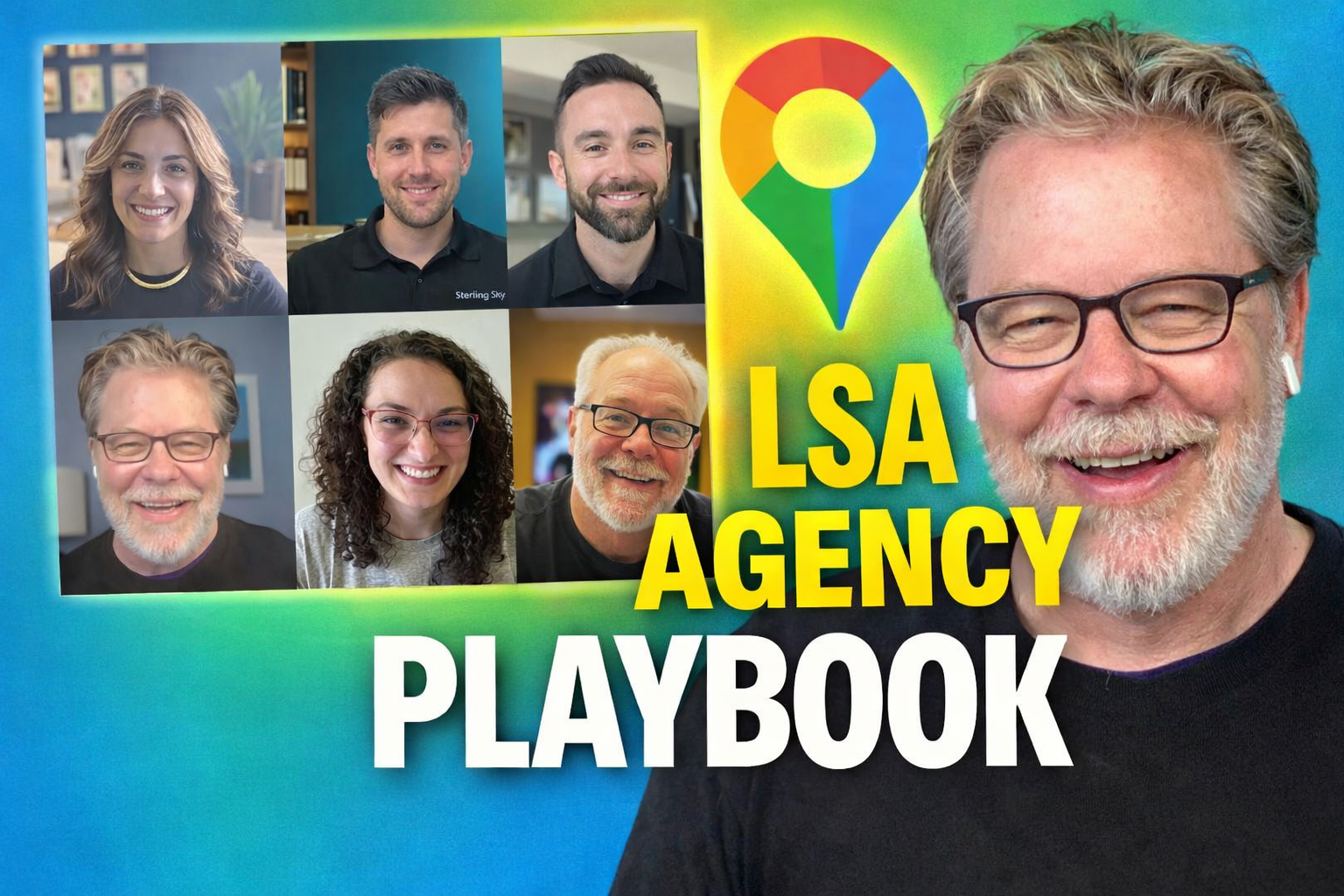
In this Near Memo panel discussion, Greg Sterling and Mike Blumenthal bring together Eric Levine (Leadwise HQ), Claudia Tomina (Reputation Arm), Matt Casady (Sterling Sky), and Crystal Horton (Google Business Profile Platinum Product Expert) to examine how agencies are building services around Google Local Service Ads. The conversation explores ranking factors, pricing models, fraud challenges, lead quality issues, and how agencies set expectations with clients when managing LSAs in competitive markets.
Interested in sponsoring this podcast or our newsletters please reach out to mblumenthal@nearmedia.co
The Podcast Deets
1️⃣ How Google Local Service Ads Actually Work (00:10 – 14:30)
The discussion begins with an overview of Local Service Ads and why they have become such an important part of Google’s local search ecosystem. Former Google employee Eric Levine explains that LSAs operate differently from traditional Google Ads, relying heavily on trust and responsiveness signals rather than pure bidding power. The panel explores the three primary ranking factors behind LSA visibility: reviews, service radius, and responsiveness to incoming leads. Reviews influence both consumer trust and algorithmic ranking, while responsiveness measures how consistently businesses answer calls and respond to inquiries. The panel also discusses how LSAs are increasingly connected to Google Business Profiles, meaning reputation management and local SEO signals may indirectly influence ad performance.
Key Takeaways
- LSA rankings are primarily driven by reviews, service radius, and responsiveness.
- Unlike traditional PPC ads, LSAs cannot simply be bought to the top position.
- Google Business Profile signals and reputation management likely influence LSA performance.
- Businesses must manage reviews and lead response processes, not just ad settings.
2️⃣ Fraud, Lead Quality, and Managing LSAs for Clients (14:30 – 33:00)
The panel then turns to the practical challenges agencies face when managing LSAs for clients. Fraud remains a persistent issue in some verticals, particularly in industries like locksmiths, garage doors, and legal services. The group discusses how Google has strengthened verification processes, including identity verification and tighter integration with Google Business Profiles. Despite these improvements, agencies still encounter fake listings and difficulties removing fraudulent competitors. The conversation also covers lead quality and the removal of Google’s lead dispute feature, which previously allowed advertisers to contest invalid leads. Without that mechanism, agencies must focus on expectation setting with clients and careful campaign management to ensure LSAs remain profitable.
Key Takeaways
- Fraud and fake listings still occur in certain high-risk industries.
- Google has implemented stronger verification processes, but enforcement remains inconsistent.
- The removal of the lead dispute feature makes bad leads harder to challenge.
- Agencies must set realistic expectations with clients about lead quality and competition.
3️⃣ Building an Agency Model Around Local Service Ads (33:00 – End)
In the final segment, the panel explores how agencies are turning LSAs into a service offering. Different pricing approaches are discussed, including flat monthly management fees, consulting retainers, and hybrid models that combine LSA management with broader local SEO services. The panel agrees that LSAs have evolved from a simple DIY product into something that often requires specialized expertise, particularly in competitive industries. The discussion concludes with a look at the future of LSAs as Google integrates AI-driven search experiences. Rather than disappearing, LSAs may become embedded within AI-powered recommendations that guide consumers to trusted service providers.
Key Takeaways
- Agencies typically charge flat monthly management fees or consulting retainers for LSAs.
- Successful LSA management requires coordination between marketing, operations, and reputation management.
- LSAs may evolve alongside AI search experiences, not disappear.
- Brand recognition and trust signals may become increasingly important as discovery shifts to AI tools and social platforms.
👇 Watch by topic:
00:00 Introduction to LSAs and the panel
01:30 Eric Levine’s background working on LSAs at Google
04:00 Fraud in Local Service Ads and verification challenges
07:30 Reporting fraud and removing fake LSA listings
10:20 The real LSA ranking factors (Reviews, Radius, Responsiveness)
14:40 Do users actually click beyond the top LSA results?
18:00 Competing in crowded markets like personal injury law
21:30 LSA pricing and cost per lead across industries
24:30 When LSAs don’t work for a client
27:00 How agencies manage and bill for LSAs
30:00 DIY vs agency management for LSAs
33:00 Handling bad leads and the removal of lead disputes
37:00 Multi-quote leads and how Google charges for them
40:30 Photo best practices for LSAs
44:30 Service area targeting strategies
48:00 The future of LSAs in AI search
52:00 Brand search, AI discovery and the evolving funnel
57:30 Final thoughts
Sign up for our new Legal Marketing Newsletter. Once a month, no fluff, just good ideas.
Full Transcript -->
Near Memo Podcast – Episode 246 Transcript
Greg Sterling (00:10)
Hey everybody, welcome back to the Near Memo today. We've got a great group of panelists to talk about LSAs and LSA adjacent issues. Back with us is Eric Levine. We've also got Claudia Tomina, Crystal Horton and Matt Casady. And of course, as always, the lovely and talented Mike Blumenthal. I just love saying that. Did I say it was episode 246? I hope I did. Okay.
Mike Blumenthal (00:33)
Yeah.
Greg Sterling (00:35)
Anyway, Mike, why don't you tell us why we're doing this? We just had Eric for a two-part podcast episode, and now we've gotten back with this group of esteemed panelists. What's the genesis of this?
Mike Blumenthal (00:46)
Well, firstly, I felt Eric is new to the industry. So one, I wanted to be sure he had a good platform, but I wanted to also provide that platform to others. I'm curious about LSAs. I see them as really a very strong play by Google and local as a pay to play avenue. And I am just curious from the point of view of agencies, how you make money with it, what things you can do that can set you apart.
And I wanted to give other agencies some presence in that. And I also wanted to give them a chance to grill poor Eric, because he used to work at Google. So he can uncover all their dirty laundry. Although, as we learned in the last one, he's very circumspect. So you're to have to really needle this poor schmuck to get some good juice out of him.
Claudia Tomina (01:31)
Yeah.
Greg Sterling (01:32)
Yeah, you can just treat Eric like a whistleblower, and this is congressional testimony. OK. All right, so no, there's none of that, of course. So Eric, for people that didn't see the first two installments or our initial interview with you, why don't you just give a little bit of background about your history at Google and with LSAs for context, and then we can jump in.
Mike Blumenthal (01:37)
Yes, that's right. And your relationship with Epstein,
Asking for a friend.
Eric Levine (02:00)
Yeah, absolutely. So I worked at Google for about six and a half years. started summer of 2019 and I came on during the law pilot. this was summer 2019. And so we were cold calling lawyers trying to get them to try Google's newest ad product, local services ads. And we've just seen like a lot of evolution. So I helped the rollout on the go to market side with like healthcare and with the global expansion and then
Yeah, more recently, I launched Leadwise HQ about three months ago, almost to the day. And now we help multi-location operators and we help other agencies manage LSAs and really sort of navigate Google's ever-changing landscape.
Greg Sterling (02:44)
Okay, and do you guys want to say anything about yourselves? Since I mean, I assume most people are going to know you and know your agencies, but do you want to introduce yourselves at all?
Mike Blumenthal (02:51)
Please do, Matt, Crystal, Claudia, take a moment.
Matt Casady (02:53)
Sure.
Yeah, Matt Casady from Sterling Sky. I help our clients. I'm an account manager and strategist and also help our clients with LSAs. I'm kind of the in-house LSA guy, so to speak. And yeah, just been passionate about LSAs since about 2020. I've been super fascinated with how they work. So yeah.
Claudia Tomina (03:17)
And I'm Claudia Tomina with Reputation Arm. And I work with a lot of multi-location brands, managing Google business profiles, listings management, review management, often get sucked into LSA discussions because we're managing for the brand at whole. And yeah.
Crystal Horton (03:33)
I'm Crystal Horton, a Platinum Google Business Profile product expert and a managed partner with Local Services.
Greg Sterling (03:40)
Okay, great. So Mike, why don't you jump in with your.
Mike Blumenthal (03:45)
Sure.
So I've been following fraud on Google for many, many years. I am just curious from each of your perspectives, much fraud and LSA has a long history. First, it was brought out to not to be fraud proof. It was very difficult to get a profile and Google found that that didn't scale very well. And then it was full of fraud. Anybody could get an LSA and everybody used it to cheat. And
subsequently about a year ago, it integrated more tightly with GMB and GMB's verification process. So I'm curious how much fraud you see in the product these days, both on the side of illicit listings and also...
Greg Sterling (04:27)
Thank you for your time.
Mike Blumenthal (04:27)
fraud on click fraud,
if there is click
Eric Levine (04:30)
Yeah, absolutely. yeah, while there like quite a bit of like review fraud, and I think that that probably still happens to this day, you know, it's, only so much that Google can do to try to figure out whether reviews are legitimate or not. And then when you're dealing with such volume, no matter how sophisticated Google's tech is, it's, it's really tough to, to catch bad actors, but bad actors do get caught. There was an initiative in the law.
vertical called IDV, identity verification, which came about, I think we believe, because of fraud, where essentially people have to upload a copy of their driver's license in order to prove that they are who they are. So not just that you have a bar number and that your name is John Smith on the bar website, but you actually have to show your ID. And then, yeah, as Mike brought up, the business affiliation, where the link between the Google Business Profile and LSA, Google Business Profile has to be
verified all the information has to be super consistent. yeah, and then there's always like notorious verticals. I think like the advanced verification vertical is pretty notorious for that. Garage door locksmiths, stuff like that. Especially, you know, also with the review gaming as well. yeah, I'm curious to hear from your guys' perspective as well. What you guys have seen.
Mike Blumenthal (05:41)
Do you guys see much fraud, Matt?
Matt Casady (05:42)
I mean, I'm still seeing,
I still see fraud. and I, like, I would be curious if like, kind of changing the question a little bit, if, anyone has had success getting the fraud removed or like reporting it, because I mean, in every case, like we've, we've set it up the chain through LSA rep and like with anything with Google, it's like, okay.
Thanks for the feedback. We'll send it up to chain and like, you know, nothing ever. you never, the listing is still there a few weeks later and it's like, okay, you know, or even months, but.
So I'm curious if anyone's had success actually getting those removed because we still see it. Like you said, Eric, we see it in the garage door space where, you know, our client has the darnedest time getting verified. And yet they've got several fake listings in their market. That's like obviously fake that are live. Or you see like the lawyers that are the disability lawyer who's serving multiple states and it's like clearly legit, not legit listing, but.
Yeah, that's our experience with it.
Crystal Horton (06:40)
I agree. It's definitely tough, Matt, especially in the garage door space where it's almost 18 plus months to get past that advertiser or advanced verification. Showing proofs of vehicle registration, documents of proof with the government. And then yet these lead gen companies pass no problems within three months. They have a fancy LSA account that's generating over 300 leads a month.
So what I've found to take down companies like that is if they start overlapping between multiple LSA accounts, I report it through our managed partner. That's the best way that I've been able to get it taken down. Other than that, we have to go through the Google Business Profile side of things because the GBP is your source of truth. And so we have better luck.
when we work with Google Business Profile as opposed to LSA support.
Mike Blumenthal (07:41)
So you do that through the forum or through support and then to the forum?
Crystal Horton (07:45)
through support, through the forum, wherever we will get a response through the redressal form, creating a case ID, anything that we need to do in order to just get some attention on it.
Mike Blumenthal (07:57)
So it's usually based on the idea that this location is fake and that thus needs to be removed from the GBP and then subsequently gets removed from LSA. Gotcha.
Claudia Tomina (08:07)
That's really smart.
Eric Levine (08:07)
Yeah.
Yeah, it's tough too, because people will say, hey, my competitor, they're cheating. Look into them. That happens a lot. So I think it's also tough from Google's perspective too, because competitors are constantly doing that to each other. We know that they'll call each other's ads and try to run their ad budgets up, but also calling out frauds, that's a big thing. I would even tell people not to not waste your time.
with it, but there's not much bang for buck trying to take competitors down. But yeah, it's tough. Google wants to take them down because it doesn't make Google look good when that happens, but it's trying to suss out. Sometimes it's a lot of he said, she said, and it can be really, really tough to figure out who's legitimately committing fraud and who's not. then is Google going to be paying somebody to be investigating that full time? Because it would be thousands, probably tens of thousands.
of cases either per month or per year that they would have to be looking into. it's fraud is really, really tough. It's got to be super, super explicit that somebody is clearly violating the policies that you could see externally before they even took a look at it.
Mike Blumenthal (09:11)
But there
isn't any, like in GBP there's this process, right? You can report it on maps and then you report it through the redressal form. Then you get a case number, then you can escalate it. Then you can actually, through the forms in GBP, escalate it so that a human or some facsimile of a human might look at it. And then you might be able to go back and say that, oh, I have additional proof and they look at it again. And sooner or later, if you have a legitimate case,
Although again, it may take two or three or four attempts. It's very frustrating, but at least there's a path. It doesn't sound like there's even a pathway that is open and available to agencies other than as Crystal noted through her top tier company that she's doing business with.
Eric Levine (09:57)
Yeah, I'm not, I can't remember the exact percentage of people who have dedicated support on LSA, but I want to say it's less than 10%. It might be less than 5%. And, and so, yeah, so it's, it's really limited. LSA is just limited in general. know, LSA and Google ads are, they share some, they share some things like access and security and billing and stuff, but it's a, it's a separate platform, separate teams. And even though it's all Google, things are kind of separate, but
Yeah, it is tough.
Greg Sterling (10:22)
So let's just refresh everybody on the sort of ranking factors that are most important for the top LSA position. So you've either got two or three that show up. And we talked about this when we had you on before. But for the people that didn't see that, why don't you just kind of lay those out for everybody?
Eric Levine (10:39)
Yeah, so the top three ranking factors are the three Rs. So that's usually what I start with. reviews, so both quality and quantity of reviews. People typically ask like, how many reviews should I have? You know, what is a good number of reviews? And it's gonna be based on your competition. So if on average, you know, you're in the plumbing space, it's very competitive. And on average, the top 10 people have over a thousand reviews.
That gives you a good idea about where you stack up. And so that's reviews. Then there's radius. So that's the actual.
Mike Blumenthal (11:11)
Well, you mentioned
quantity there, or quality of the review. Could you be a little more explicit about that?
Greg Sterling (11:15)
Yeah,
good follow up.
Eric Levine (11:18)
Yeah, yeah, absolutely. quantity of reviews, so total number, and then the quality. Exactly. Totally, totally, yeah. So like the numbers, like 4.9 stars, 4.9 stars. Yeah, our rating.
Mike Blumenthal (11:21)
That's obvious, right. Big number, more than your competitor. Okay, what's quality mean?
Greg Sterling (11:30)
Just the star rating.
Mike Blumenthal (11:31)
⁓ I see. Sorry.
Greg Sterling (11:33)
There's no investigation of the text or anything like that, right? It's just purely volume and star ratings.
Eric Levine (11:41)
So that's a little bit complicated because from an SEO standpoint, from a Google Business Profile standpoint, responding to reviews and some of those SEO basics improve Google Business Profile. And if LSA is pulling signals from Google Business Profile, if they have a very, close relationship, then there's a chance that they are also pulling those intent signals. That GBP is saying, this business has good review.
Greg Sterling (12:09)
engagement or whatever.
Eric Levine (12:10)
Exactly, 100%. And so yeah, so a lot of people ask like what is the link between SEO and LSA? And there is some overlap, but Google's not explicit, you know, that this equals this. yeah, so that's the review side. Radius is the actual areas inside the profile and budget that you target. And then there's responsiveness. So how often you answer the phone.
And yeah, responsiveness is a little bit finicky sometimes because just because you answer the phone, know, a lot of people say, you know, the phone will ring three or four times and then we have an automated service on third or fourth ring will answer the phone automatically to make sure that it doesn't go to voicemail. And so, you know, that can be good. So your responsiveness rate is high. But if people are clicking on you, if customers are clicking on you because it's just taking too much time.
know, the phone has been ringing for a minute or a minute and a half before a human or anybody's actually answered the phone. You know, that's not good. But yeah, those are the top three ranking factors that Google uses.
Claudia Tomina (13:11)
I have a question. If somebody's brand new, like you're adding on a new franchisee, is there like a certain number of reviews that they should have before you start onboarding them to LSA?
Eric Levine (13:22)
So there's a minimum threshold. Most verticals, the minimum is five reviews that you have to have. But again, what I typically tell people is, you know, got to look at the competition in the area. You know, if you are a painter in rural Iowa, and you know, on average people have 20, 40, 50 reviews, then if you have five to 10 reviews, you know, you're in the neighborhood proportionally. And as long as you're continuing to get reviews over time, there are other things that you can do other than getting reviews.
by having a wide service area, by answering the phone, by opting into the other CTAs, like messaging and booking. So there are other things that you can do, but you also have to know that from a user experience standpoint, somebody's gonna look. When you see a restaurant that has five five-star reviews and another restaurant that has 1,000 4.7 star reviews, from a user experience, if you have more reviews, you're gonna appear as more trusted.
So to your question, like how do you how do you kind of get it going? There's a couple things you can do You can just have the LSA run and continue to try to get reviews over time But you got to come back to set expectations with the client to let them know like hey guys This is where you stack up against the competition reviews is a really important ranking factor to Google also to customers Who you know are trying to find out how trustworthy that you are? So yeah, it's a little bit of a you got to kind of build it up while you're doing it But it's not just reviews that impact ranking
Greg Sterling (14:41)
So piggybacking on Claudia's question, unless you have a follow up, Claudia. OK, so piggybacking on that question, I'd be curious to know how many leads actually come through the, I don't know what we'd call it. We would call it otherwise the local finder in an organic context where you click on more businesses and you see additional listings beyond the top three, and then you scroll and may interact with those. we see that in our research, we see that behavior
sort of vary by category. Mostly what people are doing is choosing from the visible listings, which would include in an LSA context, the top two or top three, depending on the category and the platform. Is anybody coming through the more business, I forget what the button says, more businesses or whatever. So below the top three, do leads actually come through those or is it always the top listings?
Eric Levine (15:29)
So I did a very biased user experience study with my parents asking them to, we did a search for painters and I said, I want you to find the best painter here. And so she's looking through and she goes, this one, she picked the second one. And I said, why'd you pick that? She goes, it just looked good. And I said, would you look through more, like you said, would you go to the next page? How long would you take to search through all these? And she said, well,
I'm not an expert at exterior painting, so I don't even know what I am comparing. So I always kind of laugh at that, which is like, well, people like, you know, we want to compare plumbers or we want to compare, you know, personal injury lawyers. If you're not a personal injury lawyer, what are you comparing? Like genuinely, are you looking at reviews or, you know, are photos of a law firm telling you that this lawyer, because they have good photos, is going to deliver me more money for the car accident that I was in?
So yeah, it's tough.
Greg Sterling (16:25)
Well, so is that a statement that people generally do not click through to the additional businesses and choose from those that don't rank in the top two or three?
Eric Levine (16:34)
Um, people likely will click into it to take a look, but, um, that's what I think the benefit of the feature, like the get a quote feature is, is because really, you know, top three, top four, top five, again, you know, it doesn't really matter to me if I'm looking for a plumber. Um, you know, I have an issue in my house that I need resolved immediately. So the most important thing is can I get somebody here quickly? Which means I'm going to send a note to everybody, um, uh, you know, to the top four or five. And then I want to quote.
to make sure that it's not completely out of my price range.
Greg Sterling (17:05)
But you don't have any internal data from your experience, anecdotal or otherwise. mean, this kind of focus group of one is consistent with what we've seen in our research. But I was hoping that you had some sense of what actually happened, but you don't, it sounds like.
Eric Levine (17:21)
like as far as how
Greg Sterling (17:22)
From
your experience as a Google employee, like where are people, are a bunch of people clicking through and then choosing businesses lower down the list, being more selective or more thoughtful about it, or are they just sort of choosing from the top three? I mean, our experience indicates that they choose from the top three basically most of the time. Sometimes they look at the others, but most of time not.
Eric Levine (17:41)
Yeah, that's.
Yeah, that's most generally the case. ⁓
Greg Sterling (17:48)
Okay,
so to go back to Koladia's question then, it's not even worth it then, I would infer to do any LSA advertising at all, unless you're within striking distance of the top, in terms of review quality and quantity, the top competitors in that category, that you're just wasting your time and money.
Eric Levine (18:05)
If you do a search
If you do a search right now, you'll see that the order of rankings is not just that the highest reviews are at the top. So sometimes you'll see somebody that has 54 reviews that shows up at the top. Again, that's not how it looks. And then a lot of times what people will say is, my ad just won't show up at the top. I search for it all the time. It just never shows up at the top. When we drill down and go into the account, you look at absolute top impression share. It will show you percentage. And I say, hey, it says 25 %
of the 10,000 impressions that you got, a quarter of them, you were the number one result. So you absolutely are showing up at the top. Google is cycling through the rankings. So yeah, I still do think it is worth it because the data is showing that you are showing up at the top a good percentage of the time.
Greg Sterling (18:51)
Yeah, but as you said before, and then I'll defer to other people, if I'm a PI lawyer in Los Angeles, California, and the top PI lawyers have 1,500 reviews, 1,700 reviews, and I've got 100 or 200 reviews, is there any chance that I'm going to show up there?
Eric Levine (19:13)
Yeah, there's still a chance because again, reviews is not the only thing that matters, right? If you're able to be agile and let's say you have a big law firm and you have an intake team and you don't have messaging set up because the call intake team isn't set up to do that and you're a smaller firm and you're able to opt into messaging and you do do that, then yeah, then you can't compete like that. But yeah, I mean, even if you're a smaller, you know, personal injury lawyer, I used to call them that the
PI lawyers are advertising maximalists. They are the only people who advertise on buses, bus benches, billboards. Electricians don't put up billboards. So even if you are a smaller personal injury lawyer, to have the value of the digital real estate at the top of Google is still extremely important for you as a brand in order to get your brand out there.
Crystal Horton (19:59)
The other thing I'd to add, Greg, when you are verified through the LSA, it shows a blue verified check mark on the Google Business Profile. And that helps as a conversion rate on the business profile through Maps. So whether or not you're showing up on LSA, it still benefits you.
Mike Blumenthal (19:59)
What are those ads? Go ahead, Crystal.
Greg Sterling (20:20)
That's a good point. Thank you. Mike, you were gonna say something?
Mike Blumenthal (20:23)
I was
just curious what these at how Google prices them, how they run, what is it, what's the variety across markets and verticals? And if there's any transparency in the pricing, I know originally it was fixed pricing and moved to some sort of bid system. I'm curious about. And so in the end, in a big market, PI lawyer, what are they paying for an LSA ad?
Eric Levine (20:45)
Yeah, so there's actually a cost tool on the local services website. You scroll about halfway down. You put in how many leads you want per month, what zip code you're in, and then it'll give you what the average range is. It'll give a $20 to $10 to $30 range, something like that. PI law in the more competitive verticals. And I'd be curious, Matt, Crystal, Claudia, what you guys see as well. But $150?
I mean, you know, yeah, it's pretty brutal, but the auction does cause the price to continue to drive up. And there are people who are just willing to have their budgets set at, you know, I want $10 million worth of leads per week, even though they would never get that. So yeah, the auction on that is going to continue to stay high. And then we see that that's like one of the biggest pieces of feedback we get is that the prices on LSA have continued to go up and up and up.
Claudia Tomina (21:17)
Yeah.
a question in regards to that. let's just say it's super competitive, like your personal injury lawyer, it's like super competitive. I mean, and you say, okay, I'm going to try it. And you know, your budget has to be at least 2500 to $3,000. And then you try it. And then, you know, the clients like totally disappointed because they're not getting any quality leads, they weren't able to close. I mean, at what point do you tell your client,
All right, your market's way too competitive. Do you ever do that? Have you found yourself in a situation where you say, don't even recommend LSA for you?
Eric Levine (22:16)
Absolutely, all the time. I rather set expectations with the client and let them know and be honest versus make two to three months worth of fees from them and then have them get pissed off and have them tell us that we didn't set expectations with them. Absolutely. And yeah, I tell them that it's brutal and that it's very, different from Google Ads. At Google Ads, it's a little bit more straightforward. This is how much you pay in order to show up at the top. LSA is a lot different. It's more complicated. Responsiveness.
reviews. are things that are, again, those top three ranking factors of those top three, two of them, if I'm managing your LSA, I'm not in control of your reviews. I'm not in control of how you're asking for reviews, whether you're responding to them. And I'm definitely not in control of how your lead intake team is answering the phone. So the top ranking factors actually aren't even in control of people who are managing the ad when you think about it. So definitely, it's an expectation setting game with the client to let them know. If LSA,
you know, matters a lot to them, then, you know, being able to kind of take that worry off the table for them to say, Hey, you know, we can manage it. But if they're not having a good experience or if, so I see this a lot in the healthcare space. There are a lot of high value businesses in the healthcare space that are not primary care doctors. So for example, like pain management clinics, they make a ton of money and they are constantly looking for
constantly trying to advertise on LSA, but they don't, there isn't a category for pain management. So I tell them, hey, guys, it's not close for you. The lead quality that's going to come in is going to be people searching for physician near me, primary care near me. So I tell them, do not do this. You guys are going to have a bad experience. I've got more positive feedback from that. I've gotten referrals from people being like, yeah, he was honest about this. We can't do it, but you should meet with them because these other guys do do something that...
will fit with LSA.
Greg Sterling (24:03)
So that raises the question about negative keywords. Is that something that Google will ever introduce into the system in the same way that it exists in PPC? So you can avoid those kinds of primary care when that's not really what I do?
Eric Levine (24:20)
So that's definitely, that was a huge piece of feedback that we would get. But as far as I know, haven't heard anything about that. You can obviously do negative service area targeting, but as far as negative keyword targeting, not that I know of.
Matt Casady (24:33)
Eric, I have a quick question.
Mike Blumenthal (24:34)
So I'm curious,
go ahead, Matt.
Greg Sterling (24:35)
Yeah, go for
it, myth.
Matt Casady (24:36)
I was gonna say, kind of going back to Claudia's question about like, if you're telling a client like this maybe isn't a good fit for you, let's say you took over a new account and you're like doing your like, quote unquote, like best practices for that account. Like I have.
the things that we found that work best, know, it's really sky that we do for clients. But I'm curious from your end, what, you know, have you found like, do you do like zip code versus County targeting? Are you gonna like, like what are things that you're gonna do? Like what bidding modes, what would you define as like best practices for a new account or for account that's like struggling and you're trying to prove it.
Eric Levine (25:14)
Yeah, so it's tough. At Leadwise HQ, what we do is we have essentially like a custom score scoring engine that we built. So we put different like weights on the way different like profile and budget settings are set. And then that gives us like a baseline score. And then we make recommendations against that. And so like from a high level, what we look at is
Verification status, we look at service area configuration, and then we look at the bid mode that you're using. We also want to know what's happened in the past. Did you guys used to have accounts in the past? Did another agency have this and the account got suspended? We want to know a little bit about the history that's going to indicate some things. Responsiveness rate, if they go, they just tried some new AI tool and it messed up the responsiveness rate. And so we tell them, yeah, it's going to take a little bit of time of consistently answering the phone in order to improve that.
But yeah, so we look at all those things, but it's tough because it really is case by case. A law firm versus a plumbing business is going to vary widely. know, LSAs are to a degree, set it and forget it a bit. The issue and where the expertise comes in is in the infinite edge cases.
And that is really what makes or breaks. What I think is somebody who's like a competent, you know, LSA ad manager is being able to recognize all those edge cases and be able to apply it to a specific client. So you may say that, you know, messaging and booking that has to be opted into this client and the client tells you we can't do that. So you have to come up then with some, you know, custom ways and some other things that they can do in order to make sure that the account is doing the best they can up against their business structure.
So for whatever reason, they can't do messaging. So it's like, OK, so we have to think about some other things. I might also want to kind of audit and figure out how are they asking for reviews, right? Some of the things that aren't on the LSA side that I don't have control over, but that I know is going to impact how well their LSA performs, I'm to want to ask them about that. Same thing about the lead intake. I'm going to want to ask them, how is it set up? Do you guys have somebody answering the phone eight hours a day, and then it goes to a call center? How often are you auditing that call center? Do you guys ever secret shop?
and call them at one o'clock in the morning. So LSA is like a golf score. It's a whole bunch of different factors. And then what we've done, like at our agencies, we've added some weighting and some scores to that so that we can create a baseline and then set expectations with the clients. Hey, here's how we would set it up. Here's where you're at. And then just being honest with them about, you know, essentially, you know, what's gonna happen to the best of their ability.
Greg Sterling (27:40)
So related question, what did you consistently see people doing wrong when you were at Google? What was the big one or two top mistakes that people consistently made in managing LSAs?
Eric Levine (27:51)
So is this like agencies or just how profiles were set up?
Greg Sterling (27:54)
Well, for both. You could answer for both.
Eric Levine (27:57)
Yeah. So for just how accounts are set up, a lot of people don't know what the best practices are. For a long time, trying to read the LSA Help Center and extract from the Help Center, based on all this information in the Help Center, how should my ad look? It's very difficult to suss out exactly what it means. If you read the
Greg Sterling (28:20)
Well, now you can use
Gemini for that or ChatGPT, right?
Eric Levine (28:23)
Yeah, you can't, but even Gemini and ChatGPT will say, be sure to dispute leads. And I'm like, there's no more lead disputes. it's clearly not reading the right sources. So that's the other part that's a little scary is trying to rely on what you think may be true, which is why expertise is so important. So yeah, that's the other thing. Maybe just a disclaimer is like, be careful what Gemini says about LSA ad management. It is unreliable and I cannot put a finer point on that.
that it makes stuff up and I'm like, oh, you're lying. is not, I mean, selfishly, I'm like, this is great for my business because it makes LSA expertise even more valuable. yeah, so, and then how agencies manage it. for individual businesses, make sure you have best practices opted in. It's difficult to figure out what that is. There's a lot of podcasts and blogs and stuff that people write about that. And then for agencies, obviously you have to make sure best practices are established, but.
The number one most important thing for agencies to do with their clients with LSA is set expectations. You've got to understand the limitations of LSA. If your clients are used to Google Ads and pay-per-click, you need to understand that there is a massive difference between how LSAs operate and how PPC operates. You cannot just pay your way to the top like you could with Google Ads. The importance of the SEO.
part of things, is again, that's answering the phone, the reviews and all that stuff. So yeah, that's the number one reason that people churn from agencies is they feel like the agency either lied to them or failed to set expectations. yeah, for both categories.
Mike Blumenthal (29:51)
How do
you, how do each of you bill for LSA services? I'm curious.
Eric Levine (29:54)
Like how much do we charge?
so it's case by case. so for like smaller businesses with fewer locations, we charge a little bit more for, for bigger. We charge a little bit wider, as, as we've just been. Sure. Yeah. Yeah, absolutely. but we're also like, we're, trying a whole bunch of different models to kind of see what works. because it's not, I don't know, maybe with Google ads, it's a little bit easier. People typically will do like a percentage of ad spend. LSA is a little bit different, but.
Mike Blumenthal (30:05)
It's a monthly management fee or something similar.
Eric Levine (30:23)
I have talked to so many different agencies and so many people managing it and everybody seems to do it slightly differently. But yeah.
Mike Blumenthal (30:29)
How about you guys? Matt, Crystal.
Matt Casady (30:31)
Yeah, we do.
We have two different plans basically that are ongoing. So one is like more of a consulting where we're doing ongoing optimizations and testing of the account. And then we have a managed plan, which is basically the same thing. But on top of that, our team with the client's permission is also reviewing each of the calls.
where possible, adding client information, marking leads, book, rating them, and so forth. So both are ongoing options. We also do LSA audits, one-time audits, yeah, typically the monthly consulting or management.
Claudia Tomina (31:06)
So we've moved away from percentage and strictly to a flat fee, no matter ad spend.
Mike Blumenthal (31:11)
And how about you, Crystal?
Crystal Horton (31:13)
It's a monthly management fee that includes consultation, reporting, optimization, and
lead management. I have seen some agencies charge a percentage, which has actually been successful for them. I've also seen other agencies that charged per lead. That type of model has sort of shut down their department because LSA doesn't just work based off of leads that way. And then I've seen others that include it in their SEO.
platform where if they're Google Business Profile, they'll just include it. I've also seen other agencies that are more Google Ads focused on pay-per-click. And so they also just include LSA into that fee as well. So it's structured in many different ways.
Mike Blumenthal (32:02)
And is it still, mean, originally this product was brought out to be a DIY product. Is it still a DIY product or do the many vagaries and algorithmic impositions create a world in which no individual business can really know how to do this?
Eric Levine (32:21)
Yeah, it gets it varies how much you want to do it yourself. There are some people who are plumbers who are like really interested in advertising and they actually like it and they like having being into the nitty gritty of how their money's being spent. They want to have a real close eye on it. And then there's other people who are like, I cannot be bothered. You know, we want more leads, but the dream for us is for somebody to just call us and say, show up at, you know, one, two, three Main Street. And, you know, we just want to do plumbing. So yeah, we've definitely seen.
Devices in all versions.
Mike Blumenthal (32:50)
So I just as a note, go ahead, Claudia, go ahead.
Claudia Tomina (32:50)
I just want to
No, want to, I'm kind of changing subjects. So if you want to go ahead. So you said no more disputing. There's no disputes. just want to clarify. Like, so you tell your clients don't ever dispute a lead no matter how bad of a lead it was.
Crystal Horton (32:57)
you
Eric Levine (33:08)
You cannot do that, so they removed the dispute feature. So inside the lead, when you click into a specific lead, in the top right, there was a little menu bar. You'd click it, and it used to say, dispute. You'd click it, and it'd say, dispute in progress. Now, when you go in there and you click on it, it says, lead. So you click on it, and then it gives you a survey. Very satisfied, not satisfied, completely dissatisfied. An extremely small percentage of the time when you click,
extremely dissatisfied, Google may give you an ad credit back. But I tell people to be very, cautious of that. Some people will use that feature as a dispute feature. And essentially what you are doing is you are training Google to say, hey, for all these searches that people are doing, and then that turned into leads, I'm not satisfied with any of them. So Google is going to send you fewer and fewer and fewer of those.
Because what Google cares about is making sure that the customer gets their problem solved. So if you're constantly telling Google, I'm not able to solve this customer's problem over and over and over again, they're going to pull you down because essentially you're not able to solve their users' problems.
Claudia Tomina (34:16)
Okay, so can I ask another question? So this is like really interests me because like restoration companies, there's like there's not a mold category. Like people just know mold is associated with a restoration company. So, but a lot of restoration companies don't do mold, they just do water and fire restoration and have nothing to do with mold mitigation or like it's a different license. So how should these restoration companies
address that because they're getting mold leads and maybe somebody searched restoration and then they got the mold lead that way. So like how would you address that with your client?
Eric Levine (34:54)
So at end of the day, to quote a famous rapper, if it doesn't make dollars, it doesn't make sense. If the ROI is not there, it doesn't matter what category they're in. It doesn't matter what ad platform they're using. You have to advocate for your client. So if it's making money, but they're concerned because a percentage of the time, the lead quality that they're getting isn't good, that's it. You just got to ask them whether or not it's continuing to be worth it.
As far as like, are we supposed to do with bad leads that come in, back to the expectation setting game. If you're in the restoration category, is that the name of the category? I think it's got another name, right?
Claudia Tomina (35:28)
I mean, usually the primary category is water damage restoration.
Eric Levine (35:34)
Got it. So yeah, so like for water damage, the vast majority of searches in that category are going to be for the broad category. They're be for water damage. So let's say you go into their profile and budget and you know, one of the toggles, like what's, what's an example of one of the job types that's in there.
Claudia Tomina (35:49)
like a like flood ⁓
Eric Levine (35:51)
Flood, okay.
Yeah, so let's say like flood damage or something like that. I can't remember exactly what flood that is. Let's say they have flood damage turned off and they're getting leads for flood damage and they go, hey, Claudia, why am I getting calls for flood damage? I thought we had that toggled off. What you basically have to tell them is that, guys, out of 10 searches that people are doing for like water restoration near me, eight,
or nine out of 10 of those searches are going to be for water damage near me. So that's what somebody does a search for their ad shows up because they're in that category. And then when they get on the phone, they say, Hey, we're looking for flood damage. ⁓ and, the, client still like, know, ostensibly, they still want to show up for water removal for that category. but yeah, we just have to like set the expectation with them that like they still showed up for that search and that that is a valid lead because they're in that category, but back to the expectation setting part of that.
Mike Blumenthal (36:23)
.
you
Eric Levine (36:47)
And we actually see that a lot more in the personal injury law space because not a lot of people know what a personal injury lawyer does. Like if you were to ask 10 people on the street, what does a personal injury lawyer do? I don't know if 10 out of 10 people would be able to tell you, maybe half would, which means that about half the time it picks up the phone for a PI lawyer. there may or may not be accurate. And they say, Hey, no, we, got bit by a dog and they go, well, we had dog bite turned off.
The search that was done that triggered their ad was personal injury lawyer in Dallas. That lawyer that serves Dallas still technically wants to show up for that lead. Yeah. The only time you would ever have recourse is let's say back to the water damage example, you had flood damage turned off. If you can take a screenshot on Google search where somebody types in flood damage, you know, professional near me, and you see your, your client's ad show up.
Mike Blumenthal (37:14)
You
Good boy.
Eric Levine (37:41)
If you take a screenshot of that, that is something that you could action against because your ad shouldn't show up for that query because you had to toggle it off. But in general, the vast majority of are going to be through that broad.
Greg Sterling (37:52)
I have any more questions about sort bad leads and managing bad leads? No? OK, I have a question about the multiple quote scenario, right? That's going to four people. If you check that box, it'll go to a total of four, your initial one and then three others. Is that right?
Eric Levine (38:08)
Yes, I believe it messages the top four results.
Greg Sterling (38:11)
So
that was the question. The question is where do those other lead sources come from? I mean, where do those other firms come from? Are they just the top four in order or is there some other consideration?
Eric Levine (38:23)
I believe it's the top four in order. Yeah, somebody else might be able to confirm that, but yeah, it should be the top one.
Greg Sterling (38:28)
Okay, okay. I can keep going.
Okay, Claudia, Crystal, Matt. Matt, do you have other questions that you want to ask?
Mike Blumenthal (38:37)
I'm curious about that one is how does it get built?
Greg Sterling (38:40)
Right.
Eric Levine (38:40)
I believe everyone is charged. yes, please. Yeah, Matt, please.
Mike Blumenthal (38:43)
Full amount. Whatever it is.
Matt Casady (38:46)
Yeah, we.
I was just going to say, we, we, we loved that internally when, you know, any reference it in your first chat, Eric, that, you know, used to say half off for the eats and conveniently Google. Took the half off discount right around the time that they started rolling out the, you know, get multiple opinions. So, now I think that the, help center basically says it's based on like likelihood of their converting. So it basically Google.
it can choose how much to charge you for it. yeah, we've seen it's not, you know, definitely not half off anymore, but yeah, that timing was...
Greg Sterling (39:22)
Do you have a?
Do you have any visibility into how those sort of others perform? the, you know, when somebody says I'm looking for these additional leads, do you have any sense from your time there, whether people are actually contacting those or they perform equally well or there are some, you know, lesser performance?
Eric Levine (39:39)
Yeah, I mean, it's going to be case by case, right? So if you need a plumber, you only need one plumber to come over. So like.
Greg Sterling (39:45)
So it's going
to be the first one.
Eric Levine (39:47)
It will, it's going to depend. If it's super urgent, you may not care about the price and you just want somebody to come over now. If you're like looking for a locksmith, literally I need to get into my house or I need to get into my car. That's the most important thing. I really don't care how much it costs. If you're doing something like, let's say a home remodel, like, you know, a few percentage points difference in price is going to make a big difference. And you're all, it's not, it's also not urgent. So.
That you may take more time. You may even reach out to more than four people in order to get even more feedback to make sure about how you balance that. But really, the reason that Google made that change to the message multiple is because I think we talked about this last time is because they're really just mimicking the user behavior anyway. If somebody needs a locksmith right now because I'm locked out of my house, I'm going to message as many people as humanly possible, and I need somebody to get back to me. And then similar thing with
like a bathroom remodel. I really want to make sure that I'm not paying two, three grand more when there's absolutely no need to, when the top two people, one guy has 1,500 reviews, another person has 1,200 reviews. So yeah, I think it's just more about them meeting customers where they were.
Greg Sterling (40:57)
And conveniently, Google makes more money.
Eric Levine (41:00)
If you charge twice as much, you make twice as much money. It's pretty... smart.
Crystal Horton (41:02)
Yeah. ⁓
Mike Blumenthal (41:04)
This
is 4x, this is not 2x, this is 4x.
Eric Levine (41:07)
That's it, yeah.
Greg Sterling (41:08)
So we've been talking for a while. I want to be mindful of the time here for everybody. can you review, you talked in our previous interview about image photography and image best practices for LSAs. Why don't you just kind of go over the highlights of that? What are some of the things that people really need to pay attention to with images?
Eric Levine (41:28)
So.
Greg Sterling (41:29)
And do they impact performance ranking conversions?
Eric Levine (41:33)
Yeah, so what Google will say as far as best practices is you need four to six high quality photos minimum on the ad. And you obviously have to have some photos. And I believe they actually even used to have a call out inside the profile and budget when you had no photos added. And they would say, adding photos increases conversion by 26%. And they actually used to cite a statistic. I'm not sure if they still do that. So yeah, you need at least four to six high quality photos.
And then really, what you want to do is you want to demonstrate the user journey with the photos. So the best way to think about it is almost like Amazon product photos. So if you're going to buy like a new office chair, you essentially want to see how the chair works in action. You want to see how you sit in it, how it gets assembled and all that. For the local services example, let's say home services like for a plumber or HVAC.
The order in which I want to see the photos, the first photo is I want to see the truck in the driveway so that as a person who called the plumber, I see, okay, it's going to be a blue van that pulls up. And then, you know, gentlemen walks up to the, you know, up to the front. I want to see somebody in a white polo shirt with the logo of the brand. Then maybe the third photo is I see them, you know, doing some work underneath the sink. And then maybe a fourth or fifth photo is either, you know, other action shots if they do other things like, you know,
Mike Blumenthal (42:54)
you
Eric Levine (42:54)
electrical
or something else. And then very last, or it's really almost not needed at all, is the logo of the business. A lot of times I'll see people put the logo first. ⁓ And you got to think from a customer's perspective, the logo of your brand is obviously very important to that brand, but it doesn't tell me that you are a good plumber. So yeah, so that's on the home services side. For lawyers, very similar. I want to...
Mike Blumenthal (43:02)
you
Eric Levine (43:17)
What is the user journey that somebody is going to go through? Let's say for like family law or estate law, where I'm going to actually walk into a lawyer's office. I want to see the outside of the building as the first photo. So I see exactly where I'm going to pull up. Next, I want to see a picture of the front desk. And I can see where the receptionist is sitting. Then next, I want to see a picture of the conference room. And then after that, maybe a picture of the whole team. And then again, fifth or sixth or seventh down the line is the logo.
of the brand, but also like on average, people are really only looking at a couple photos.
Claudia Tomina (43:49)
Eric, is it
relevant to delete photos, or does it work against you if you delete photos?
Eric Levine (43:54)
No, no, it doesn't work against you. but just know, I've talked to some people who say like, you know, we upload a photo every week, you know, so that Google knows, like we have activity. like I would say don't waste your time with that. You know, by the time you get to five, six, you know, after 10 photos, nobody's like cycling through 40 photos for your law firm. That's going to like, that was the photo that got me to convert. people aren't spending that much time.
Greg Sterling (44:18)
So Crystal, were you going to say something? No? OK. So a question about service areas. So my recollection is that you were encouraging people to target as widely as possible. What would you say about service area targeting best practices? And is targeting too wide an area, does that potentially dilute your ability to rank or penalize or harm your ability to rank?
Crystal Horton (44:20)
No.
Claudia Tomina (44:45)
Specifically
zip code versus county. That's what I want to know
Eric Levine (44:49)
Gotcha, gotcha. So inside the help center, it says that you should serve as wide as you can reasonably serve. So that's what it says in the help center. If you're targeting further than your technicians are able to drive, like this is not smart, you're to lose leads because they're just going to be too many miles away and nobody's going to want to travel there. So it's got to make sense for you in the home services space where people are actually driving to jobs. In the law vertical,
you can target statewide and suggest that you do target statewide. Because if you have passed the bar in Texas, you're able to serve the entire state. As far as zip code versus county, that's really dealer's choice. Google gives you a whole bunch of different options because based on the type of business, they may have different service area criteria. So if you're a franchise or a real estate agent or something, they typically will have particular kind of gang territory that they're not able to
overlap with each other. And if it's based on county or if it's based on city, that's why they just give you the option to do that. But the most important thing is kind of what's covered in blue in the actual service area section, less whether it's this city versus this like zip code.
Claudia Tomina (45:53)
Okay, but Google will tell you to remove like overlaps. So what if your county is overlapping with your zip code?
Eric Levine (45:59)
So they won't tell you to remove service area overlaps in a single ad unit. So let's say you've got a zip code here, but then you've also targeted the county. That's not what they mean by overlap. By overlap, they mean two different businesses. So you've got chain businesses together. You just don't want to have two businesses overlap. They call that double service.
Claudia Tomina (46:19)
Yeah.
Crystal Horton (46:19)
I think what you're talking about Claudia is the duplicates that flag in the map where it says you've got four duplicates because your zip codes are being targeted under the county.
Greg Sterling (46:29)
Okay, so kind of winding down here a little bit.
What, if you were, if you were like Matt scenario, you're, you're, you're taking over an account or you're, you know, you've got a new client and they're, they have an existing LSA program or they want to get into the LSA situation. well, no, actually let's just, let's just use it as you're the Matt's earlier example. You're taking over somebody who's run LSAs in the past and you, touched on this before, but let's be really explicit. What would be the first.
two or three things that you would do in auditing that account.
Eric Levine (47:01)
yeah, I mean, so like what we talked about last time, it's, it's going to like depend case by case. And like at Leadwise HQ, what we do is very, very custom. It's extremely like secret sauce about how we do it because there are so many different things that go into it. but it's really on balance, like from a high level verification status, like past history, you know, what has happened to the account recently? That's probably like, you know, most importantly, where we just suspended,
What did another agency, an old agency create overlapping accounts and now we've got some sort of an issue. would want to know like account history. Next thing I would want to look at the service area section. You know, I've seen like service area bugs where people's service areas are, look kind of spotty and I'll say, Hey, how come this isn't more filled in or how come you haven't targeted more? they say, well, we tried to, but there seems to be a bug. So I'd be like, okay, well, we need to file a bug for this. So I'd want to look at account history. Then I would want to look at service areas.
And then, know, bid mode. We'd want to look at, make sure that they're using the right bid mode. And then, yeah, photos as well. Like photos are small and it's, you know, there really isn't like a particular guide for how photos should look. So I will click into the photos and I will, you know, look at them like very, very intensely to make sure they're not too blurry, whatever that may be. But yeah, that's kind of how we do it.
Greg Sterling (48:20)
Okay, want to give you guys the opportunity to ask a question or compound question that you didn't get, that you didn't hear an answer to, or that you didn't get to ask during the main part of this discussion. Is there something, some burning question that you have? Go ahead.
Matt Casady (48:31)
Yeah.
Yeah, I have a question on just kind of like the future of LSAs, Eric. is there, first of all, do you see LSAs ever going away? you see like, in like new verticals they're rolling out with? And then I know this is multiple questions in one, but like what features, if any, do you see being added like to LSAs?
Eric Levine (48:59)
Absolutely. So as far as the LSA is going away, I don't think that's going to happen. LSAs have been pretty successful and pretty important to businesses. And so I personally don't see them going away. I see them integrating pretty well into AI search. So when you ask Gemini, which plumber should I use? Or I take my phone and I, you know,
go through my house and I use the augmented reality in order to show me what the kitchen remodel would look like. And I say, OK, tell me how much it's going to cost. Here's what my budget is. Who are the people on search who are trusted, reliable, been in business for 20 years, who are within my price range? Show me the top three. And then tell me what I should be comparing and what questions I should ask them when I get them on the phone or when I send that request a quote. So I see basically just like multi-step, these high intent based questions. And then.
them basically surfacing ads. And it could potentially be that they surface PPC ads or they could surface LSAs or they could surface whatever it may be. So I don't see the LSAs going away. I also think that the verification, the blue check, the fact that if somebody's doing locksmith that they've passed the background check, like the structure and value of LSA, I don't see that going away. As far as new verticals,
I will say, think they have like over a hundred verticals right now and some of them are still in pilot. So, you know, just like they've always done, my guess is they're going to continue to roll out more verticals. Probably, you know, try to see what works, but yeah, my guess is if it's still like, makes sense to continue to expand. And then as far as new features, that's, that's hard to say. That's hard to say.
But one of the big, like more recent ones is that direct business search breakout, being able to see how much direct business search leads costs, why some of them are, you know, charged particular way. You're like, aren't those supposed to be free anyway? So some of the, just a little bit more drill down on the reporting side. but, yeah, it's, it's, it's tough with LSAs. you know, I think the team is sort of always trying to balance making it accessible to a small business owner, you know, like.
My dad, he's a general contractor. He could not use Google ads. It would break his brain. But for local services ads, it's probably simple enough for him to set it up. So that's the balance. If they add too many features and make it too complicated, it's going to be Google ads. yeah, that's kind of the balance.
Greg Sterling (51:17)
One quick thing about that, one of the ad types that Chat GPT previewed was an interactive ad where you could ask questions about the service within the ad. It had a chat feature. Do you see something like that being integrated into LSAs at some point in the future?
Eric Levine (51:30)
Yeah, that would be like ideal is essentially like follow up questions, right? So you're a personal injury lawyer. I would love if Google asked the lead a couple of questions, similar to the questions my lead intake would ask. Like I would love if Google could quickly ask a couple of those questions. You know, were you actually injured in a car accident? You searched for personal injury lawyer near me. What's the actual, like job type that you, you know, are looking for? You actually were bit by a dog.
OK, well then now we can actually filter out those people who don't have Dogbite toggled on. And then we can pull in some of the review sentiment and see, these are the best Dogbite attorneys in the area. And so I just see that the lead quality would go up just by asking a few follow-up questions. So yeah, that would be a dream feature.
Greg Sterling (52:15)
or Claudia's mold question, right? You could eliminate that, right?
Claudia Tomina (52:19)
Right.
Eric Levine (52:21)
Yes.
Claudia Tomina (52:21)
What are your thoughts on using AI tools for like LSA?
Eric Levine (52:25)
expand on that a little bit. What do you mean by that?
Claudia Tomina (52:27)
There's like broccoli AI for like LSA lead ratings and things like that. Have you ever tried anything in regards to an AI tool?
Eric Levine (52:37)
Yes, we've definitely been playing around with a few different AI tools. The sort of gap that I see is that no matter how useful the tool, you still have to have LSA expertise in order to sort of understand like what the edge cases are. Now, if you have something that's really good at like lead scoring, I could see that as being good because the
Business itself could train the AI to lead score. And so I could see that being as really valuable. yeah, as far as some other specific tools for LSA, it's pretty limited. Most of them I see either certainly in the SEO space and then a lot in the Google Ads space. But even that, the reviews are still mixed on having LSA sort of do everything for you.
sort of despite what LinkedIn and Twitter says that I've seen.
Greg Sterling (53:32)
Crystal, what's still outstanding in your mind that we didn't get to talk about?
Crystal Horton (53:38)
I think let's go back to direct business search where you type in the brand name, the LSA account shows up. They click on that. The prompt asks one if you're a customer, two if you're not. Based off of that, that's how it gets charged. Now that the reporting is showing direct business search, we are finding that more than 70 % of those leads are getting charged full price.
and there is no way to dispute that. So any advice on how to proceed that way?
Mike Blumenthal (54:12)
.
Greg Sterling (54:13)
No.
Crystal Horton (54:14)
Thank
Eric Levine (54:15)
That's going to be tough. My guess is that it's probably pretty accurate. If Google is showing you what's happening, then my guess is that it's probably pretty accurate and that people actually are pressing, press 2 if you're a new customer. That's my guess is people are probably pressing that. But yeah, to your point, about 70%, that seems really high.
that 70 % of the time somebody's doing a direct search for that business. And then when they call, go, yeah, I'm a brand new customer. Yeah, it seems like kind of high, but yeah.
Claudia Tomina (54:49)
Maybe
it's fraud, maybe it's your competitors.
Mike Blumenthal (54:52)
Or maybe it's good brand advertising in the legal space. We see one of the primary considerations of people who click on LSAs is that they've heard about this company before and it could be just a really effective brain campaign.
Crystal Horton (54:52)
Yeah.
Greg Sterling (54:55)
Right, that's right.
So this is an important point, I think, without going into too long a digression. I think this is my thesis. We're going to see more and more of Google usage be navigational or brand search over time, because people, these informational queries or these comparison queries are going to be offloaded to chat GPT or AI mode or someplace else, right? Or they're hearing about, you know, they're on social media and they've heard about the brand and they want to look, you know, they want to look at reviews or whatever it is.
Crystal Horton (55:07)
Okay.
Greg Sterling (55:33)
And so they're doing this kind of validation verification search on Google, but it's not this kind of initial discovery. And I think that will create more and more of the circumstance that Crystal is talking about where you've got a name in mind and you're clicking on LSA because it's the top of the page and it's just convenient for you.
Crystal Horton (55:53)
Yeah.
Mike Blumenthal (55:54)
Although
I would contend, Greg, that Google is going to want to desirous of controlling that whole funnel from AI down through the click on LSA. And if they find that they're losing too much to ChatGPT or TikTok, they're going to develop a product that brings those queries back in and drives the click on the ad. Right.
Greg Sterling (56:11)
Yeah. Well, I said, I also said AI mode, right? So if somebody
starts in AI mode and the LSA shows up in AI mode, then that's totally legit because they're saying, I need to find a mold remediation company. And then they go down the funnel and they contact that. if they're in AI mode and there is no LSA or they're on TikTok and they come to Google or they're on ChatGPT and they come to Google, which
I have a lot of data that says when people do these local searches on chat GPT, they then go to Google very often, you know, in a lot of cases, because they're looking for the additional information that Google has that isn't as reliable or isn't present on chat GPT. I think we're just going to see more of that behavior where the LSA is a convenient way to get more information about that particular business as opposed to like, here are the three that I'm choosing from, you know, that's my thesis.
Eric Levine (57:06)
Yeah, I think it's also going to depend a little bit about where you came from and where your business, what your business is used to. So if you're, if you're used to showing up on organic and you're used to somebody doing a direct search for your business and your GBP comes up or your organic listing comes up. And then now LSA is basically taking that and charging for it. You go, LSA is now charging, charging me for what used to be organic versus let's say that you were heavy in PPC and somebody else was bidding on your brand term.
a lot and you were in a brand battle for your own name, like quite heavily with LSAs. You're the only one who can bid on that branded term or you're the only one who can show up for that branded term. So that is, you know, your best way to defend that top spot. So I think a little bit also depends on where you came from. You were used to showing up organic and Google took that away is now charging for it versus, you know, if you're constantly fighting brand battles on PPC and then now LSA gives you a way to, just pay to be fixed there.
yeah, so think it's going to be a little bit of both.
Greg Sterling (58:00)
So Mike, any final questions from you?
Mike Blumenthal (58:03)
No, I just note that I probably hit my physical limit.
Greg Sterling (58:06)
All right, well, Eric, any final remarks you want to say or anybody else? Matt, Crystal, Claudia, anything you want to say about anything we've discussed today that hasn't already been talked about?
No? Okay. Well, thank you all for joining us. Great information. Really valuable for people, I think, to hear this and to hear these tactical pieces of advice. So thanks for making yourselves available. Where can people find all of you if they want to follow up and talk to any of you? Claudia, you start.
Eric Levine (58:15)
Please.
Claudia Tomina (58:32)
You can find me on LinkedIn or just Google reputation arm and land on our website.
Greg Sterling (58:37)
Okay, Matt.
Matt Casady (58:38)
Yeah, same LinkedIn or just Google Sterling Sky. And yeah, you can find us on there.
Greg Sterling (58:44)
Okay, Claudia, or sorry, not Claudia, Crystal.
Crystal Horton (58:47)
Same here, LinkedIn, or you can type in my name and my details will populate in Google search.
Greg Sterling (58:53)
Okay, and Eric, last but not least.
Eric Levine (58:55)
You can find us at leadwisehq.com and really appreciate your guys time. Thank you again.
Greg Sterling (59:01)
Yes, and thanks everybody for listening. Thanks for participating. Thanks for listening. We'll see you next time.
Claudia Tomina (59:02)
Thanks, Eric.